


Page 458 - 9780077418427.pdf
P. 458
/Users/user-f465/Desktop
          tiL12214_ch17_433-454.indd Page 435  9/3/10  6:20 PM user-f465
          tiL12214_ch17_433-454.indd Page 435  9/3/10  6:20 PM user-f465                                                /Users/user-f465/Desktop


                                                                                                                        Chlorine ion

                                                                                                                        Sodium ion


                                                                                                                       Repeating
                                                                                                                       structural unit


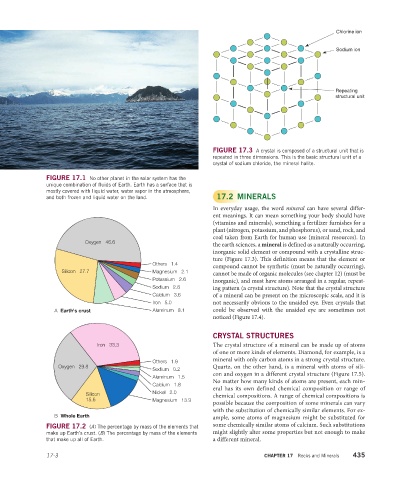
                                                                               FIGURE 17.3  A crystal is composed of a structural unit that is
                                                                               repeated in three dimensions. This is the basic structural unit of a
                                                                               crystal of sodium chloride, the mineral halite.

                       FIGURE 17.1  No other planet in the solar system has the
                       unique combination of fluids of Earth. Earth has a surface that is
                       mostly covered with liquid water, water vapor in the atmosphere,
                       and both frozen and liquid water on the land.            17.2 MINERALS
                                                                               In everyday usage, the word  mineral can have several differ-
                                                                               ent meanings. It can mean something your body should have
                                                                               (vitamins and minerals), something a fertilizer furnishes for a
                                                                               plant (nitrogen, potassium, and phosphorus), or sand, rock, and
                                                                               coal taken from Earth for human use (mineral resources). In
                                    Oxygen   46.6
                                                                               the earth sciences, a mineral is defined as a naturally occurring,
                                                                               inorganic solid element or compound with a crystalline struc-
                                                                               ture (Figure 17.3). This definition means that the element or
                                                           Others   1.4        compound cannot be synthetic (must be naturally occurring),
                             Silicon   27.7                Magnesium   2.1       cannot be made of organic molecules (see chapter 12) (must be
                                                           Potassium   2.6     inorganic), and must have atoms arranged in a regular, repeat-
                                                           Sodium   2.8        ing pattern (a crystal structure). Note that the crystal structure
                                                           Calcium   3.6       of a mineral can be present on the microscopic scale, and it is
                                                           Iron   5.0          not necessarily  obvious to the unaided eye. Even crystals that
                          A  Earth's crust                 Aluminum   8.1      could be observed with the unaided eye are sometimes not
                                                                                 noticed (Figure 17.4).

                                                                               CRYSTAL STRUCTURES
                                        Iron   33.3                            The crystal structure of a mineral can be made up of atoms
                                                                               of one or more kinds of elements. Diamond, for example, is a
                                                           Others   1.9        mineral with only carbon atoms in a strong crystal structure.
                           Oxygen   29.8                   Sodium   0.2        Quartz, on the other hand, is a mineral with atoms of sili-
                                                                               con and oxygen in a different crystal structure ( Figure 17.5).
                                                           Aluminum   1.5
                                                                               No matter how many kinds of atoms are present, each min-
                                                           Calcium   1.8       eral has its own defined chemical composition or range of
                                     Silicon               Nickel   2.0        chemical compositions. A range of chemical compositions is
                                     15.6                  Magnesium   13.9
                                                                               possible  because the composition of some minerals can vary
                                                                               with the substitution of chemically similar elements. For ex-
                          B  Whole Earth                                       ample, some atoms of magnesium might be substituted for
                                                                               some chemically similar atoms of calcium. Such substitutions
                       FIGURE 17.2  (A) The percentage by mass of the elements that
                       make up Earth’s crust. (B) The percentage by mass of the elements   might slightly alter some properties but not enough to make
                       that make up all of Earth.                              a different mineral.

                       17-3                                                                     CHAPTER 17  Rocks and Minerals   435

