


Page 462 - 9780077418427.pdf
P. 462
/Users/user-f465/Desktop
          tiL12214_ch17_433-454.indd Page 439  9/3/10  6:20 PM user-f465
          tiL12214_ch17_433-454.indd Page 439  9/3/10  6:20 PM user-f465                                                /Users/user-f465/Desktop


                                                                                TABLE 17.2

                                                                                The Mohs hardness scale
                                                                                Mineral               Assigned Hardness
                                                                                Talc (softest)                1
                                                                                Gypsum                       2
                                                                                Calcite                      3
                                                                                Fluorite                     4
                                                                                Apatite                      5
                                                                                Orthoclase                   6
                                                                                Quartz                       7
                                                                                Topaz                        8
                                                                                Corundum                     9
                                                                                Diamond (hardest)           10

                                                                               Note: The hardness of some common objects is sometimes used for comparisons
                                                                               rather than an actual test mineral. Here are some of the common objects and
                                                                               their  approximate hardnesses on the same scale: fingernail, 2.5; copper penny,
                                                                               3.5; ordinary glass, 5 to 6; pocketknife blade, 5 to 6.
                       A

                                                                               structure is cleavage, the tendency of minerals to break along
                                                                               smooth planes. Where the cleavage occurs depends on zones of
                                                                               weakness in the crystal structure. Mica, for example, will break
                                                                               along zones of weakness into very thin sheets. Calcite and halite
                                                                               will break in three directions, and if you hit either mineral with
                                                                               a hammer, it will shatter into little pieces with angles consistent
                                                                               with the original specimen (assuming it was cleaved).


                                                                                     CONCEPTS Applied


                                                                                     Grow Your Own
                                                                                 Experiment with growing crystals from solutions of alum,
                                                                                   copper sulfate, salt, or potassium permanganate. Write a
                                                                                   procedure that will tell others what the important variables
                       B
                                                                                 are for growing large, well-formed crystals.
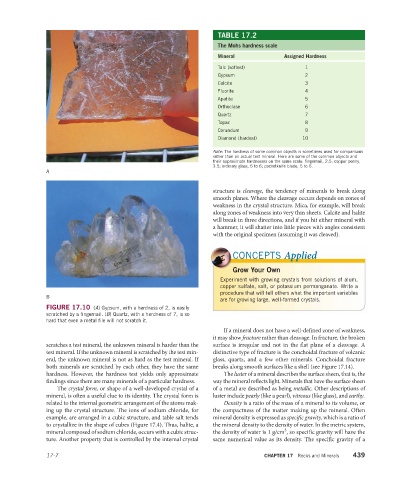
                       FIGURE 17.10  (A) Gypsum, with a hardness of 2, is easily
                       scratched by a fingernail. (B) Quartz, with a hardness of 7, is so
                       hard that even a metal file will not scratch it.
                                                                                  If a mineral does not have a well-defined zone of weakness,
                                                                               it may show fracture rather than cleavage. In fracture, the  broken
                       scratches a test mineral, the unknown mineral is harder than the   surface is irregular and not in the flat plane of a cleavage. A
                       test mineral. If the unknown mineral is scratched by the test min-    distinctive type of fracture is the conchoidal fracture of  volcanic
                       eral, the unknown mineral is not as hard as the test mineral. If   glass, quartz, and a few other minerals. Conchoidal fracture
                       both minerals are scratched by each other, they have the same   breaks along smooth surfaces like a shell (see Figure 17.14).
                       hardness. However, the hardness test yields only approximate   The luster of a mineral describes the surface sheen, that is, the
                       findings since there are many minerals of a particular hardness.  way the mineral reflects light. Minerals that have the surface sheen
                           The crystal form, or shape of a well-developed crystal of a   of a metal are described as being metallic. Other descriptions of
                       mineral, is often a useful clue to its identity. The crystal form is   luster include pearly (like a pearl), vitreous (like glass), and earthy.
                       related to the internal geometric arrangement of the atoms mak-  Density is a ratio of the mass of a mineral to its volume, or
                       ing up the crystal structure. The ions of sodium chloride, for   the compactness of the matter making up the mineral. Often
                       example, are arranged in a cubic structure, and table salt tends   mineral density is expressed as specific gravity, which is a ratio of
                       to crystallize in the shape of cubes (Figure 17.4). Thus, halite, a   the mineral density to the density of water. In the metric system,
                                                                                                      3
                       mineral composed of sodium chloride, occurs with a cubic struc-  the density of water is 1 g/cm , so specific gravity will have the
                       ture. Another property that is controlled by the internal crystal   same numerical value as its density. The specific gravity of a

                       17-7                                                                     CHAPTER 17  Rocks and Minerals   439

