


Page 465 - 9780077418427.pdf
P. 465
/Users/user-f465/Desktop
          tiL12214_ch17_433-454.indd Page 442  9/3/10  6:20 PM user-f465
          tiL12214_ch17_433-454.indd Page 442  9/3/10  6:20 PM user-f465                                                /Users/user-f465/Desktop


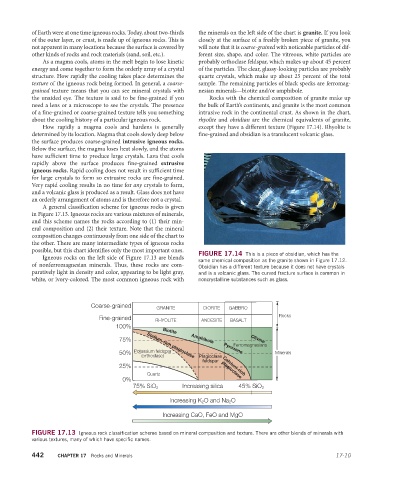
                   of Earth were at one time igneous rocks. Today, about two-thirds   the minerals on the left side of the chart is granite. If you look
                   of the outer layer, or crust, is made up of igneous rocks. Th is is   closely at the surface of a freshly broken piece of granite, you
                   not apparent in many locations because the surface is covered by   will note that it is coarse-grained with noticeable particles of dif-
                   other kinds of rocks and rock materials (sand, soil, etc.).  ferent size, shape, and color. The vitreous, white particles are
                      As a magma cools, atoms in the melt begin to lose kinetic   probably orthoclase feldspar, which makes up about 45 percent
                   energy and come together to form the orderly array of a crystal   of the particles. The clear, glassy-looking particles are probably
                   structure. How rapidly the cooling takes place determines the   quartz crystals, which make up about 25 percent of the total
                   texture of the igneous rock being formed. In general, a coarse-  sample. The remaining particles of black specks are ferromag-
                   grained texture means that you can see mineral crystals with   nesian minerals —biotite and/or amphibole.
                   the unaided eye. The texture is said to be fine-grained if you   Rocks with the chemical composition of granite make up
                   need a lens or a microscope to see the crystals. The presence   the bulk of Earth’s continents, and granite is the most common
                   of a  fine-grained or coarse-grained texture tells you something   intrusive rock in the continental crust. As shown in the chart,
                   about the cooling history of a particular igneous rock.  rhyolite and  obsidian are the chemical equivalents of granite,
                      How rapidly a magma cools and hardens is generally   except they have a different texture (Figure 17.14). Rhyolite is
                     determined by its location. Magma that cools slowly deep  below   fine-grained and obsidian is a translucent volcanic glass.
                   the surface produces coarse-grained intrusive igneous rocks.
                     Below the surface, the magma loses heat slowly, and the atoms
                   have sufficient time to produce large crystals. Lava that cools
                   rapidly above the surface produces fine-grained  extrusive
                    igneous rocks. Rapid cooling does not result in sufficient time
                   for large crystals to form so extrusive rocks are fine-grained.
                   Very rapid cooling results in no time for any crystals to form,
                   and a volcanic glass is produced as a result. Glass does not have
                   an orderly arrangement of atoms and is therefore not a crystal.
                      A general classification scheme for igneous rocks is given
                   in Figure 17.13. Igneous rocks are various mixtures of minerals,
                   and this scheme names the rocks according to (1) their min-
                   eral composition and (2) their texture. Note that the mineral
                     composition changes continuously from one side of the chart to
                   the other. There are many intermediate types of igneous rocks
                   possible, but this chart identifies only the most important ones.
                                                                          FIGURE 17.14  This is a piece of obsidian, which has the
                      Igneous rocks on the left side of Figure 17.13 are blends
                                                                          same chemical composition as the granite shown in Figure 17.12.
                   of nonferromagnesian minerals. Thus, these rocks are com-  Obsidian has a different texture because it does not have crystals
                   paratively light in density and color, appearing to be light gray,   and is a volcanic glass. The curved fracture surface is common in
                   white, or ivory-colored. The most common igneous rock with   noncrystalline substances such as glass.


                                      Coarse-grained        GRANITE         DIORITE  GABBRO
                                         Fine-grained       RHYOLITE       ANDESITE  BASALT          Rocks
                                               100%
                                                              Biotite
                                                75%                     Amphibole          Olivine
                                                                                      Ferromagnesians
                                                50%  Potassium feldspar           Pyroxene         Minerals
                                                       (orthoclase)
                                                         Sodium-rich plagioclase
                                                25%                       Plagioclase Calcium-rich
                                                         Quartz
                                                 0%
                                                                           feldspar plagioclase
                                                                     Increasing silica
                                                    75% SiO 2                          45% SiO 2
                                                                Increasing K 2O and Na 2O

                                                              Increasing CaO, FeO and MgO


                   FIGURE 17.13  Igneous rock classification scheme based on mineral composition and texture. There are other blends of minerals with
                   various textures, many of which have specific names.

                   442     CHAPTER 17  Rocks and Minerals                                                              17-10

