


Page 464 - 9780077418427.pdf
P. 464
/Users/user-f465/Desktop
          tiL12214_ch17_433-454.indd Page 441  9/3/10  6:20 PM user-f465
          tiL12214_ch17_433-454.indd Page 441  9/3/10  6:20 PM user-f465                                                /Users/user-f465/Desktop


                                                                                                  Plagioclase
                                                                                                  feldspar
                                                                                                              High
                                                                                                              temperature
                                                                                                  Ca
                                  Olivine


                                        Augite


                                           Hornblende
                                                                                Na

                                                     Biotite                                                  Low
                                                                                                              temperature
                                                                   Potassium feldspar
                                                                      Muscovite
                                                                       Quartz

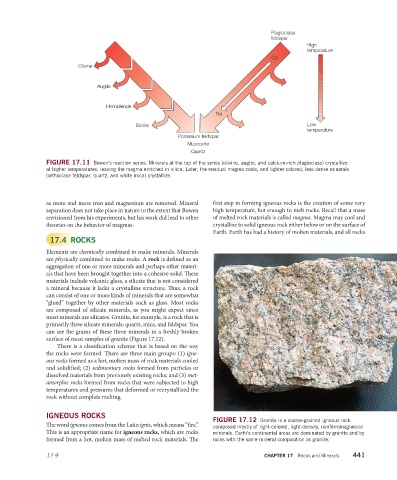
                       FIGURE 17.11  Bowen’s reaction series. Minerals at the top of the series (olivine, augite, and calcium-rich plagioclase) crystallize
                       at higher temperatures, leaving the magma enriched in silica. Later, the residual magma cools, and lighter-colored, less dense minerals
                         (orthoclase feldspar, quartz, and white mica) crystallize.


                       as more and more iron and magnesium are removed. Mineral   first step in forming igneous rocks is the creation of some very
                       separation does not take place in nature to the extent that Bowen   high temperature, hot enough to melt rocks. Recall that a mass
                       envisioned from his experiments, but his work did lead to other   of melted rock materials is called magma. Magma may cool and
                       theories on the behavior of magmas.                     crystallize to solid igneous rock either below or on the surface of
                                                                               Earth. Earth has had a history of molten materials, and all rocks
                         17.4 ROCKS
                       Elements are chemically combined to make minerals. Minerals
                       are physically combined to make rocks. A rock is defi ned as an
                       aggregation of one or more minerals and perhaps other materi-
                       als that have been brought together into a cohesive solid. Th ese
                         materials include volcanic glass, a silicate that is not considered

                       a mineral because it lacks a crystalline structure. Thus, a rock
                       can consist of one or more kinds of minerals that are somewhat
                       “glued” together by other materials such as glass. Most rocks
                       are composed of silicate minerals, as you might expect since
                       most minerals are silicates. Granite, for example, is a rock that is
                         primarily three silicate minerals: quartz, mica, and feldspar. You
                       can see the grains of these three minerals in a freshly broken
                       surface of most samples of granite (Figure 17.12).
                           There is a classification scheme that is based on the way
                       the rocks were formed. There are three main groups: (1) igne-
                       ous rocks formed as a hot, molten mass of rock materials cooled
                       and solidified; (2) sedimentary rocks formed from particles or
                         dissolved materials from previously existing rocks; and (3) met-
                       amorphic rocks formed from rocks that were subjected to high
                       temperatures and pressures that deformed or recrystallized the
                       rock without complete melting.


                       IGNEOUS ROCKS
                                                                               FIGURE 17.12  Granite is a coarse-grained igneous rock
                       The word igneous comes from the Latin ignis, which means “fire.”   composed mostly of light-colored, light-density, nonferromagnesian
                       This is an appropriate name for igneous rocks, which are rocks   minerals. Earth’s continental areas are dominated by granite and by
                       formed from a hot, molten mass of melted rock materials.  Th e   rocks with the same mineral composition as granite.

                       17-9                                                                     CHAPTER 17  Rocks and Minerals   441

