


Page 467 - 9780077418427.pdf
P. 467
/Users/user-f465/Desktop
          tiL12214_ch17_433-454.indd Page 444  9/3/10  6:20 PM user-f465
          tiL12214_ch17_433-454.indd Page 444  9/3/10  6:20 PM user-f465                                                /Users/user-f465/Desktop


                           A Closer Look


                           Asbestos
                         sbestos is a common name for any of
                     Aseveral minerals that can be separated
                     into fireproof fibers, which will not melt
                     or  ignite. The fibers can be woven into a
                     fireproof cloth, used directly as fireproof
                       insulation material, or mixed with plaster or
                     other materials. People now have a fear of all
                     asbestos because it is presumed to be a health
                     hazard (Box Figure 17.1). However, there are
                     about six commercial varieties of asbestos.
                     Five of these varieties are made from an am-
                     phibole mineral and are commercially called
                     brown and blue asbestos. The other variety is
                     made from chrysotile, a serpentine  family of
                     minerals, and is commercially called white
                     asbestos. White asbestos is the asbestos
                     mined and most commonly used in North
                     America. It is only the amphibole asbestos
                     (brown and blue  asbestos) that has been
                     linked to cancer, even for a short  exposure
                     time. There is, however, no evidence that
                     exposure to white asbestos results in an
                     increased health hazard. It makes sense to
                     ban the use of and remove all the existing
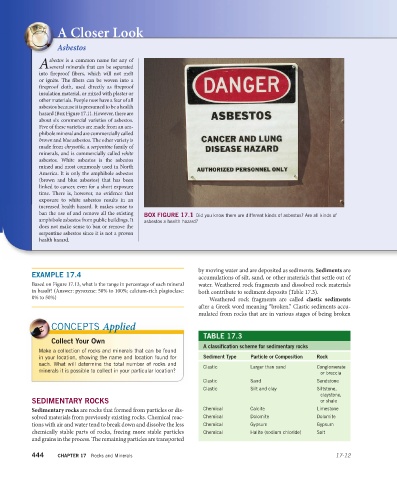
                                                        BOX FIGURE 17.1  Did you know there are different kinds of asbestos? Are all kinds of
                     amphibole asbestos from public buildings. It   asbestos a health hazard?
                     does not make sense to ban or remove the
                     serpentine asbestos since it is not a proven
                     health hazard.


                                                                          by moving water and are deposited as sediments. Sediments are
                   EXAMPLE 17.4
                                                                            accumulations of silt, sand, or other materials that settle out of
                   Based on Figure 17.13, what is the range in percentage of each mineral   water. Weathered rock fragments and dissolved rock materials
                   in basalt? (Answer: pyroxene: 50% to 100%; calcium-rich plagioclase:   both contribute to sediment deposits (Table 17.3).
                   0% to 50%)
                                                                             Weathered rock fragments are called  clastic sediments
                                                                            after a Greek word meaning “broken.” Clastic sediments accu-
                                                                          mulated from rocks that are in various stages of being broken
                         CONCEPTS Applied
                                                                           TABLE 17.3
                         Collect Your Own
                                                                           A classification scheme for sedimentary rocks
                     Make a collection of rocks and minerals that can be found
                     in your location, showing the name and location found for   Sediment Type  Particle or Composition  Rock
                     each. What will determine the total number of rocks and   Clastic     Larger than sand      Conglomerate
                     minerals it is possible to collect in your particular location?                              or breccia
                                                                           Clastic         Sand                  Sandstone
                                                                           Clastic         Silt and clay         Siltstone,
                                                                                                                  claystone,
                   SEDIMENTARY ROCKS                                                                              or shale
                   Sedimentary rocks are rocks that formed from particles or dis-  Chemical  Calcite             Limestone
                   solved materials from previously existing rocks. Chemical reac-  Chemical  Dolomite           Dolomite
                   tions with air and water tend to break down and dissolve the less   Chemical  Gypsum          Gypsum
                   chemically stable parts of rocks, freeing more stable particles   Chemical   Halite (sodium chloride)   Salt
                   and grains in the process. The remaining particles are transported

                   444     CHAPTER 17  Rocks and Minerals                                                              17-12

