


Page 472 - 9780077418427.pdf
P. 472
/Users/user-f465/Desktop
          tiL12214_ch17_433-454.indd Page 449  9/3/10  6:20 PM user-f465
          tiL12214_ch17_433-454.indd Page 449  9/3/10  6:20 PM user-f465                                                /Users/user-f465/Desktop


                       by weathering and erosion. Seas advance and retreat over the                    Weathering
                                                                                                       and erosion
                       continents as materials are cycled from the atmosphere to the
                       land and from the surface to the interior of Earth and then
                       back again. Rocks are transformed from one type to another
                       through this continual change. There is not a single rock on
                       Earth’s  surface today that has remained unchanged through                                       Lithification
                       Earth’s long history. The concept of continually changing     Solidification
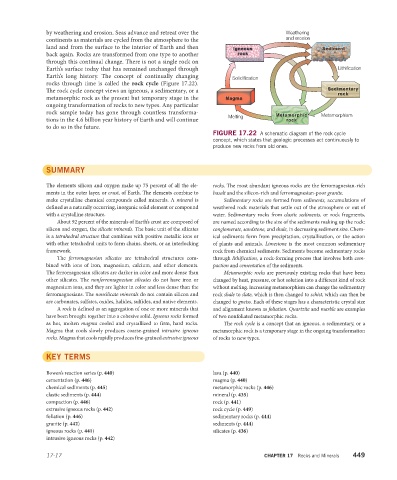
                       rocks through time is called the  rock cycle  (Figure 17.22).
                       The rock cycle concept views an  igneous, a sedimentary, or a

                       metamorphic rock as the present but temporary stage in the
                       ongoing transformation of rocks to new types. Any particular
                       rock  sample  today has gone through  countless transforma-                                 Metamorphism
                                                                                    Melting
                       tions in the 4.6 billion year history of Earth and will continue
                       to do so in the future.
                                                                               FIGURE 17.22  A schematic diagram of the rock cycle
                                                                               concept, which states that geologic processes act continuously to
                                                                               produce new rocks from old ones.


                       SUMMARY

                       The elements silicon and oxygen make up 75 percent of all the ele-  rocks. The most abundant igneous rocks are the  ferromagnesian-rich
                       ments in the outer layer, or crust, of Earth. The elements combine to   basalt and the silicon-rich and ferromagnesian-poor  granite.
                       make crystalline chemical compounds called minerals. A mineral is   Sedimentary rocks are formed from sediments, accumulations of
                        defined as a naturally occurring, inorganic solid element or compound   weathered rock materials that settle out of the atmosphere or out of
                        with a crystalline structure.                          water. Sedimentary rocks from  clastic sediments, or rock fragments,
                           About 92 percent of the minerals of Earth’s crust are composed of   are named according to the size of the sediments making up the rock:
                        silicon and oxygen, the silicate minerals. The basic unit of the silicates     conglomerate, sandstone, and shale, in decreasing sediment size. Chem-
                        is a tetrahedral structure that combines with positive metallic ions or   ical sediments form from precipitation, crystallization, or the action
                        with other tetrahedral units to form chains, sheets, or an interlocking   of plants and animals.  Limestone is the most common sedimentary
                        framework.                                             rock from chemical sediments. Sediments become sedimentary rocks
                           The  ferromagnesian silicates are tetrahedral structures com-  through lithification, a rock-forming process that involves both com-
                        bined with ions of iron, magnesium, calcium, and other elements.   paction and cementation of the sediments.
                        The  ferromagnesian silicates are darker in color and more dense than   Metamorphic rocks are previously existing rocks that have been
                        other silicates. The  nonferromagnesian silicates do not have iron or   changed by heat, pressure, or hot solution into a different kind of rock
                        magnesium ions, and they are lighter in color and less dense than the   without melting. Increasing metamorphism can change the sedimentary
                        ferromagnesians. The nonsilicate minerals do not contain silicon and   rock shale to slate, which is then changed to schist, which can then be
                        are carbonates, sulfates, oxides, halides, sulfides, and native  elements.  changed to gneiss. Each of these stages has a characteristic crystal size
                           A rock is defined as an aggregation of one or more minerals that   and alignment known as foliation. Quartzite and marble are examples
                        have been brought together into a cohesive solid. Igneous rocks formed   of two nonfoliated metamorphic rocks.
                        as hot, molten  magma cooled and crystallized to firm, hard rocks.   The rock cycle is a concept that an igneous, a sedimentary, or a
                          Magma that cools slowly produces coarse-grained  intrusive igneous   metamorphic rock is a temporary stage in the ongoing transformation
                        rocks. Magma that cools rapidly produces fine-grained ex trusive igneous   of rocks to new types.


                       KEY TERMS

                       Bowen’s reaction series (p. 440)                        lava (p. 440)
                       cementation (p. 446)                                    magma (p. 440)
                       chemical sediments (p. 445)                             metamorphic rocks (p. 446)
                       clastic sediments (p. 444)                              mineral (p. 435)
                       compaction (p. 446)                                     rock (p. 441)
                       extrusive igneous rocks (p. 442)                        rock cycle (p. 449)
                       foliation (p. 446)                                      sedimentary rocks (p. 444)
                       granite (p. 442)                                        sediments (p. 444)
                       igneous rocks (p. 441)                                  silicates (p. 436)
                       intrusive igneous rocks (p. 442)

                       17-17                                                                    CHAPTER 17  Rocks and Minerals   449

