


Page 470 - 9780077418427.pdf
P. 470
/Users/user-f465/Desktop
          tiL12214_ch17_433-454.indd Page 447  9/3/10  6:20 PM user-f465
          tiL12214_ch17_433-454.indd Page 447  9/3/10  6:20 PM user-f465                                                /Users/user-f465/Desktop


                                                                                  Science and Society


                                                                                             Using Mineral Resources
                              ost people understand that our mineral   is too low, plants grow poorly, if at all. Most   that already have adequate phosphate miner-
                          M  resources are limited and that when   agricultural soils are artificially fertilized with   als. Estimates are that the worldwide existing
                          we use them, they are gone. Of course, some   phosphate minerals. Without this amend-  land area with adequate phosphate minerals
                          mineral resources can be recycled,  reducing   ment, plant productivity would decline and,   will supply food for only 2 billion people on
                          the need to mine more minerals. For ex-  in some cases, cease altogether.  all of Earth. Phosphate is an essential  element
                          ample, aluminum can be recycled and used      Phosphate occurs naturally as the min-  for all life on Earth, and no other element can
                          over and over. Glass, copper, iron, and other   eral apatite. Deposits of apatite were formed   function in its place.
                          metals can similarly be recycled repeatedly.   where ocean currents carried water rich in
                          Other critical resources, however, cannot   dissolved phosphate ions to the continen-
                          be recycled and cannot be replaced. Crude   tal shelf. Here, phosphate ions replaced the   QUESTIONS TO DISCUSS
                          oil, for example, is a dwindling  resource that   carbonate ions in limestone, forming the   Discuss with your group the following
                          will eventually become depleted. Oil is not   mineral apatite. Apatite also occurs as a   questions concerning the use of mineral
                          recyclable once it is burned, and no new   minor accessory mineral  in most igneous,   resources:
                          supplies are being created, at least not at a   sedimentary, and metamorphic rocks. Some
                          rate  that  would make them available in     igneous rocks serve as a source of phosphate     1.  Should the mining industry be permit-
                          the  immediate future. Even if Earth were a   fertilizer, but most phosphate is mined from   ted to exhaust an important mineral
                            hollow vessel completely filled with oil, it   formerly submerged coastal areas of lime-  resource? Provide reasons with your
                          would eventually become depleted, perhaps   stone, such as those found in Florida.  answer.
                          sooner than you might think.          Trends in phosphate production and    2.  What are the advantage and disadvan-
                             Also another of our mineral resources   use suggest that the world reserves of phos-  tages of a controlled mining industry?
                          that is critically needed for our survival will   phate rock will eventually be exhausted. New     3.  If phosphate minerals supplies become
                          eventually be depleted. That resource is phos-  sources might be discovered, but eventually   exhausted, who should be responsible
                          phorus derived from phosphate rock. Phos-  phosphate rock will no longer be available   for developing new supplies or
                          phorus is an essential nutrient required for   for use as a fertilizer. When this happens, the   substitutes, the mining industry or
                          plant growth, and if its concentration in soils   food supply will have to be grown on lands   governments?


                       of foliation is  determined by the extent of the metamorphic
                       changes (Table 17.5). For  example, slate is a metamorphic rock
                       formed from the sedimentary rock shale. Slate is fine-grained
                       with no crystals  visible to the unaided eye. Alignment of the
                         microscopic crystals results in a tendency of slate to split into
                       flat sheets. Greater heat and pressure can cause greater meta-
                       morphic change, resulting in larger crystals and increased fo-
                       liation. The metamorphic rock called  schist can be produced
                       from slate by further  metamorphism. In schist, the cleavage
                       surfaces are now visible, and coarser mica crystals are visible
                       to the unaided eye. Still further  metamorphism of schist may
                       break down the mica crystals and produce alternating bands of
                       light and dark minerals. These bands are characteristic of the
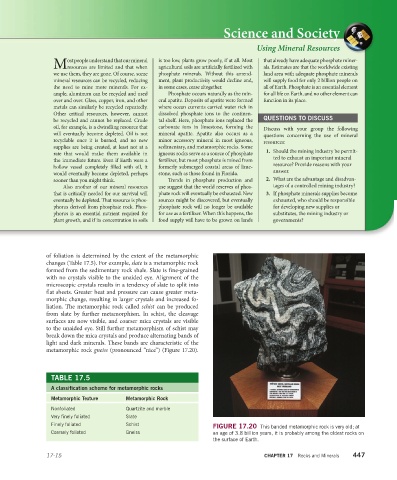
                       metamorphic rock gneiss  (pronounced “nice”) (Figure 17.20).


                         TABLE 17.5
                         A classification scheme for metamorphic rocks
                         Metamorphic Texture      Metamorphic Rock
                         Nonfoliated              Quartzite and marble
                         Very finely foliated     Slate
                         Finely foliated          Schist
                                                                               FIGURE 17.20  This banded metamorphic rock is very old; at
                         Coarsely foliated        Gneiss                       an age of 3.8 billion years, it is probably among the oldest rocks on
                                                                               the surface of Earth.

                       17-15                                                                    CHAPTER 17  Rocks and Minerals   447

