


Page 469 - 9780077418427.pdf
P. 469
/Users/user-f465/Desktop
          tiL12214_ch17_433-454.indd Page 446  9/3/10  6:20 PM user-f465
          tiL12214_ch17_433-454.indd Page 446  9/3/10  6:20 PM user-f465                                                /Users/user-f465/Desktop


                                                                        Overburden
                                          Feldspar
                                                                                                    Cement
                         Quartz

                                                  Pore space


                           A After deposition                    B Compaction                   C Cementation

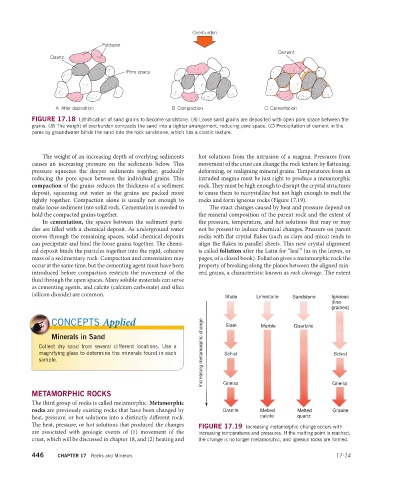
                   FIGURE 17.18  Lithification of sand grains to become sandstone. (A) Loose sand grains are deposited with open pore space between the
                   grains. (B) The weight of overburden compacts the sand into a tighter arrangement, reducing pore space. (C) Precipitation of cement in the
                   pores by groundwater binds the sand into the rock sandstone, which has a clastic texture.


                      The weight of an increasing depth of overlying sediments   hot solutions from the intrusion of a magma. Pressures from
                   causes an increasing pressure on the sediments below. This   movement of the crust can change the rock  texture by fl attening,
                   pressure squeezes the deeper sediments together, gradually   deforming, or realigning mineral grains. Temperatures from an
                     reducing the pore space between the individual grains. This   intruded magma must be just right to produce a metamorphic
                     compaction of the grains reduces the thickness of a sediment   rock. They must be high enough to disrupt the crystal structures

                   deposit, squeezing out water as the grains are packed more   to cause them to  recrystallize but not high enough to melt the
                   tightly together. Compaction alone is usually not enough to   rocks and form igneous rocks (Figure 17.19).
                   make loose sediment into solid rock. Cementation is needed to   The exact changes caused by heat and pressure depend on
                   hold the compacted grains together.                    the mineral composition of the parent rock and the extent of
                      In  cementation, the spaces between the sediment parti-  the  pressure, temperature, and hot solutions that may or may
                   cles are filled with a chemical deposit. As underground water   not be present to induce chemical changes. Pressure on parent

                   moves through the remaining spaces, solid chemical deposits   rocks with flat crystal flakes (such as clays and mica) tends to
                   can  precipitate and bind the loose grains together. Th e chemi-  align the flakes in parallel sheets. This new crystal alignment
                   cal  deposit binds the particles together into the rigid, cohesive   is called  foliation after the Latin for “leaf” (as in the leaves, or
                   mass of a sedi mentary rock. Compaction and cementation may   pages, of a closed book). Foliation gives a metamorphic rock the
                   occur at the same time, but the cementing agent must have been   property of breaking along the planes between the aligned min-
                     introduced before compaction restricts the movement of the   eral grains, a characteristic known as rock cleavage. The  extent
                   fluid through the open spaces. Many soluble materials can serve

                   as cementing agents, and calcite (calcium carbonate) and silica
                     (silicon dioxide) are common.


                         CONCEPTS Applied


                         Minerals in Sand
                     Collect dry sand from several different locations. Use a
                       magnifying glass to determine the minerals found in each
                       sample.


                   METAMORPHIC ROCKS
                   The third group of rocks is called metamorphic. Metamorphic
                   rocks are previously existing rocks that have been changed by
                   heat, pressure, or hot solutions into a distinctly diff erent rock.
                   The heat, pressure, or hot solutions that produced the changes   FIGURE 17.19  Increasing metamorphic change occurs with

                   are associated with geologic events of (1) movement of the     increasing temperatures and pressures. If the melting point is reached,
                   crust, which will be discussed in chapter 18, and (2) heating and   the change is no longer metamorphic, and igneous rocks are formed.

                   446     CHAPTER 17  Rocks and Minerals                                                              17-14

