


Page 468 - 9780077418427.pdf
P. 468
/Users/user-f465/Desktop
          tiL12214_ch17_433-454.indd Page 445  9/3/10  6:20 PM user-f465
          tiL12214_ch17_433-454.indd Page 445  9/3/10  6:20 PM user-f465                                                /Users/user-f465/Desktop


                         TABLE 17.4

                         A simplified classification scheme for clastic sediments
                         and rocks
                         Sediment Name    Size Range           Rock
                         Boulder          Over 256 mm
                                           (10 in)
                         Gravel          2–256 mm              Conglomerate
                                           (0.08–10 in)          or breccia*
                         Sand            1/16–2 mm             Sandstone
                                            (0.025–0.08 in)
                         Silt (or dust)   1/256–1/16 mm        Siltstone**
                                            (0.00015–0.025 in)
                         Clay (or dust)   Less than 1/256 mm   Claystone**
                                            (less than 0.00015 in)
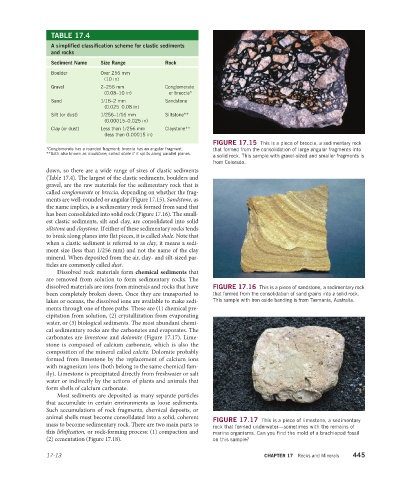
                                                                               FIGURE 17.15  This is a piece of breccia, a sedimentary rock
                       *Conglomerate has a rounded fragment; breccia has an angular fragment.  that formed from the consolidation of large angular fragments into
                       **Both also known as mudstone; called shale if it splits along parallel planes.
                                                                               a solid rock. This sample with gravel-sized and smaller fragments is
                                                                               from Colorado.
                       down, so there are a wide range of sizes of clastic sediments
                       (Table 17.4). The largest of the clastic sediments, boulders and
                       gravel, are the raw  materials for the sedimentary rock that is
                       called conglomerate or breccia, depending on whether the frag-
                       ments are well-rounded or angular (Figure 17.15). Sandstone, as
                       the name implies, is a sedimentary rock formed from sand that
                       has been consolidated into solid rock (Figure 17.16). The small-
                       est clastic sediments, silt and clay, are consolidated into solid
                       siltstone and claystone. If  either of these sedimentary rocks tends
                       to break along planes into flat pieces, it is called shale. Note that
                       when a clastic sediment is  referred to as clay, it means a sedi-
                       ment size (less than 1/256 mm) and not the name of the clay
                       mineral. When deposited from the air, clay- and silt-sized par-
                       ticles are commonly called dust.
                           Dissolved rock materials form chemical sediments that
                       are removed from solution to form sedimentary rocks. The
                         dissolved materials are ions from minerals and rocks that have   FIGURE 17.16  This is a piece of sandstone, a sedimentary rock
                       been completely broken down. Once they are transported to   that formed from the consolidation of sand grains into a solid rock.
                       lakes or oceans, the dissolved ions are available to make sedi-  This sample with iron oxide banding is from Tasmania, Australia.
                       ments through one of three paths. These are (1) chemical pre-
                       cipitation from solution, (2) crystallization from evaporating
                       water, or (3) biological sediments. The most abundant chemi-
                       cal sedimentary rocks are the carbonates and evaporates. The
                       carbonates are limestone and dolomite (Figure 17.17). Lime-
                       stone is composed of calcium carbonate, which is also the
                       composition of the mineral called calcite. Dolomite probably
                       formed from limestone by the replacement of calcium ions
                       with magnesium ions (both  belong to the same chemical fam-
                       ily). Limestone is precipitated directly from freshwater or salt
                       water or indirectly by the actions of plants and animals that
                       form shells of calcium carbonate.
                           Most sediments are deposited as many separate particles
                       that accumulate in certain environments as loose sediments.
                       Such accumulations of rock fragments, chemical deposits, or
                       animal shells must become consolidated into a solid, coherent
                                                                               FIGURE 17.17  This is a piece of limestone, a sedimentary
                       mass to become sedimentary rock. There are two main parts to   rock that formed underwater—sometimes with the remains of
                       this lithification, or rock-forming process: (1) compaction and   marine organisms. Can you find the mold of a brachiopod fossil
                       (2) cementation (Figure 17.18).                         on this sample?

                       17-13                                                                    CHAPTER 17  Rocks and Minerals   445

