


Page 500 - 9780077418427.pdf
P. 500
/Users/user-f465/Desktop
          tiL12214_ch19_477-500.indd Page 477  9/3/10  6:22 PM user-f465
          tiL12214_ch19_477-500.indd Page 477  9/3/10  6:22 PM user-f465                                                /Users/user-f465/Desktop


                                                                                                  Building

                                                                             19                   Earth’s
                                                                             19


                                                                                                  Surface


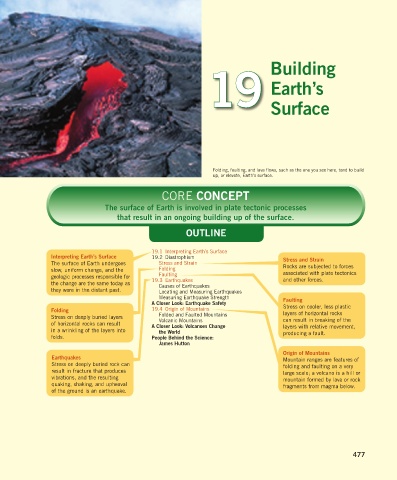
                                                                               Folding, faulting, and lava flows, such as the one you see here, tend to build
                                                                               up, or elevate, Earth’s surface.


                                                              CORE CONCEPT

                                           The surface of Earth is involved in plate tectonic processes
                                               that result in an ongoing building up of the surface.

                                                                      OUTLINE


                                                          19.1  Interpreting Earth’s Surface
                         Interpreting Earth’s Surface     19.2 Diastrophism                           Stress and Strain
                         The surface of Earth undergoes      Stress and Strain                        Rocks are subjected to forces
                         slow, uniform change, and the       Folding
                                                             Faulting                                 associated with plate tectonics
                         geologic processes responsible for
                                                          19.3 Earthquakes                            and other forces.
                         the change are the same today as
                                                             Causes of Earthquakes
                         they were in the distant past.      Locating and Measuring Earthquakes
                                                             Measuring Earthquake Strength
                                                          A Closer Look: Earthquake Safety              Faulting
                           Folding                        19.4  Origin of Mountains                   Stress on cooler, less plastic
                                                                                                      layers of horizontal rocks
                         Stress on deeply buried layers      Folded and Faulted Mountains             can result in breaking of the
                                                             Volcanic Mountains
                         of horizontal rocks can result   A Closer Look: Volcanoes Change             layers with relative movement,
                         in a wrinkling of the layers into   the World                                producing a fault.
                         folds.                           People Behind the Science:
                                                             James Hutton

                                                                                                        Origin of Mountains
                         Earthq uakes                                                                 Mountain ranges are features of
                         Stress on deeply buried rock can                                             folding and faulting on a very
                         result in fracture that produces                                             large scale; a volcano is a hill or
                         vibrations, and the resulting                                                mountain formed by lava or rock
                         quaking, shaking, and upheaval                                               fragments from magma below.
                         of the ground is an earthquake.


                                                                                                                             477

