


Page 503 - 9780077418427.pdf
P. 503
/Users/user-f465/Desktop
          tiL12214_ch19_477-500.indd Page 480  9/3/10  6:22 PM user-f465
          tiL12214_ch19_477-500.indd Page 480  9/3/10  6:22 PM user-f465                                                /Users/user-f465/Desktop


                      deformation. Plastic deformation permanently alters the
                      shape of a material.
                                                                                   Elastic limit  Plastic
                     4.  Finally, at some great pressure, the metal will rupture,              deformation
                      resulting in a break in the material.                                                    Rupture

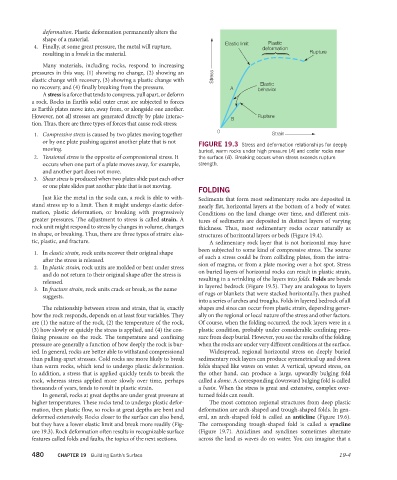
                      Many materials, including rocks, respond to increasing
                   pressures in this way, (1) showing no change, (2) showing an
                   elastic change with recovery, (3) showing a plastic change with   Stress   Elastic
                   no recovery, and (4) finally breaking from the pressure.         A         behavior
                      A stress is a force that tends to compress, pull apart, or deform
                   a rock. Rocks in Earth’s solid outer crust are subjected to forces
                   as Earth’s plates move into, away from, or alongside one another.
                   However, not all stresses are generated directly by plate interac-        Rupture
                                                                                     B
                   tion. Thus, there are three types of forces that cause rock stress:
                                                                                0
                     1.  Compressive stress is caused by two plates moving together               Strain
                      or by one plate pushing against another plate that is not
                                                                          FIGURE 19.3  Stress and deformation relationships for deeply
                      moving.                                             buried, warm rocks under high pressure (A) and cooler rocks near
                     2.  Tensional stress is the opposite of compressional stress. It   the surface (B). Breaking occurs when stress exceeds rupture
                      occurs when one part of a plate moves away, for example,   strength.
                      and another part does not move.
                     3.  Shear stress is produced when two plates slide past each other
                      or one plate slides past another plate that is not moving.
                                                                          FOLDING
                      Just like the metal in the soda can, a rock is able to with-  Sediments that form most sedimentary rocks are deposited in
                   stand stress up to a limit. Then it might undergo elastic defor-  nearly flat, horizontal layers at the bottom of a body of water.
                   mation, plastic deformation, or breaking with progressively   Conditions on the land change over time, and different mix-
                   greater pressures. The adjustment to stress is called strain. A   tures of sediments are deposited in distinct layers of varying
                   rock unit might respond to stress by changes in volume, changes   thickness. Thus, most sedimentary rocks occur naturally as
                   in shape, or breaking. Thus, there are three types of strain: elas-  structures of horizontal layers or beds (Figure 19.4).
                   tic, plastic, and fracture.                               A sedimentary rock layer that is not horizontal may have
                                                                          been subjected to some kind of compressive stress. The source
                     1. In elastic strain, rock units recover their original shape
                                                                          of such a stress could be from colliding plates, from the intru-

                      after the stress is released.
                                                                          sion of magma, or from a plate moving over a hot spot. Stress
                     2. In plastic strain, rock units are molded or bent under stress
                                                                          on buried layers of horizontal rocks can result in plastic strain,
                      and do not return to their original shape after the stress is

                                                                          resulting in a wrinkling of the layers into folds. Folds are bends
                      released.
                                                                          in layered bedrock (Figure 19.5). They are analogous to layers
                     3. In fracture strain, rock units crack or break, as the name
                                                                          of rugs or blankets that were stacked horizontally, then pushed
                      suggests.
                                                                          into a series of arches and troughs. Folds in layered bedrock of all
                      The relationship between stress and strain, that is, exactly   shapes and sizes can occur from plastic strain, depending gener-
                   how the rock responds, depends on at least four variables. They   ally on the regional or local nature of the stress and other factors.
                   are (1) the nature of the rock, (2) the temperature of the rock,   Of course, when the folding occurred, the rock layers were in a
                   (3) how slowly or quickly the stress is applied, and (4) the con-  plastic condition, probably under considerable confining pres-
                   fining pressure on the rock. The temperature and confining   sure from deep burial. However, you see the results of the folding
                   pressure are generally a function of how deeply the rock is bur-  when the rocks are under very different conditions at the surface.
                   ied. In general, rocks are better able to withstand compressional   Widespread, regional horizontal stress on deeply buried
                   than pulling-apart stresses. Cold rocks are more likely to break   sedimentary rock layers can produce symmetrical up and down
                   than warm rocks, which tend to undergo plastic deformation.   folds shaped like waves on water. A vertical, upward stress, on
                   In addition, a stress that is applied quickly tends to break the   the other hand, can produce a large, upwardly bulging fold
                   rock, whereas stress applied more slowly over time, perhaps   called a dome. A corresponding downward bulging fold is called
                   thousands of years, tends to result in plastic strain.  a basin. When the stress is great and extensive, complex over-
                      In general, rocks at great depths are under great pressure at   turned folds can result.
                   higher temperatures. These rocks tend to undergo plastic defor-  The most common regional structures from deep plastic
                   mation, then plastic flow, so rocks at great depths are bent and   deformation are arch-shaped and trough-shaped folds. In gen-
                   deformed extensively. Rocks closer to the surface can also bend,   eral, an arch-shaped fold is called an anticline (Figure 19.6).
                   but they have a lower elastic limit and break more readily (Fig-  The corresponding trough-shaped fold is called a  syncline
                   ure 19.3). Rock deformation often results in recognizable surface   (Figure 19.7). Anticlines and synclines sometimes alternate
                   features called folds and faults, the topics of the next sections.  across the land as waves do on water. You can imagine that a

                   480     CHAPTER 19  Building Earth’s Surface                                                         19-4

