


Page 505 - 9780077418427.pdf
P. 505
/Users/user-f465/Desktop
          tiL12214_ch19_477-500.indd Page 482  9/3/10  6:22 PM user-f465
          tiL12214_ch19_477-500.indd Page 482  9/3/10  6:22 PM user-f465                                                /Users/user-f465/Desktop


                   FAULTING                                                                       Direction of
                   Rock layers do not always respond to stress by folding. Rocks near             dip of fault  Strike of fault
                   the surface are cooler and under less pressure, so they tend to
                   be more brittle. A sudden stress on these rocks may reach the
                   rupture point, resulting in a cracking and breaking of the rock
                   structure. If there is breaking of rock without a relative displace-
                   ment on either side of the break, the crack is called a joint. Joints   Ore vein
                                                                            Hanging wall
                                                                                                                    Footwall
                   are common in rocks exposed at the surface of Earth. They can be   block  along fault              block
                   produced from compressional stresses, but they are also formed
                   by other processes such as the contraction of an  igneous rock     Hanging
                   while cooling. Basalt often develops columnar jointing from the    wall
                   contraction of cooling, solidified magma. The joints are parallel                Footwall
                   and evenly spaced, resulting in the appearance of hexagonal col-
                   umns (Figure 19.8). The Devil’s Post Pile in California and Devil’s   A
                   Tower in Wyoming are classic examples of columnar jointing.
                      When there is relative movement between the rocks on  either
                   side of a fracture, the crack is called a fault. When faulting occurs,
                   the rocks on one side move relative to the rocks on the other side
                   along the surface of the fault, which is called the fault plane. Faults
                   are generally described in terms of (1) the steepness of the fault
                   plane, that is, the angle between the plane and an imaginary hori-
                   zontal plane, and (2) the direction of relative movement. There
                   are basically three ways that rocks on one side of a fault can move
                   relative to the rocks on the other side: (1) up and down (called
                   dip), (2) horizontally, or sideways (called strike), and (3) with ele-
                   ments of both directions of movement (called oblique).
                      One classification scheme for faults is based on an ori-
                   entation referent borrowed from mining (many ore veins are
                   associated with fault planes). Imagine a mine with a fault plane
                   running across a horizontal shaft. Unless the plane is perfectly
                   vertical, a miner would stand on the mass of rock below the
                   fault plane and look up at the mass of rock above. Therefore,


                                                                               B
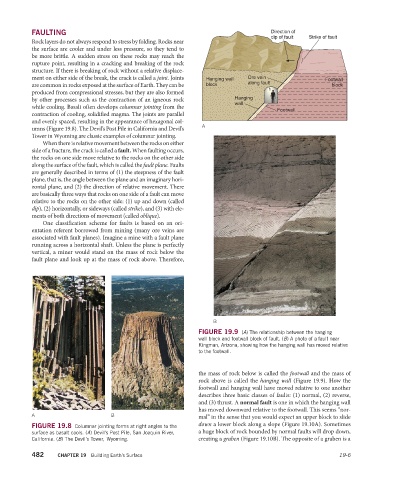
                                                                          FIGURE 19.9  (A) The relationship between the hanging
                                                                          wall block and footwall block of fault. (B) A photo of a fault near
                                                                          Kingman, Arizona, showing how the hanging wall has moved relative
                                                                          to the footwall.


                                                                          the mass of rock below is called the footwall and the mass of
                                                                          rock above is called the hanging wall (Figure 19.9). How the
                                                                          footwall and hanging wall have moved relative to one another
                                                                          describes three basic classes of faults: (1) normal, (2) reverse,
                                                                          and (3) thrust. A normal fault is one in which the hanging wall
                                                                          has moved downward relative to the footwall. This seems “nor-
                   A                         B                            mal” in the sense that you would expect an upper block to slide
                                                                          down a lower block along a slope (Figure 19.10A). Sometimes
                   FIGURE 19.8  Columnar jointing forms at right angles to the
                   surface as basalt cools. (A) Devil’s Post Pile, San Joaquin River,   a huge block of rock bounded by normal faults will drop down,
                   California. (B) The Devil’s Tower, Wyoming.            creating a graben (Figure 19.10B). The opposite of a graben is a

                   482     CHAPTER 19  Building Earth’s Surface                                                         19-6

