


Page 504 - 9780077418427.pdf
P. 504
/Users/user-f465/Desktop
          tiL12214_ch19_477-500.indd Page 481  9/3/10  6:22 PM user-f465
          tiL12214_ch19_477-500.indd Page 481  9/3/10  6:22 PM user-f465                                                /Users/user-f465/Desktop


                        A                                                      B

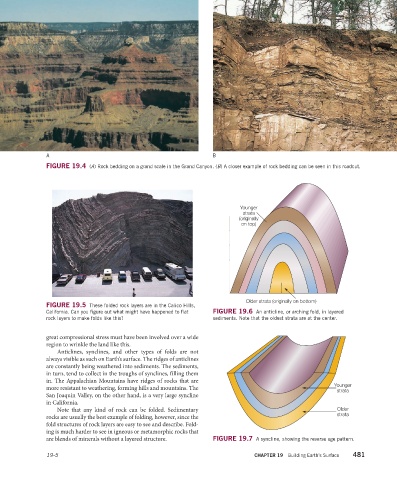
                       FIGURE 19.4  (A) Rock bedding on a grand scale in the Grand Canyon. (B) A closer example of rock bedding can be seen in this roadcut.


                                                                                        Younger
                                                                                         strata
                                                                                       (originally
                                                                                        on top)


                                                                                          Older strata (originally on bottom)
                       FIGURE 19.5  These folded rock layers are in the Calico Hills,
                       California. Can you figure out what might have happened to flat   FIGURE 19.6  An anticline, or arching fold, in layered
                       rock layers to make folds like this?                    sediments. Note that the oldest strata are at the center.


                       great compressional stress must have been involved over a wide
                       region to wrinkle the land like this.
                           Anticlines, synclines, and other types of folds are not
                         always visible as such on Earth’s surface. The ridges of  anticlines
                       are constantly being weathered into sediments. The sediments,
                       in turn, tend to collect in the troughs of synclines, filling them
                       in. The Appalachian Mountains have ridges of rocks that are
                                                                                                                       Younger
                       more resistant to weathering, forming hills and mountains. The
                                                                                                                        strata
                       San Joaquin Valley, on the other hand, is a very large syncline
                       in California.
                           Note that any kind of rock can be folded. Sedimentary                                        Older
                       rocks are usually the best example of folding, however, since the                                strata
                       fold structures of rock layers are easy to see and describe. Fold-
                       ing is much harder to see in igneous or metamorphic rocks that
                       are blends of minerals without a layered structure.     FIGURE 19.7  A syncline, showing the reverse age pattern.

                       19-5                                                                 CHAPTER 19  Building Earth’s Surface   481

