


Page 57 - 9780077418427.pdf
P. 57
/Users/user-f465/Desktop
          tiL12214_ch02_025-060.indd Page 34  9/1/10  9:55 PM user-f465
          tiL12214_ch02_025-060.indd Page 34  9/1/10  9:55 PM user-f465                                                 /Users/user-f465/Desktop


                   general, the strong nuclear force between particles inside a
                                   2
                   nucleus is about 10  times stronger than the electromagnetic    Direction of motion    Forces opposing
                                  39
                   force and about 10  times stronger than the gravitation force.     F    = 0            motion
                                                                                       applied
                   The fundamental forces are responsible for everything that                          F air
                   happens in the universe, and we will learn more about them
                   in chapters on electricity, light, nuclear energy, chemistry,                        F floor
                     geology, and astronomy.                                             F       F            F
                                                                             A            air  +  floor  =     net


                    2.3  HORIZONTAL MOTION ON LAND
                                                                                           F applied      Forces opposing
                   Everyday experience seems to indicate that Aristotle’s idea                            motion
                   about horizontal motion on Earth’s surface is correct.  After all,                  F air
                   moving objects that are not pushed or pulled do come to rest
                   in a short period of time. It would seem that an object keeps                        F floor
                   moving only if a force continues to push it. A moving auto-    F      F floor        F applied
                   mobile will slow and come to rest if you turn off the ignition.   B  air  +    +              = F net  = 0
                   Likewise, a ball that you roll along the floor will slow until it
                   comes to rest. Is the natural state of an object to be at rest, and
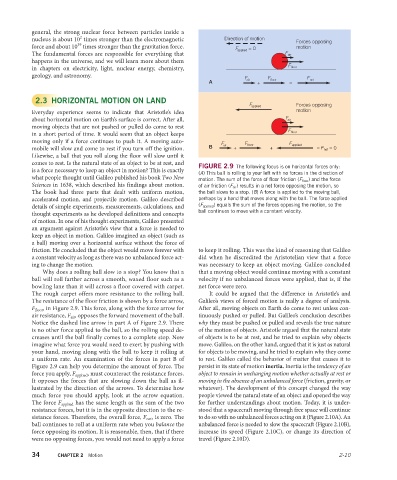
                                                                          FIGURE 2.9  The following focus is on horizontal forces only:
                   is a force  necessary to keep an object in motion? This is exactly
                                                                          (A) This ball is rolling to your left with no forces in the direction of
                   what  people thought until Galileo published his book Two New   motion. The sum of the force of floor friction (F floor ) and the force
                    Sciences in 1638, which described his findings about motion.   of air friction (F air ) results in a net force opposing the motion, so
                   The book had three parts that dealt with uniform motion,   the ball slows to a stop. (B) A force is applied to the moving ball,
                     accelerated motion, and projectile motion. Galileo described   perhaps by a hand that moves along with the ball. The force applied
                   details of simple experiments, measurements, calculations, and   (F applied ) equals the sum of the forces opposing the motion, so the
                                                                          ball continues to move with a constant velocity.
                   thought experiments as he developed definitions and concepts
                   of motion. In one of his thought experiments, Galileo presented
                   an argument against Aristotle’s view that a force is needed to
                   keep an object in motion. Galileo imagined an object (such as
                   a ball) moving over a horizontal surface without the force of
                   friction. He concluded that the object would move forever with   to keep it rolling. This was the kind of reasoning that Galileo
                   a constant velocity as long as there was no unbalanced force act-  did when he discredited the Aristotelian view that a force
                   ing to change the  motion.                             was necessary to keep an object moving. Galileo concluded
                      Why does a rolling ball slow to a stop? You know that a   that a moving object would continue moving with a constant
                   ball will roll farther across a smooth, waxed floor such as a   velocity if no unbalanced forces were applied, that is, if the
                   bowling lane than it will across a floor covered with carpet.   net force were zero.
                   The rough carpet offers more resistance to the rolling ball.   It could be argued that the difference in Aristotle’s and
                   The resistance of the floor friction is shown by a force  arrow,     Galileo’s views of forced motion is really a degree of analysis.
                   F floor , in Figure 2.9. This force, along with the force arrow for     After all, moving objects on Earth do come to rest unless con-
                   air resistance, F air , opposes the forward movement of the ball.   tinuously pushed or pulled. But Galileo’s conclusion describes
                     Notice the dashed line arrow in part A of Figure 2.9. There   why they must be pushed or pulled and reveals the true nature
                   is no other force applied to the ball, so the rolling speed de-  of the motion of objects. Aristotle argued that the natural state
                   creases until the ball finally comes to a complete stop. Now   of objects is to be at rest, and he tried to explain why objects
                   imagine what force you would need to exert by pushing with   move. Galileo, on the other hand, argued that it is just as natural
                   your hand, moving along with the ball to keep it rolling at   for objects to be moving, and he tried to explain why they come
                   a uniform rate. An examination of the forces in part B of   to rest. Galileo called the behavior of matter that causes it to
                   Figure 2.9 can help you determine the amount of force. The   persist in its state of motion inertia. Inertia is the tendency of an
                   force you apply, F applied , must counteract the resistance forces.   object to remain in unchanging motion whether actually at rest or
                   It opposes the forces that are slowing down the ball as il-  moving in the absence of an unbalanced force (friction, gravity, or
                   lustrated by the direction of the arrows. To determine how   whatever). The  development of this concept changed the way
                   much force you should apply, look at the arrow equation.   people viewed the natural state of an object and opened the way
                   The force F applied  has the same length as the sum of the two   for further understandings about motion. Today, it is under-
                   resistance forces, but it is in the opposite direction to the re-  stood that a spacecraft moving through free space will continue
                   sistance forces. Therefore, the  overall force, F net , is zero. The   to do so with no unbalanced forces acting on it (Figure 2.10A). An
                   ball continues to roll at a uniform rate when you balance the   unbalanced force is needed to slow the spacecraft ( Figure 2.10B),
                   force opposing its motion. It is reasonable, then, that if there   increase its speed (Figure 2.10C), or change its direction of
                   were no opposing forces, you would not need to apply a force   travel (Figure 2.10D).

                   34      CHAPTER 2 Motion                                                                             2-10

