


Page 526 - 9780077418427.pdf
P. 526
/Users/user-f465/Desktop
          tiL12214_ch20_501-520.indd Page 503  9/3/10  6:23 PM user-f465
          tiL12214_ch20_501-520.indd Page 503  9/3/10  6:23 PM user-f465                                                /Users/user-f465/Desktop


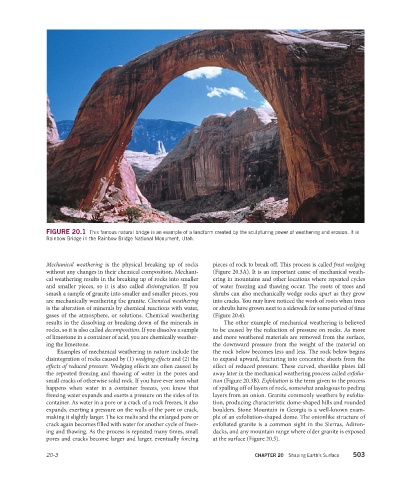
                       FIGURE 20.1  This famous natural bridge is an example of a landform created by the sculpturing power of weathering and erosion. It is
                       Rainbow Bridge in the Rainbow Bridge National Monument, Utah.


                       Mechanical weathering is the physical breaking up of rocks   pieces of rock to break off. This process is called frost wedging
                       without any changes in their chemical composition. Mechani-  (Figure 20.3A). It is an important cause of mechanical weath-
                       cal weathering results in the breaking up of rocks into smaller   ering in mountains and other locations where repeated cycles
                       and smaller pieces, so it is also called  disintegration.  If you   of water freezing and thawing occur. The roots of trees and
                       smash a sample of granite into smaller and smaller pieces, you   shrubs can also mechanically wedge rocks apart as they grow
                       are mechanically weathering the granite. Chemical weathering   into cracks. You may have noticed the work of roots when trees
                       is the  alteration of minerals by chemical reactions with water,   or shrubs have grown next to a sidewalk for some period of time
                       gases of the atmosphere, or solutions. Chemical weathering   (Figure 20.4).
                       results in the dissolving or breaking down of the minerals in   The other example of mechanical weathering is believed
                       rocks, so it is also called decomposition. If you dissolve a sample   to be caused by the reduction of pressure on rocks. As more
                       of limestone in a container of acid, you are chemically weather-  and more weathered materials are removed from the surface,
                       ing the limestone.                                      the downward pressure from the weight of the material on
                           Examples of mechanical weathering in nature include the   the rock below becomes less and less. The rock below begins
                       disintegration of rocks caused by (1) wedging effects and (2) the   to expand upward, fracturing into concentric sheets from the
                       effects of reduced pressure. Wedging effects are often caused by   effect of reduced pressure. These curved, sheetlike plates fall
                       the repeated freezing and thawing of water in the pores and   away later in the mechanical weathering process called exfolia-
                       small cracks of otherwise solid rock. If you have ever seen what   tion (Figure 20.3B). Exfoliation is the term given to the process
                       happens when water in a container freezes, you know that   of spalling off of layers of rock, somewhat analogous to peeling
                       freezing water expands and exerts a pressure on the sides of its   layers from an onion. Granite commonly weathers by exfolia-
                       container. As water in a pore or a crack of a rock freezes, it also   tion, producing characteristic dome-shaped hills and rounded
                       expands, exerting a pressure on the walls of the pore or crack,   boulders. Stone Mountain in Georgia is a well-known exam-
                       making it slightly larger. The ice melts and the enlarged pore or   ple of an  exfoliation-shaped dome. The onionlike structure of
                       crack again becomes filled with water for another cycle of freez-    exfoliated granite is a common sight in the Sierras, Adiron-
                       ing and thawing. As the process is repeated many times, small   dacks, and any mountain range where older granite is exposed
                       pores and cracks become larger and larger, eventually forcing   at the  surface (Figure 20.5).

                       20-3                                                                  CHAPTER 20  Shaping Earth’s Surface   503

