


Page 527 - 9780077418427.pdf
P. 527
/Users/user-f465/Desktop
          tiL12214_ch20_501-520.indd Page 504  9/3/10  6:23 PM user-f465
          tiL12214_ch20_501-520.indd Page 504  9/3/10  6:23 PM user-f465                                                /Users/user-f465/Desktop


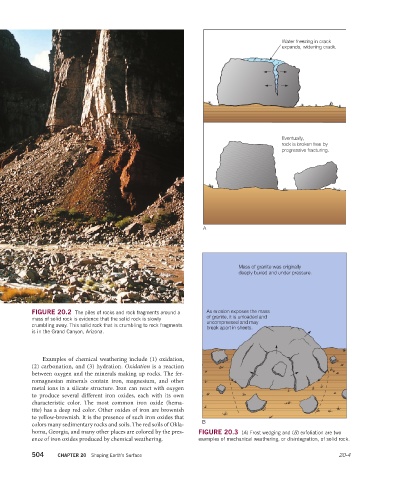
                                                                                                      Water freezing in crack
                                                                                                      expands, widening crack.


                                                                                                     Eventually,
                                                                                                     rock is broken free by
                                                                                                     progressive fracturing.


                                                                           A


                                                                                       Mass of granite was originally
                                                                                       deeply buried and under pressure.


                   FIGURE 20.2  The piles of rocks and rock fragments around a   As erosion exposes the mass
                   mass of solid rock is evidence that the solid rock is slowly   of granite, it is unloaded and
                                                                             uncompressed and may
                   crumbling away. This solid rock that is crumbling to rock fragments   break apart in sheets.
                   is in the Grand Canyon, Arizona.


                      Examples of chemical weathering include (1) oxidation,
                   (2) carbonation, and (3) hydration. Oxidation is a reaction
                   between oxygen and the minerals making up rocks. The fer-
                   romagnesian minerals contain iron, magnesium, and other
                   metal ions in a silicate structure. Iron can react with oxygen
                   to produce several different iron oxides, each with its own
                   characteristic color. The most common iron oxide (hema-
                   tite) has a deep red color. Other oxides of iron are brownish
                   to  yellow-brownish. It is the presence of such iron oxides that
                   colors many sedimentary rocks and soils. The red soils of Okla-  B
                   homa, Georgia, and many other places are colored by the pres-  FIGURE 20.3  (A) Frost wedging and (B) exfoliation are two
                   ence of iron oxides produced by chemical weathering.   examples of mechanical weathering, or disintegration, of solid rock.

                   504     CHAPTER 20  Shaping Earth’s Surface                                                          20-4

