


Page 529 - 9780077418427.pdf
P. 529
/Users/user-f465/Desktop
          tiL12214_ch20_501-520.indd Page 506  9/3/10  6:23 PM user-f465
          tiL12214_ch20_501-520.indd Page 506  9/3/10  6:23 PM user-f465                                                /Users/user-f465/Desktop


                                                                           20.3 SOILS
                                                                          Accumulations of the products of weathering—sand, silt, and
                                                                          clay—result in a layer of unconsolidated earth materials known
                                                                          as soil. Soil is, however, usually understood to be more than just
                                                                          loose weathered materials such as sand or clay. Soil is a mixture
                                                                          of unconsolidated weathered earth materials and humus, which
                                                                          is altered, decay-resistant organic matter. A mature, fertile soil
                                                                          is the result of centuries of mechanical and chemical weather-
                                                                          ing of rock, combined with years of accumulated decayed plants
                                                                          and other organic matter. Soil forms over the solid rock below,
                                                                          which is generally known as bedrock.
                                                                             There are thousands of different soil types, depending on
                                                                          such things as the parent rock type; climate; time of accumula-
                                                                          tion; topographic relief; elevation; rainfall; percentage of clay,
                                                                          sand, or silt; amount of humus; and a number of other envi-
                   A                                                      ronmental variables. In general, soils formed in cold and dry
                                                                          climates are shallower with less humus than soils produced in
                                                                          wet and warm climates. This is so because chemical reactions
                                                                          occur at a faster pace in warmer, wetter soil than they do in
                                                                          dry, cooler soil. In addition, the wet and warm climate would
                                                                          be more conducive to plant growth, which would provide more
                                                                          organic matter for the formation of humus.
                                                                             An easily crumbled soil that has approximately equal pro-
                                                                          portions of sand, silt, and clay is called loam. Loam is a great soil
                                                                          for gardening because it drains well but holds enough moisture
                                                                          for sustained plant growth. Loam is usually found in the top-
                                                                          most layers of soil, so it is also referred to as topsoil. Topsoil is
                                                                          usually more fertile because it is closer to the source of humus.
                                                                          The soil beneath, referred to as  subsoil,  often contains more
                                                                          rocks and mineral accumulations and lacks humus.
                                                                             As described in the section on weathering, quartz grains of
                                                                          sand and clay minerals are the two minerals that usually remain
                                                                          after rock has weathered completely. The sand grains help keep
                                                                          the soil loose and aerated, allowing good water drainage. Clay
                                                                          minerals, on the other hand, help hold water in a soil. A good,
                                                                          fertile loam contains some clay and some sand. The balanced
                                                                          mixture of clay minerals and sand provides plants with both the
                                                                          air and the water that they need for optimum root growth.

                                                                                 CONCEPTS Applied

                                                                                 City Weathering
                                                                             Prepare a display of photographs that show weathering and
                                                                             erosion processes at work in a  city environment. Provide
                                                                               location, agent of weathering or erosion, and a description of
                                                                             what could be done to slow or stop each process illustrated.


                   B                                                       20.4 EROSION
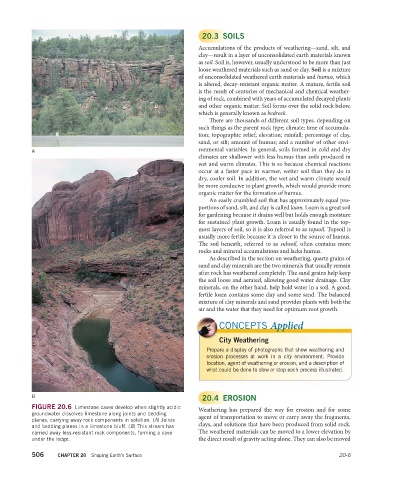
                   FIGURE 20.6  Limestone caves develop when slightly acidic   Weathering has prepared the way for erosion and for some
                   groundwater dissolves limestone along joints and bedding
                                                                          agent of transportation to move or carry away the fragments,
                   planes, carrying away rock components in solution. (A) Joints
                   and bedding planes in a limestone bluff. (B) This stream has   clays, and solutions that have been produced from solid rock.
                   carried away less-resistant rock components, forming a cave   The weathered materials can be moved to a lower elevation by
                   under the ledge.                                       the direct result of gravity acting alone. They can also be moved

                   506     CHAPTER 20  Shaping Earth’s Surface                                                          20-6

