


Page 530 - 9780077418427.pdf
P. 530
/Users/user-f465/Desktop
          tiL12214_ch20_501-520.indd Page 507  9/3/10  6:23 PM user-f465
          tiL12214_ch20_501-520.indd Page 507  9/3/10  6:23 PM user-f465                                                /Users/user-f465/Desktop


                       to a lower elevation by gravity acting through some intermedi-
                       ate agent, such as running water, wind, or glaciers. The erosion
                       of weathered materials as a result of gravity alone will be con-
                       sidered first.


                       MASS MOVEMENT
                       Gravity constantly acts on every mass of materials on the surface
                       of Earth, pulling parts of elevated regions toward lower levels.
                       Rocks in the elevated regions are able to temporarily resist this
                       constant pull through their cohesiveness with a main rock mass
                       or by the friction of the rock on a slope. Whenever anything hap-
                       pens to reduce the cohesiveness or to reduce the friction, gravity
                       pulls the freed material to a lower elevation. Thus, gravity acts   Solid rock
                       directly on individual rock fragments and on large amounts of
                                                                                                                         Soil
                       surface materials as a mass, pulling all to a lower elevation. Ero-
                       sion caused by gravity acting directly is called mass movement
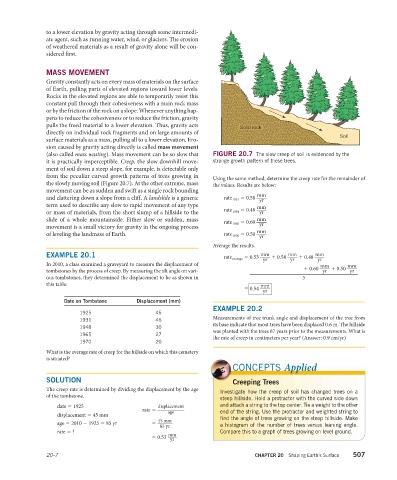
                       (also called mass wasting). Mass movement can be so slow that   FIGURE 20.7  The slow creep of soil is evidenced by the
                       it is practically imperceptible. Creep, the slow downhill move-  strange growth pattern of these trees.
                       ment of soil down a steep slope, for  example, is detectable only
                       from the peculiar curved growth patterns of trees growing in   Using the same method, determine the creep rate for the remainder of
                       the slowly moving soil (Figure 20.7). At the other extreme, mass   the values. Results are below:
                       movement can be as sudden and swift as a single rock bounding
                                                                                             mm
                       and clattering down a slope from a cliff. A landslide is a generic    rate    1931   = 0.58    _
                                                                                              yr
                       term used to describe any slow to rapid movement of any type          _
                                                                                             mm
                                                                                   rate    1948   = 0.48
                       or mass of materials, from the short slump of a hillside to the        yr
                       slide of a whole mountainside. Either slow or sudden, mass    rate    1965   = 0.60    _
                                                                                             mm
                       movement is a small victory for gravity in the ongoing process         yr
                                                                                             mm
                       of leveling the landmass of Earth.                          rate    1970   = 0.50    _
                                                                                              yr
                                                                               Average the results.
                                                                                                        mm
                                                                                              mm
                         EXAMPLE 20.1                                             rate average  = 0.53   _     + 0.58    _     + 0.48    _
                                                                                                                 mm


                                                                                               yr       yr       yr
                       In 2010, a class examined a graveyard to measure the displacement of                       _        _
                                                                                                                  mm
                                                                                                                           mm

                                                                                                             + 0.60         + 0.50

                       tombstones by the process of creep. By measuring the tilt angle on vari-                    yr       yr
                       ous tombstones, they determined the displacement to be as shown in                   5
                       this table:                                                            _
                                                                                              mm
                                                                                         = 0.54
                                                                                               yr
                             Date on Tombstone       Displacement (mm)
                                                                               EXAMPLE 20.2
                                   1925                     45
                                                                               Measurements of tree trunk angle and displacement of the tree from
                                   1931                     46
                                                                               its base indicate that most trees have been displaced 0.6 m. The hillside
                                   1948                     30
                                                                               was planted with the trees 67 years prior to the measurements. What is
                                   1965                     27
                                                                               the rate of creep in centimeters per year? (Answer: 0.9 cm/yr)
                                   1970                     20
                       What is the average rate of creep for the hillside on which this cemetery
                       is situated?
                                                                                     CONCEPTS Applied
                       SOLUTION                                                      Creeping Trees
                       The creep rate is determined by dividing the displacement by the age
                                                                                 Investigate how the creep of soil has changed trees on a
                       of the tombstone.
                                                                                 steep hillside. Hold a protractor with the curved side down
                           date = 1925                      _                    and attach a string to the top center. Tie a weight to the other
                                                             displacement


                                                       rate =      age           end of the string. Use the protractor and weighted string to
                           displacement = 45 mm
                                                            _                    find the angle of trees growing on the steep hillside. Make
                                                            45 mm


                           age = 2010 − 1925 = 85 yr      =
                                                             85 yr               a histogram of the number of trees versus leaning angle.
                           rate = ?                                              Compare this to a graph of trees growing on level ground.
                                                                mm
                                                          = 0.53    _
                                                                 yr
                       20-7                                                                  CHAPTER 20  Shaping Earth’s Surface   507

