


Page 528 - 9780077418427.pdf
P. 528
/Users/user-f465/Desktop
          tiL12214_ch20_501-520.indd Page 505  9/3/10  6:23 PM user-f465
          tiL12214_ch20_501-520.indd Page 505  9/3/10  6:23 PM user-f465                                                /Users/user-f465/Desktop


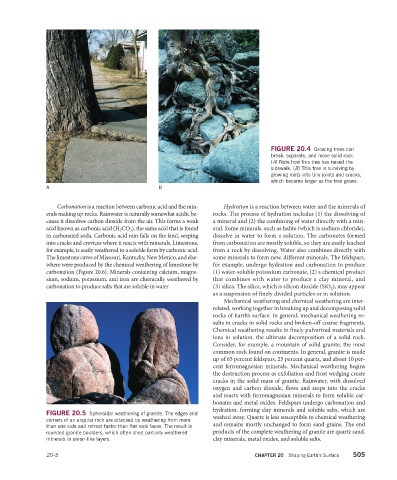
                                                                                                  FIGURE 20.4  Growing trees can
                                                                                                  break, separate, and move solid rock.
                                                                                                  (A) Note how this tree has raised the
                                                                                                  sidewalk. (B) This tree is surviving by
                                                                                                  growing roots into tiny joints and cracks,
                                                                                                  which become larger as the tree grows.
                       A                                     B


                           Carbonation is a reaction between carbonic acid and the min-  Hydration is a reaction between water and the minerals of
                       erals making up rocks. Rainwater is naturally somewhat acidic be-  rocks. The process of hydration includes (1) the dissolving of
                       cause it dissolves carbon dioxide from the air. This forms a weak   a mineral and (2) the combining of water directly with a min-
                       acid known as carbonic acid (H 2 CO 3 ), the same acid that is found   eral. Some minerals, such as halite (which is sodium chloride),
                       in carbonated soda. Carbonic acid rain falls on the land, seeping   dissolve in water to form a solution. The carbonates formed
                       into cracks and crevices where it reacts with minerals. Limestone,   from carbonation are mostly soluble, so they are eas ily leached
                       for example, is easily weathered to a soluble form by carbonic acid.   from a rock by dissolving. Water also combines  directly with
                       The limestone caves of Missouri, Kentucky, New Mexico, and else-  some minerals to form new, different minerals. The feldspars,
                       where were produced by the chemical weathering of limestone by   for example, undergo hydration and carbonation to produce
                       carbona tion (Fig ure 20.6). Minerals containing calcium, magne-  (1) water-soluble potassium carbonate, (2) a chemical product

                       sium, sodium, potassium, and iron are chemically weathered by   that combines with water to produce a clay mineral, and
                       carbonation to produce salts that are soluble in water.  (3) silica. The silica, which is silicon dioxide (SiO 2 ), may appear
                                                                               as a suspension of finely divided particles or in  solution.
                                                                                  Mechanical weathering and chemical weathering are inter-
                                                                               related, working together in breaking up and decomposing solid
                                                                               rocks of Earth’s surface. In general, mechanical weathering re-
                                                                               sults in cracks in solid rocks and broken-off coarse fragments.
                                                                               Chemical weathering results in finely pulverized materials and
                                                                               ions in solution, the ultimate decomposition of a solid rock.
                                                                               Consider, for example, a mountain of solid granite, the most
                                                                               common rock found on continents. In general, granite is made
                                                                               up of 65 percent feldspars, 25 percent quartz, and about 10 per-
                                                                               cent ferromagnesian minerals. Mechanical weathering begins
                                                                               the destruction process as exfoliation and frost wedging create
                                                                               cracks in the solid mass of granite. Rainwater, with dissolved
                                                                               oxygen and carbon dioxide, flows and seeps into the cracks
                                                                               and reacts with ferromagnesian minerals to form soluble car-
                                                                               bonates and metal oxides. Feldspars undergo carbonation and
                                                                               hydration, forming clay minerals and soluble salts, which are
                       FIGURE 20.5  Spheroidal weathering of granite. The edges and
                                                                               washed away. Quartz is less susceptible to chemical weathering
                       corners of an angular rock are attacked by weathering from more
                       than one side and retreat faster than flat rock faces. The result is   and remains mostly unchanged to form sand grains. The end
                       rounded granite boulders, which often shed partially weathered   products of the complete weathering of granite are quartz sand,
                       minerals in onion-like layers.                          clay minerals, metal oxides, and soluble salts.

                       20-5                                                                  CHAPTER 20  Shaping Earth’s Surface   505

