Page 531 - 9780077418427.pdf
P. 531

/Users/user-f465/Desktop
          tiL12214_ch20_501-520.indd Page 508  9/3/10  6:23 PM user-f465
          tiL12214_ch20_501-520.indd Page 508  9/3/10  6:23 PM user-f465                                                /Users/user-f465/Desktop


                   RUNNING WATER                                          river, you know that the river is at work moving mountains, bit
                   Running water is the most important of all the erosional agents   by bit, to the ocean. It has been estimated that rivers remove
                   of gravity that remove rock materials to lower levels.  enough dissolved materials and sediments to make the whole
                      Erosion by running water begins with rainfall. Each raindrop   surface of the United States flat in a little over 20 million years,
                   impacting the soil moves small rock fragments about, but it also   a very short time compared to the 4.6 billion year age of Earth.
                   begins to dissolve some of the soluble products of weathering.   In addition to transporting materials that were weathered
                   If the rainfall is heavy enough, a shallow layer or sheet of water   and eroded by other agents of erosion, streams do their own
                   forms on the surface, transporting small fragments and dissolved   erosive work. Streams can dissolve soluble materials directly
                   materials across the surface. This sheet erosion picks up fragments   from rocks and sediments. They also quarry and pluck fragments
                   and dissolved material, then transports them to small streams at   and pieces of rocks from beds of solid rock by hydraulic action.
                   lower levels (Figure 20.8). The small streams move to larger chan-  Most of the erosion accomplished directly by streams, however,
                   nels, and the running water transports  materials three different   is done by the more massive fragments that are rolled, bounced,
                   ways: (1) as dissolved rock materials carried in solution, (2) as   and slid along the streambed and against one another. This
                   clay minerals and small grains carried in suspension, and (3) as   results in a grinding and filing action on the fragments and a
                   sand and larger rock fragments that are rolled, bounced, and slid   wearing away of the streambed.
                   along the bottom of the streambed. Just how much material is   As a stream cuts downward into its bed, other agents of
                   eroded and transported by the stream depends on the volume of   erosion such as mass movement begin to widen the channel as
                   water, its velocity, and the load that it is already carrying.  mate rials slump into the moving water. The load that the stream
                      Streams and major rivers are at work, for the most part,   carries is increased by this slumping, which slows the stream. As
                   24 hours a day every day of the year moving rock fragments   the stream slows, it begins to develop bends, or meanders, along
                   and dissolved materials from elevated landmasses to the oceans.   the channel. Meanders have a dramatic effect on stream erosion
                   Any time you see mud, clay, and sand being transported by a   because the water moves faster around an outside bank than it
                                                                          does around the inside bank downstream. This difference in
                                                                          stream velocity means that the stream has a greater erosion abil-
                                                                          ity on the outside, downstream side and less on the sheltered area
                                                                          inside of curves. The stream begins to widen the floor of the val-
                                                                          ley through which it runs by eroding on the outside of the mean-
                                                                          der, then depositing the eroded material on the inside of another
                                                                          bend downstream. The stream thus begins to erode laterally,
                                                                          slowly working its way across the land. Sometimes two bends in
                                                                          the stream meet, forming a cutoff meander called an oxbow lake.


                                                                            EXAMPLE 20.3
                                                                                                                       5
                                                                          Each year a major river in a humid region transports 1.49 × 10  Mg of
                                                                                                               3
                                                                                                                  2
                                                                          sediment eroded from a drainage area of 6.54 × 10  km . What is the
                                                                          thickness ( z) of soil, in meters, that would be eroded from this land-
                                                                          scape in 1 million years? Assume the average density of the soil being
                                                                                                        3
                                                                          eroded in the drainage basin is 1.3 Mg/m  and that all of the sediment
                                                                          being transported in the river has been eroded from the landscape.
                                                                          SOLUTION
                                                                          This type of problem is best solved by subdividing it into steps that
                                                                          consider the volume of sediment eroded in 1 million years and the
                                                                          thickness of sediment associated with this volume.
                                                                          Step 1: Volume Removed
                                                                                        5 Mg      6          m _       m _
                                                                                         _

                                                                                                                       ρ
                                                                             m = 1.49 × 1 0          (1 × 1 0    yr)   ρ =             ∴ V =
                                                                                          yr                 V
                                                                                                                    11
                                                                                        11
                                                                                                             1.49 × 1 0     Mg
                                                                               = 1.49 × 10  Mg               __
                                                                                                         V =
                                                                                                                   Mg
                                                                                    Mg
                                                                                    _                           1.3    _
                                                                              ρ = 1.3                               3
                                                                                     3
                                                                                     m                              m
                                                                                                                   11 Mg
                                                                                                             1.49 × 1 0    _
                                                                               V = ?                         =   _


                                                                                                                     Mg
                                                                                                                1.3  _

                                                                                                                      m    3
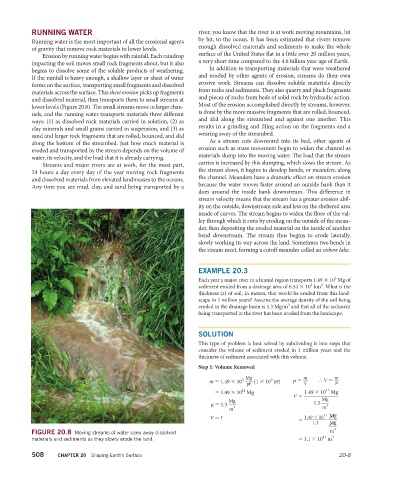
                   FIGURE 20.8  Moving streams of water carry away dissolved
                                                                                                                   11
                                                                                                                      3
                   materials and sediments as they slowly erode the land.                                    = 1.1 × 1 0      m
                   508     CHAPTER 20  Shaping Earth’s Surface                                                          20-8
   526   527   528   529   530   531   532   533   534   535   536