


Page 538 - 9780077418427.pdf
P. 538
/Users/user-f465/Desktop
          tiL12214_ch20_501-520.indd Page 515  9/3/10  6:24 PM user-f465
          tiL12214_ch20_501-520.indd Page 515  9/3/10  6:24 PM user-f465                                                /Users/user-f465/Desktop


                        A
                                                                               divided products of chemical weathering. The landforms in dry
                                                                               climates, on the other hand, tend to have sharp, angular outlines
                                                                               from the mass movement of rock material from vertical cliffs.
                                                                               Lacking as much chemical weathering, the landscapes in dry
                                                                               climate regions tend to have sharper outlines.

                                                                                 STAGE OF DEVELOPMENT
                                                                               The stage of landform development describes how effective the
                                                                               processes have been in attacking the rock structure. Stage de-
                                                                               scribes the extent to which the processes have completed their
                                                                               work, that is, the amount of the original surface that remains.
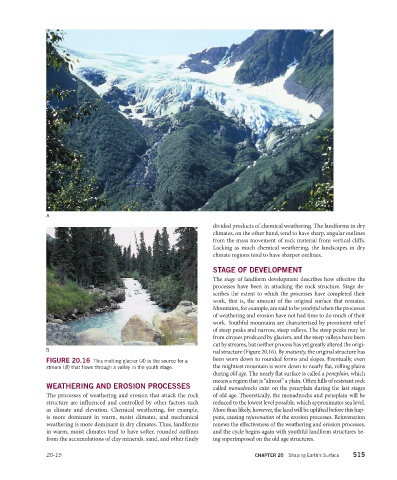
                                                                               Mountains, for example, are said to be youthful when the processes
                                                                               of weathering and erosion have not had time to do much of their
                                                                               work. Youthful mountains are characterized by prominent relief
                                                                               of steep peaks and narrow, steep valleys. The steep peaks may be
                                                                               from cirques produced by glaciers, and the steep valleys have been
                                                                               cut by streams, but neither process has yet greatly altered the origi-
                       B                                                       nal structure (Figure 20.16). By maturity, the original structure has
                                                                               been worn down to rounded forms and slopes. Eventually, even
                       FIGURE 20.16  This melting glacier (A) is the source for a
                       stream (B) that flows through a valley in the youth stage.  the mightiest mountain is worn down to nearly flat, rolling plains
                                                                               during old age. The nearly flat surface is called a peneplain, which
                                                                               means a region that is “almost” a plain. Often hills of resistant rock
                        WEATHERING AND EROSION PROCESSES                       called monadnocks exist on the peneplain during the last stages
                        The processes of weathering and erosion that attack the rock   of old age. Theoretically, the monadnocks and peneplain will be
                        structure are influenced and controlled by other factors such   reduced to the lowest level possible, which approximates sea level.
                        as climate and elevation. Chemical weathering, for example,   More than likely, however, the land will be uplifted before this hap-
                        is more dominant in warm, moist climates, and mechanical   pens, causing rejuvenation of the erosion processes. Rejuvenation
                        weathering is more dominant in dry climates. Thus, landforms   renews the effectiveness of the weathering and erosion processes,
                        in warm, moist climates tend to have softer, rounded outlines   and the cycle begins again with youthful landform structures be-
                        from the accumulations of clay minerals, sand, and other finely   ing superimposed on the old age structures.

                       20-15                                                                 CHAPTER 20  Shaping Earth’s Surface   515

