


Page 537 - 9780077418427.pdf
P. 537
/Users/user-f465/Desktop
          tiL12214_ch20_501-520.indd Page 514  9/3/10  6:24 PM user-f465
          tiL12214_ch20_501-520.indd Page 514  9/3/10  6:24 PM user-f465                                                /Users/user-f465/Desktop


                           People Behind the Science


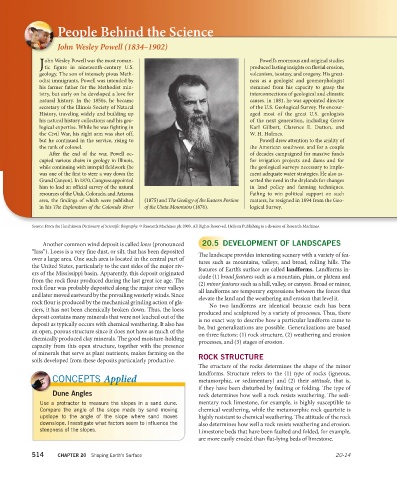
                           John Wesley Powell (1834–1902)

                       ohn Wesley Powell was the most roman-                                  Powell’s enormous and  original studies
                     Jtic figure in nineteenth-century U.S.                                produced lasting insights on fluvial erosion,
                     geology. The son of intensely pious Meth-                             volcanism, isostasy, and orogeny. His great-
                     odist immigrants, Powell was intended by                              ness as a geologist and geomorphologist
                     his farmer father for the Methodist min-                              stemmed from his capacity to grasp the
                     istry, but early on he developed a love for                           inter connections of geological and climatic
                     natural history. In the 1850s, he became                              causes. In 1881, he was appointed director
                       secretary of the Illinois Society of Natural                        of the U.S. Geological Survey. He encour-
                     History, traveling widely and building up                             aged most of the great U.S. geologists
                     his natural history collections and his geo-                          of the next  generation, including Grove
                     logical expertise. While he was fighting in                           Karl Gilbert, Clarence E. Dutton, and
                     the Civil War, his right arm was shot off,                            W. H. Holmes.
                     but he continued in the service, rising to                               Powell drew attention to the aridity of
                     the rank of colonel.                                                  the American southwest and for a couple
                        After the end of the war, Powell oc-                               of decades campaigned for massive funds
                     cupied various chairs in geology in Illinois,                         for irrigation projects and dams and for
                     while continuing with intrepid fieldwork (he                          the  geological surveys necessary to imple-
                     was one of the first to steer a way down the                          ment adequate water strategies. He also as-
                     Grand Canyon). In 1870, Congress  appointed                           serted the need in the drylands for changes
                     him to lead an official survey of the natural                         in land policy and farming techniques.
                     resources of the Utah,  Colorado, and Arizona                         Failing to win political support on such
                     area, the findings of which were published   (1875) and The Geology of the Eastern Portion   matters, he resigned in 1894 from the Geo-
                     in his The Exploration of the Colorado River   of the Uinta Mountains (1876).  logical Survey.


                   Source: From the Hutchinson Dictionary of Scientific Biography. © Research Machines plc 2003. All Rights Reserved. Helicon Publishing is a division of Research Machines.

                      Another common wind deposit is called loess (pronounced   20.5  DEVELOPMENT OF LANDSCAPES
                   “luss”). Loess is a very fine dust, or silt, that has been deposited   The landscape provides interesting scenery with a variety of fea-
                   over a large area. One such area is located in the central part of   tures such as mountains, valleys, and broad, rolling hills. The
                   the United States, particularly to the east sides of the major riv-  features of Earth’s surface are called landforms. Landforms in-
                   ers of the Mississippi basin. Apparently, this deposit originated   clude (1) broad features such as a mountain, plain, or plateau and
                   from the rock flour produced during the last great ice age. The   (2) minor features such as a hill, valley, or canyon. Broad or minor,
                   rock flour was probably deposited along the major river valleys   all landforms are temporary expressions between the forces that
                   and later moved eastward by the prevailing westerly winds. Since   elevate the land and the weathering and erosion that level it.
                   rock flour is produced by the mechanical grinding  action of gla-  No two landforms are identical because each has been
                   ciers, it has not been chemically broken down. Thus, the loess     produced and sculptured by a variety of processes. Thus, there
                   deposit contains many minerals that were not leached out of the   is no exact way to describe how a particular landform came to
                   deposit as typically occurs with chemical weathering. It also has   be, but generalizations are possible. Generalizations are based
                   an open, porous structure since it does not have as much of the   on three factors: (1) rock structure, (2) weathering and erosion
                   chemically produced clay minerals. The good moisture-holding   processes, and (3) stages of erosion.
                   capacity from this open structure, together with the presence
                   of minerals that serve as plant nutrients, makes farming on the   ROCK STRUCTURE
                   soils developed from these deposits particularly productive.
                                                                          The structure of the rocks determines the shape of the minor
                                                                          landforms. Structure refers to the (1) type of rocks (igneous,
                          CONCEPTS Applied                                metamorphic, or sedimentary) and (2) their  attitude, that is,
                                                                          if they have been disturbed by faulting or folding. The type of
                          Dune Angles                                     rock determines how well a rock resists weathering. The sedi-

                     Use a protractor to measure the slopes in a sand dune.   mentary rock limestone, for example, is highly susceptible to
                     Com pare the angle of the slope made by sand moving   chemical weathering, while the metamorphic rock quartzite is
                     upslope to the  angle of the slope where sand moves   highly resistant to chemical weathering. The attitude of the rock
                     downslope.  Investigate what factors seem to influence the   also determines how well a rock resists weathering and erosion.
                     steepness of the slopes.                             Limestone beds that have been faulted and folded, for example,
                                                                          are more easily eroded than flat-lying beds of limestone.

                   514     CHAPTER 20  Shaping Earth’s Surface                                                         20-14

