


Page 535 - 9780077418427.pdf
P. 535
/Users/user-f465/Desktop
          tiL12214_ch20_501-520.indd Page 512  9/3/10  6:24 PM user-f465
          tiL12214_ch20_501-520.indd Page 512  9/3/10  6:24 PM user-f465                                                /Users/user-f465/Desktop


                      A                                                       B

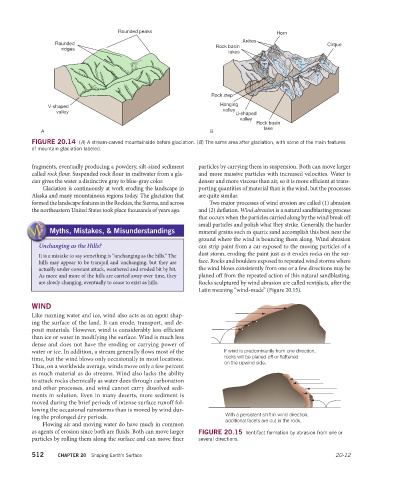
                   FIGURE 20.14  (A) A stream-carved mountainside before glaciation. (B) The same area after glaciation, with some of the main features
                   of mountain glaciation labeled.

                   fragments, eventually producing a powdery, silt-sized sediment   particles by carrying them in suspension. Both can move larger
                   called rock flour. Suspended rock flour in meltwater from a gla-  and more massive particles with increased velocities. Water is
                   cier gives the water a distinctive gray to blue-gray color.  denser and more viscous than air, so it is more efficient at trans-
                      Glaciation is continuously at work eroding the landscape in   porting quantities of material than is the wind, but the processes
                   Alaska and many mountainous regions today. The glaciation that   are quite similar.
                   formed the landscape features in the Rockies, the Sierras, and across   Two major processes of wind erosion are called (1) abrasion
                   the northeastern United States took place thousands of years ago.  and (2) deflation. Wind abrasion is a natural sandblasting process
                                                                          that occurs when the particles carried along by the wind break off
                                                                          small particles and polish what they strike. Generally, the harder
                         Myths, Mistakes, & Misunderstandings             mineral grains such as quartz sand accomplish this best near the
                                                                          ground where the wind is bouncing them along. Wind abrasion
                     Unchanging as the Hills?                             can strip paint from a car exposed to the moving particles of a
                                                                          dust storm, eroding the paint just as it erodes rocks on the sur-
                     It is a mistake to say something is “unchanging as the hills.” The
                     hills may appear to be tranquil and unchanging, but they are   face. Rocks and boulders exposed to repeated wind storms where
                     actually under constant attack, weathered and eroded bit by bit.   the wind blows consistently from one or a few directions may be
                     As more and more of the hills are carried away over time, they   planed off from the repeated action of this natural sandblasting.
                     are slowly changing, eventually to cease to exist as hills.  Rocks sculptured by wind abrasion are called ventifacts, after the
                                                                          Latin meaning “wind-made” (Figure 20.15).

                   WIND
                   Like running water and ice, wind also acts as an agent shap-
                   ing the surface of the land. It can erode, transport, and de-
                   posit materials. However, wind is considerably less efficient
                   than ice or water in modifying the surface. Wind is much less
                   dense and does not have the eroding or carrying power of
                   water or ice. In addition, a stream generally flows most of the   If wind is predominantly from one direction,
                   time, but the wind blows only occasionally in most locations.   rocks will be planed off or flattened
                                                                                  on the upwind side.
                   Thus, on a worldwide average, winds move only a few percent
                   as much material as do streams. Wind also lacks the ability
                   to attack rocks chemically as water does through carbonation
                   and other processes, and wind cannot carry dissolved sedi-
                   ments in solution. Even in many deserts, more sediment is
                   moved during the brief periods of intense surface runoff fol-
                   lowing the occasional rainstorms than is moved by wind dur-
                   ing the prolonged dry periods.                                  With a persistent shift in wind direction,
                                                                                   additional facets are cut in the rock.
                      Flowing air and moving water do have much in common
                   as agents of erosion since both are fluids. Both can move larger   FIGURE 20.15  Ventifact formation by abrasion from one or
                   particles by rolling them along the surface and can move finer   several directions.

                   512     CHAPTER 20  Shaping Earth’s Surface                                                         20-12

