


Page 536 - 9780077418427.pdf
P. 536
/Users/user-f465/Desktop
          tiL12214_ch20_501-520.indd Page 513  9/3/10  6:24 PM user-f465
          tiL12214_ch20_501-520.indd Page 513  9/3/10  6:24 PM user-f465                                                /Users/user-f465/Desktop


                                                                                   Science and Society


                                                                                                              Acid Rain
                             cid rain is a general term used to de-  BOX TABLE 20.1             emissions that result in a precipitation pH
                          Ascribe any acidic substances, wet or                                 of 4.0 to 4.5. Unfortunately, the area of New
                          dry, that fall from the atmosphere. Wet   The approximate pH of some     England and adjacent Canada downwind
                          acidic deposition could be in the form of   common acidic substances  of major acid rain sources has granite bed-
                          rain, but snow, sleet, and fog could also be                          rock, which means that the effects of acid
                                                             Substance         pH (or pH Range)
                          involved. Dry acidic deposition could in-                             rain will not be moderated as they would in
                          clude gases, dust, or any solid particles that                        the West or Midwest. This region is the geo-
                                                             Hydrochloric acid (4%)   0
                          settle out of the atmosphere to produce an                            graphic center of the acid rain problem in
                                                             Gastric (stomach)
                          acid condition.                                                       North America. A solution to the problem
                                                               solution           1.6–1.8
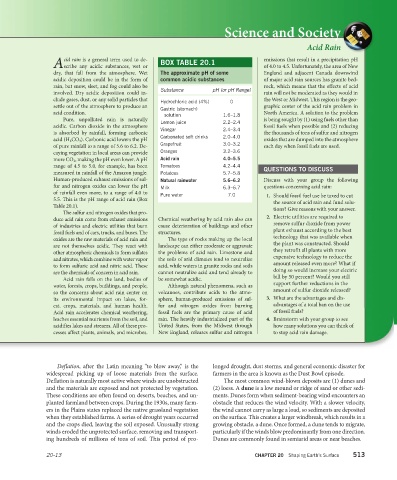
                             Pure, unpolluted rain is naturally                                 is being sought by (1) using fuels other than
                                                             Lemon juice          2.2–2.4
                          acidic. Carbon dioxide in the atmosphere                              fossil fuels when possible and (2) reducing
                                                             Vinegar              2.4–3.4
                          is absorbed by rainfall, forming carbonic                             the thousands of tons of sulfur and nitrogen
                                                             Carbonated soft drinks   2.0–4.0
                          acid (H 2 CO 3 ). Carbonic acid lowers the pH                         oxides that are dumped into the atmosphere
                          of pure rainfall to a range of 5.6 to 6.2. De-  Grapefruit  3.0–3.2   each day when fossil fuels are used.
                          caying vegetation in local areas can provide   Oranges  3.2–3.6
                          more CO 2 , making the pH even lower. A pH   Acid rain   4.0–5.5
                          range of 4.5 to 5.0, for example, has been   Tomatoes   4.2–4.4
                                                                                                QUESTIONS TO DISCUSS
                          measured in rainfall of the Amazon jungle.   Potatoes   5.7–5.8
                          Human-produced exhaust emissions of sul-  Natural rainwater   5.6–6.2  Discuss with your group the following
                          fur and nitrogen oxides can lower the pH   Milk         6.3–6.7       questions concerning acid rain:
                          of rainfall even more, to a range of 4.0 to
                                                             Pure water             7.0           1.  Should fossil fuel use be taxed to cut
                          5.5. This is the pH range of acid rain (Box
                                                                                                   the source of acid rain and fund solu-
                          Table 20.1).
                                                                                                   tions? Give reasons with your answer.
                             The sulfur and nitrogen oxides that pro-
                          duce acid rain come from exhaust emissions   Chemical weathering by acid rain also can     2.  Electric utilities are required to
                          of industries and electric utilities that burn   cause deterioration of buildings and other   remove sulfur dioxide from power
                          fossil fuels and of cars, trucks, and buses. The   structures.           plant  exhaust according to the best
                          oxides are the raw materials of acid rain and   The type of rocks making up the local     technology that was available when
                          are not themselves acidic. They react with   landscape can either moderate or aggravate   the plant was constructed. Should
                          other atmospheric chemicals to form sulfates   the problems of acid rain. Limestone and   they retrofit all plants with more
                          and nitrates, which combine with water vapor   the soils of arid climates tend to neutralize   expensive technology to reduce the
                          to form sulfuric acid and nitric acid. These   acid, while waters in granite rocks and soils   amount  released even more? What if
                          are the chemicals of concern in acid rain.  cannot neutralize acid and tend already to   doing so would increase your electric
                             Acid rain falls on the land, bodies of   be somewhat acidic.          bill by 50 percent? Would you still
                          water, forests, crops, buildings, and people,   Although natural phenomena, such as   support  further reductions in the
                          so the concerns about acid rain center on   volcanoes, contribute acids to the atmo-  amount of sulfur dioxide released?
                          its environmental impact on lakes, for-  sphere, human-produced emissions of sul-    3.  What are the advantages and dis -
                          est, crops, materials, and human health.   fur  and nitrogen oxides from burning   advantages of a total ban on the use
                          Acid rain accelerates chemical weathering,   fossil  fuels are the primary cause of acid   of fossil fuels?
                          leaches essential nutrients from the soil, and   rain. The heavily industrialized part of the     4.  Brainstorm with your group to see
                          acidifies lakes and streams. All of these pro-  United States, from the Midwest through   how many solutions you can think of
                          cesses affect plants, animals, and microbes.   New  England, releases sulfur and nitrogen   to stop acid rain damage.


                           Deflation, after the Latin meaning “to blow away,” is the   longed drought, dust storms, and general economic disaster for
                       widespread picking up of loose materials from the surface.   farmers in the area is known as the Dust Bowl episode.
                         Deflation is naturally most active where winds are unobstructed   The most common wind-blown deposits are (1) dunes and
                       and the materials are exposed and not protected by vegetation.   (2) loess. A dune is a low mound or ridge of sand or other sedi-
                       These conditions are often found on deserts, beaches, and un-  ments. Dunes form when sediment-bearing wind encounters an
                       planted farmland between crops. During the 1930s, many farm-  obstacle that reduces the wind velocity. With a slower velocity,
                       ers in the Plains states replaced the native grassland vegetation   the wind cannot carry as large a load, so sediments are deposited
                       when they established farms. A series of drought years occurred   on the surface. This creates a larger windbreak, which  results in a
                       and the crops died, leaving the soil exposed. Unusually strong   growing obstacle, a dune. Once formed, a dune tends to  migrate,
                       winds eroded the unprotected surface, removing and transport-  particularly if the winds blow predominantly from one direction.
                       ing hundreds of millions of tons of soil. This period of pro-  Dunes are commonly found in semiarid areas or near beaches.

                       20-13                                                                 CHAPTER 20  Shaping Earth’s Surface   513

