


Page 533 - 9780077418427.pdf
P. 533
/Users/user-f465/Desktop
          tiL12214_ch20_501-520.indd Page 510  9/3/10  6:23 PM user-f465
          tiL12214_ch20_501-520.indd Page 510  9/3/10  6:23 PM user-f465                                                /Users/user-f465/Desktop


                                                                          GLACIERS
                                                                          Glaciers presently cover only about 10 percent of Earth’s con-
                                                                          tinental land area, and much of this is at higher latitudes, so
                                                                          it might seem that glaciers would not have much of an overall
                                                                          effect in eroding the land. However, ice has sculptured much of
                                                                          the present landscape, and features attributed to glacial episodes
                                                                          are found over about three-quarters of the continental surface.
                                                                          Only a few tens of thousands of years ago, sheets of ice covered
                                                                          major portions of North America, Europe, and Asia. Today, the
                                                                          most extensive glaciers in the United States are those of Alaska,
                                                                          which cover about 3 percent of the state’s land area. Less exten-
                                                                          sive glacier ice is found in the mountainous  regions of Washing-
                                                                          ton, Montana, California, Colorado, and Wyoming.
                                                                             A glacier is a mass of ice on land that moves under its own
                                                                          weight. Glacier ice forms gradually from snow, but the quantity
                                                                          of snow needed to form a glacier does not fall in a single winter.
                                                                          Glaciers form in cold climates where some snow and ice persist
                                                                          throughout the year. The amount of winter snowfall must exceed
                                                                          the summer melting to accumulate a sufficient mass of snow to
                                                                          form a glacier. As the snow accumulates, it is gradually trans-
                                                                          formed into ice. The weight of the overlying snow packs it down,
                                                                          driving out much of the air, and causing it to recrystallize into a
                                                                          coarser, denser mass of interlocking ice crystals that appears
                                                                          to have a blue to deep blue color. Complete conversion of snow
                                                                          into glacial ice may take from 5 to 3,500 years, depending on
                                                                          such factors as climate and rate of snow accumulation at the top
                                                                          of the pile. Eventually, the mass of ice will become large enough
                                                                          that it begins to flow, spreading out from the accumulated mass.
                                                                          Gla ciers that form at high elevations in mountainous regions are
                                                                          called alpine glaciers. If these glaciers flow down into a valley,
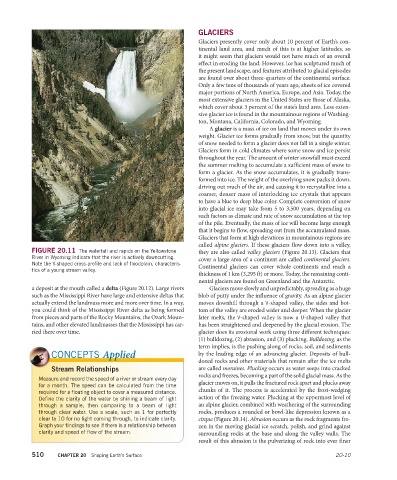
                   FIGURE 20.11  The waterfall and rapids on the Yellowstone   they are also called valley glaciers (Figure 20.13). Glaciers that
                   River in Wyoming indicate that the river is actively downcutting.   cover a large area of a continent are called continental glaciers.
                   Note the V-shaped cross-profile and lack of floodplain, characteris-  Continental glaciers can cover whole continents and reach a
                   tics of a young stream valley.
                                                                          thickness of 1 km (3,295 ft) or more. Today, the remaining conti-
                                                                          nental  glaciers are found on Greenland and the Antarctic.
                   a deposit at the mouth called a delta (Figure 20.12). Large rivers   Glaciers move slowly and unpredictably, spreading as a huge
                   such as the Mississippi River have large and extensive deltas that   blob of putty under the influence of gravity. As an alpine gla cier
                   actually extend the landmass more and more over time. In a way,   moves downhill through a  V-shaped valley, the sides and bot-
                   you could think of the Mississippi River delta as being formed   tom of the valley are eroded wider and deeper. When the  glacier
                   from pieces and parts of the Rocky Mountains, the Ozark Moun-  later melts, the  V-shaped valley is now a  U-shaped valley that
                   tains, and other elevated landmasses that the  Mississippi has car-  has been straightened and deepened by the glacial erosion. The
                   ried there over time.                                  glacier does its erosional work using three different techniques:
                                                                          (1) bulldozing, (2) abrasion, and (3) plucking. Bulldozing, as the
                                                                          term implies, is the pushing along of rocks, soil, and sediments
                         CONCEPTS Applied                                 by the leading edge of an advancing glacier. Deposits of bull-
                                                                          dozed rocks and other materials that remain after the ice melts
                         Stream Relationships                             are called moraines. Plucking occurs as water seeps into cracked
                                                                          rocks and freezes, becoming a part of the solid glacial mass. As the
                     Measure and record the speed of a river or stream every day
                     for a month. The speed can be calculated from the time   glacier moves on, it pulls the fractured rock apart and plucks away
                     required for a floating object to cover a measured distance.   chunks of it. The process is accelerated by the frost- wedging
                       Define the clarity of the water by shining a beam of light     action of the freezing water. Plucking at the uppermost level of
                     through a sample, then comparing to a beam of light   an alpine glacier, combined with weathering of the surrounding
                     through clear water. Use a scale, such as 1 for perfectly   rocks, produces a rounded or bowl-like depression known as a
                     clear to 10 for no light coming through, to indicate clarity.   cirque (Figure 20.14). Abrasion occurs as the rock fragments fro-
                     Graph your findings to see if there is a relationship between   zen in the moving glacial ice scratch, polish, and grind against
                     clarity and speed of flow of the stream.             surrounding rocks at the base and along the valley walls. The
                                                                          result of this abrasion is the pulverizing of rock into ever finer

                   510     CHAPTER 20  Shaping Earth’s Surface                                                         20-10

