


Page 544 - 9780077418427.pdf
P. 544
/Volume/201/MHDQ233/tat78194_disk1of1/0073378194/tat78194_pagefile
          tiL12214_ch21_521-540.indd Page 521  9/23/10  11:09 AM user-f465
          tiL12214_ch21_521-540.indd Page 521  9/23/10  11:09 AM user-f465             /Volume/201/MHDQ233/tat78194_disk1of1/0073378194/tat78194_pagefiles


                                                                              21
                                                                              21                  Geologic

                                                                                                  Time


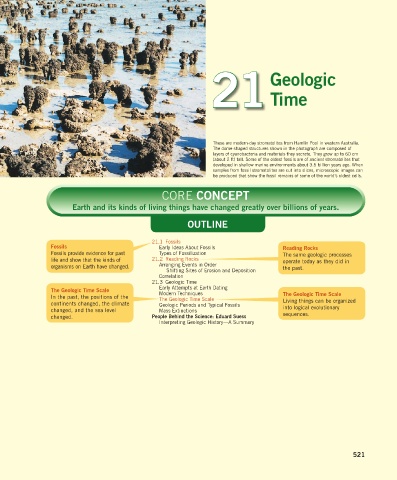
                                                                               These are modern-day stromatolites from Hamlin Pool in western  Australia.
                                                                               The dome-shaped structures shown in the photograph are composed of
                                                                               layers of cyanobacteria and materials they secrete. They grow up to 60 cm
                                                                               (about 2 ft) tall. Some of the oldest fossils are of ancient stromatolites that
                                                                               developed in shallow marine environments about 3.5 billion years ago. When
                                                                               samples from fossil stromatolites are cut into slices, microscopic images can
                                                                               be produced that show the fossil remains of some of the world’s oldest cells.


                                                              CORE CONCEPT

                                Earth and its kinds of living things have changed greatly over billions of years.

                                                                      OUTLINE


                                                          21.1 Fossils
                         Fossils                             Early Ideas About Fossils                Reading Rocks
                         Fossils provide evidence for past   Types of Fossilization                   The same geologic processes
                         life and show that the kinds of   21.2 Reading Rocks                         operate today as they did in
                         organisms on Earth have changed.    Arranging Events in Order                the past.
                                                               Shifting Sites of Erosion and Deposition
                                                             Correlation
                                                          21.3 Geologic Time
                                                             Early Attempts at Earth Dating
                           The Geologic Time Scale           Modern Techniques
                         In the past, the positions of the   The Geologic Time Scale                    The Geologic Time Scale
                         continents changed, the climate     Geologic Periods and Typical Fossils     Living things can be organized
                         changed, and the sea level          Mass Extinctions                         into logical evolutionary
                         changed.                         People Behind the Science: Eduard Suess     sequences.
                                                             Interpreting Geologic History—A Summary


                                                                                                                             521

