


Page 546 - 9780077418427.pdf
P. 546
/Volume/201/MHDQ233/tat78194_disk1of1/0073378194/tat78194_pagefile
          tiL12214_ch21_521-540.indd Page 523  9/23/10  11:09 AM user-f465
          tiL12214_ch21_521-540.indd Page 523  9/23/10  11:09 AM user-f465             /Volume/201/MHDQ233/tat78194_disk1of1/0073378194/tat78194_pagefiles


                                                                               Renaissance scholars, argued that fossils were the remains of
                                                                               organisms that had lived in the past.
                                                                                  By the early 1800s, the true nature of fossils was becoming
                                                                               widely accepted. William “Strata” Smith, an English surveyor,
                                                                               discovered at this time that sedimentary rock strata could be
                                                                               identified by the fossils they contained. Smith grew up in a
                                                                                 region of England where fossils were particularly plentiful. He
                                                                                 became a collector, keeping careful notes on where he found
                                                                               each fossil and in which type of sedimentary rock layers.  During
                                                                               his travels, he discovered that the succession of rock layers on
                                                                               the south coast of England was the same as the succession of
                                                                               rock layers on the east coast. Through his keen observations,
                                                                               Smith found that each kind of sedimentary rock had a distinc-
                                                                               tive group of fossils that was unlike the group of fossils in other
                                                                               rock layers. Smith amazed his friends by telling them where and
                                                                               in what type of rock they had found their fossils.
                                                                                  Today, the science of discovering fossils, studying the fos-
                                                                               sil record, and deciphering the history of life from fossils is
                                                                               known as paleontology. The word paleontology was invented
                                                                               in 1838 by the British geologist Charles Lyell to describe this
                                                                               newly established branch of geology. It is derived from clas-
                                                                               sic Greek roots and means “study of ancient life,” and this
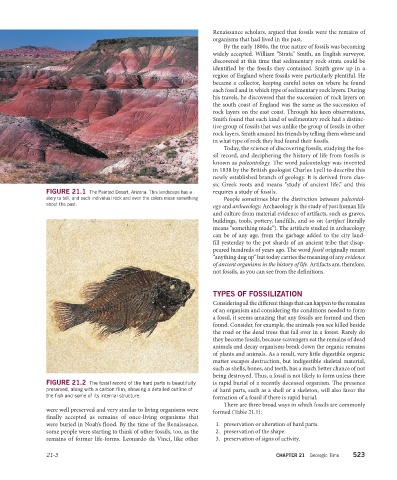
                       FIGURE 21.1  The Painted Desert, Arizona. This landscape has a     requires a study of fossils.
                       story to tell, and each individual rock and even the colors mean something   People sometimes blur the distinction between paleontol-
                       about the past.
                                                                               ogy and archaeology. Archaeology is the study of past human life
                                                                               and culture from material evidence of artifacts, such as graves,
                                                                               buildings, tools, pottery, landfills, and so on (artifact literally
                                                                               means “something made”). The artifacts studied in  archaeology
                                                                               can be of any age, from the garbage added to the city land-
                                                                               fill yesterday to the pot shards of an ancient tribe that disap-
                                                                               peared hundreds of years ago. The word fossil originally meant
                                                                                 “anything dug up” but today carries the meaning of any evidence
                                                                               of  ancient organisms in the history of life. Artifacts are, therefore,
                                                                               not  fossils, as you can see from the definitions.


                                                                               TYPES OF FOSSILIZATION
                                                                               Considering all the different things that can happen to the  remains
                                                                               of an organism and considering the conditions needed to form
                                                                               a fossil, it seems amazing that any fossils are formed and then
                                                                               found. Consider, for example, the animals you see killed beside
                                                                               the road or the dead trees that fall over in a forest. Rarely do
                                                                               they become fossils, because scavengers eat the remains of dead
                                                                                 animals and decay organisms break down the organic  remains
                                                                               of plants and animals. As a result, very little digestible organic
                                                                               matter escapes destruction, but indigestible skeletal material,
                                                                               such as shells, bones, and teeth, has a much better chance of not
                                                                               being destroyed. Thus, a fossil is not likely to form unless there
                        FIGURE 21.2  The fossil record of the hard parts is beautifully   is rapid burial of a recently deceased organism. The presence
                        preserved, along with a carbon film, showing a detailed outline of   of hard parts, such as a shell or a skeleton, will also favor the
                        the fish and some of its internal structure.           formation of a fossil if there is rapid burial.
                                                                                  There are three broad ways in which fossils are commonly
                       were well preserved and very similar to living organisms were
                                                                               formed (Table 21.1):
                       finally accepted as remains of once-living organisms that
                       were buried in Noah’s flood. By the time of the Renaissance,     1.  preservation or alteration of hard parts.
                       some people were starting to think of other fossils, too, as the     2.  preservation of the shape.
                       remains of former life-forms. Leonardo da Vinci, like other     3.  preservation of signs of activity.

                       21-3                                                                         CHAPTER 21  Geologic Time   523

