


Page 547 - 9780077418427.pdf
P. 547
/Volume/201/MHDQ233/tat78194_disk1of1/0073378194/tat78194_pagefiles
          tiL12214_ch21_521-540.indd Page 524  9/23/10  11:09 AM user-f465
          tiL12214_ch21_521-540.indd Page 524  9/23/10  11:09 AM user-f465             /Volume/201/MHDQ233/tat78194_disk1of1/0073378194/tat78194_pagefile


                    TABLE 21.1

                    Summary of the types of fossil preservation
                      I.  Preservation of all or part of the organism
                       A.  Unaltered
                          1.  Soft parts
                          2.  Hard parts
                       B.  Altered
                          1.  Mineralization
                          2.  Replacement
                          3.  Carbon films
                     II.  Preservation of the organism’s shape
                       A.  Cast
                       B.  Mold
                      III. Signs of activity
                       A.  Tracks
                       B.  Trails
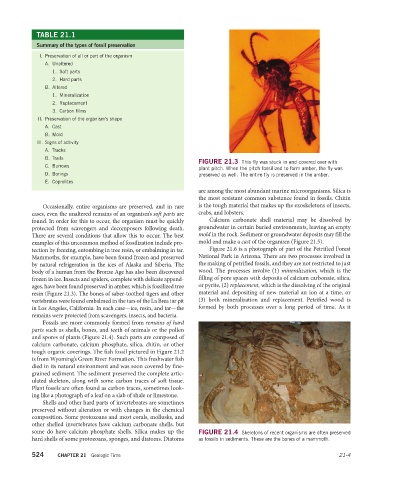
                                                                          FIGURE 21.3  This fly was stuck in and covered over with
                       C.  Burrows
                                                                          plant pitch. When the pitch fossilized to form amber, the fly was
                       D.  Borings                                        preserved as well. The entire fly is preserved in the amber.
                       E.  Coprolites
                                                                          are among the most abundant marine microorganisms. Silica is
                                                                          the most resistant common substance found in fossils. Chitin
                      Occasionally, entire organisms are preserved, and in rare   is the tough material that makes up the exoskeletons of insects,
                   cases, even the unaltered remains of an organism’s soft parts are   crabs, and lobsters.
                   found. In order for this to occur, the organism must be quickly   Calcium carbonate shell material may be dissolved by
                   protected from scavengers and decomposers following death.   groundwater in certain buried environments, leaving an empty
                   There are several conditions that allow this to occur. The best   mold in the rock. Sediment or groundwater deposits may fill the
                     examples of this uncommon method of fossilization include pro-  mold and make a cast of the organism (Figure 21.5).
                   tection by freezing, entombing in tree resin, or embalming in tar.   Figure 21.6 is a photograph of part of the Petrified Forest
                   Mammoths, for example, have been found frozen and preserved   National Park in Arizona. There are two processes involved in
                   by natural refrigeration in the ices of Alaska and Siberia. The   the making of petrified fossils, and they are not restricted to just
                   body of a human from the Bronze Age has also been discovered   wood. The processes involve (1) mineralization, which is the
                   frozen in ice. Insects and spiders, complete with delicate append-    filling of pore spaces with deposits of calcium carbonate, silica,
                   ages, have been found preserved in amber, which is  fossilized tree   or pyrite, (2) replacement, which is the dissolving of the  original
                   resin (Figure 21.3). The bones of  saber-toothed tigers and other   material and depositing of new material an ion at a time, or
                   vertebrates were found embalmed in the tars of the La Brea tar pit   (3) both mineralization and replacement. Petrified wood is
                   in Los Angeles,  California. In each case—ice, resin, and tar—the   formed by both processes over a long period of time. As it
                   remains were protected from scavengers,  insects, and bacteria.
                      Fossils are more commonly formed from remains of hard
                   parts such as shells, bones, and teeth of animals or the pollen
                   and spores of plants (Figure 21.4). Such parts are composed of
                   calcium carbonate, calcium phosphate, silica, chitin, or other
                   tough organic coverings. The fish fossil pictured in Figure 21.2
                   is from Wyoming’s Green River Formation. This freshwater fish
                   died in its natural environment and was soon covered by fine-
                   grained sediment. The sediment preserved the complete artic-
                   ulated skeleton, along with some carbon traces of soft tissue.
                   Plant  fossils are often found as carbon traces, sometimes look-
                   ing like a photograph of a leaf on a slab of shale or limestone.
                      Shells and other hard parts of invertebrates are sometimes
                   preserved without alteration or with changes in the chemical
                   composition. Some protozoans and most corals, mollusks, and
                   other shelled invertebrates have calcium carbonate shells, but
                   some do have calcium phosphate shells. Silica makes up the   FIGURE 21.4  Skeletons of recent organisms are often preserved
                   hard shells of some protozoans, sponges, and diatoms. Diatoms   as fossils in sediments. These are the bones of a mammoth.

                   524     CHAPTER 21 Geologic Time                                                                     21-4

