


Page 548 - 9780077418427.pdf
P. 548
/Volume/201/MHDQ233/tat78194_disk1of1/0073378194/tat78194_pagefile
          tiL12214_ch21_521-540.indd Page 525  9/23/10  11:09 AM user-f465
          tiL12214_ch21_521-540.indd Page 525  9/23/10  11:09 AM user-f465             /Volume/201/MHDQ233/tat78194_disk1of1/0073378194/tat78194_pagefiles


                                                                                  Finally, there are many kinds of fossils that are not the pre-
                                                                               served remains of an organism but are preserved indications of
                                                                               the activities of organisms. Some of the most interesting of such
                                                                 Mold          fossils are the footprints of various kinds of animals. There are
                                                                               examples of footprints of dinosaurs and various kinds of extinct
                                                                               mammals, including ancestors of humans. If an animal walked
                                                              Rock split to
                                                              reveal mold      through mud or other soft substrates and the substrates were
                                                                               covered with silt or volcanic ash, the pattern of the footprints
                               Shell         Shell dissolved                   can be preserved. The tunnels of burrowing animals, the inden-
                              buried          (void space)
                                                                               tations left by crawling worms, and the nests of dinosaurs have
                                                                               been preserved in a similar manner. Even the eggs of dinosaurs
                          A
                                                                               and other animals have been preserved in a mineralized form.
                                                                                  As you can see, there are many different ways in which a
                                                                     Cast        fossil can be formed, but it must be found and studied if it is
                                                                               to  reveal its part in the history of life. This means the rocks in
                                                                               which the fossil formed must now somehow make it back to the
                                                                               surface of Earth. This usually involves movement and uplift of
                                                              Rock split to    the rock and weathering and erosion of the surrounding rock
                                                              reveal cast
                            Shell   Shell dissolved  Sediment                  to  release or reveal the fossil. Most fossils are found in recently
                            buried   (void space)  deposited                   eroded sedimentary rocks—sometimes atop mountains that
                                                  into void                    were under the ocean a long, long time ago. The complete record
                          B                        space                       of what has happened in the past is not found in the  fossil alone
                                                                               but requires an understanding of the layers of rocks  present, the
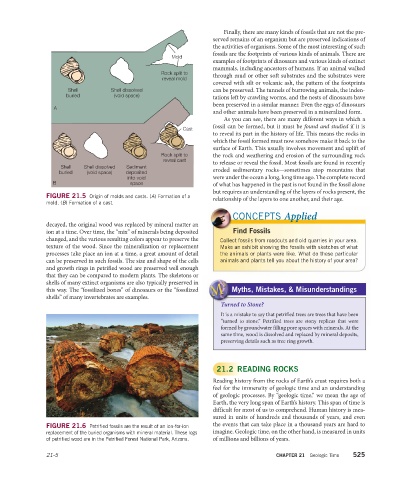
                       FIGURE 21.5  Origin of molds and casts. (A) Formation of a
                                                                               relationship of the layers to one another, and their age.
                       mold. (B) Formation of a cast.
                                                                                     CONCEPTS Applied
                         decayed, the original wood was replaced by mineral  matter an
                       ion at a time. Over time, the “mix” of minerals being deposited   Find Fossils
                       changed, and the various  resulting colors appear to preserve the   Collect fossils from roadcuts and old quarries in your area.
                       texture of the wood. Since the mineralization or replacement   Make an exhibit showing the fossils with sketches of what
                       processes take place an ion at a time, a great amount of detail   the animals or plants were like. What do these particular
                       can be preserved in such fossils. The size and shape of the cells   animals and plants tell you about the history of your area?
                       and growth rings in petrified wood are preserved well enough
                       that they can be compared to modern plants. The skeletons or
                       shells of many extinct organisms are also typically preserved in
                       this way. The “fossilized bones” of dinosaurs or the “fossilized   Myths, Mistakes, & Misunderstandings
                       shells” of many invertebrates are examples.
                                                                                 Turned to Stone?
                                                                                 It is a mistake to say that petrified trees are trees that have been
                                                                                 “turned to stone.” Petrified trees are stony replicas that were
                                                                                 formed by groundwater filling pore spaces with minerals. At the
                                                                                 same time, wood is dissolved and replaced by mineral deposits,
                                                                                 preserving details such as tree ring growth.


                                                                                21.2 READING ROCKS

                                                                               Reading history from the rocks of Earth’s crust requires both a
                                                                               feel for the immensity of geologic time and an understanding
                                                                               of geologic processes. By “geologic time,” we mean the age of
                                                                               Earth, the very long span of Earth’s history. This span of time is
                                                                               difficult for most of us to comprehend. Human history is mea-
                                                                               sured in units of hundreds and thousands of years, and even
                                                                               the events that can take place in a thousand years are hard to
                       FIGURE 21.6  Petrified fossils are the result of an ion-for-ion
                         replacement of the buried organisms with mineral material. These logs   imagine. Geologic time, on the other hand, is measured in units
                       of petrified wood are in the Petrified Forest National Park, Arizona.  of millions and billions of years.

                       21-5                                                                         CHAPTER 21  Geologic Time   525

