


Page 573 - 9780077418427.pdf
P. 573
/Volume/201/MHDQ233/tat78194_disk1of1/0073378194/tat78194_pagefile
          tiL12214_ch22_541-564.indd Page 550  9/23/10  11:08 AM user-f465
          tiL12214_ch22_541-564.indd Page 550  9/23/10  11:08 AM user-f465             /Volume/201/MHDQ233/tat78194_disk1of1/0073378194/tat78194_pagefiles


                           A Closer Look


                           The Windchill Factor
                        he term  windchill is attributed to the   an average height of 1.5 m (5 ft) above the   you feel cooler. How much cooler depends
                     TAntarctic explorer Paul A. Siple. During   ground, which is closer to the height of a hu-  on how fast the air is moving and the outside
                     the 1940s, Siple and Charles F. Passel con-  man face than the height of an anemometer   temperature—which is what the windchill
                     ducted experiments on how long it took a can   and takes advantage of  advances in science,   factor tells you. Thus, windchill is an attempt
                     of water to freeze at various temperatures and   technology, and computers. The new chart   to measure the combined effect of low
                     wind speeds at a height of 10 m (33 ft) above   also highlights the danger of frostbite.  temperature and wind on humans (Box
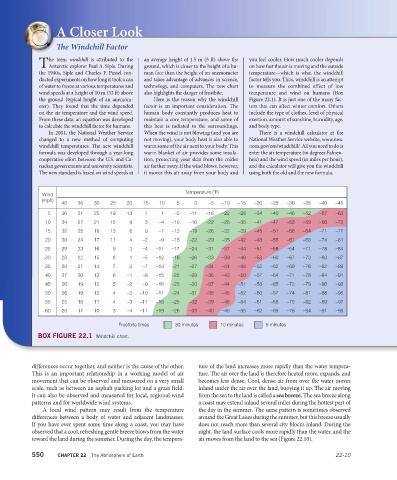
                     the ground (typical height of an anemom-  Here is the reason why the windchill   Figure 22.1). It is just one of the many fac-
                     eter). They found that the time depended   factor is an important consideration. The   tors that can affect winter comfort. Others
                     on the air temperature and the wind speed.   human body constantly produces heat to   include the type of clothes, level of physical
                     From these data, an equation was developed   maintain a core temperature, and some of   exertion, amount of sunshine, humidity, age,
                     to calculate the windchill factor for humans.  this heat is radiated to the surroundings.   and body type.
                        In 2001, the National Weather Service   When the wind is not blowing (and you are   There is a windchill calculator at the
                     changed to a new method of computing   not moving), your body heat is also able to   National Weather Service website, www.nws.
                     windchill temperatures. The new windchill   warm some of the air next to your body. This   noaa.gov/om/windchill/. All you need to do is
                     formula was developed through a year-long   warm blanket of air provides some insula-  enter the air temperature (in degrees Fahren-
                       cooperative effort between the U.S. and Ca-  tion, protecting your skin from the colder   heit) and the wind speed (in miles per hour),
                     nadian governments and university  scientists.   air farther away. If the wind blows, however,   and the calculator will give you the windchill
                     The new standard is based on wind speeds at   it moves this air away from your body and   using both the old and the new formula.


                      Wind                                           Temperature (˚F)
                      (mph)  40   35   30    25   20    15   10    5     0   –5   –10  –15  –20   –25  –30   –35  –40  –45

                        5    36   31   25    19   13    7     1   –5   –11  –16   –22  –28  –34   –40  –46   –52  –57  –63
                       10    34   27   21    15    9    3    –4  –10   –16  –22   –28  –35  –41   –47  –53   –59  –66  –72
                       15    32   25   19    13    6    0    –7  –13   –19  –26   –32  –39  –45   –51  –58   –64  –71  –77
                       20    30   24   17    11    4   –2    –9  –15   –22  –29   –35  –42  –48   –55  –61   –68  –74  –81
                       25    29   23   16     9    3   –4   –11  –17   –24  –31   –37  –44  –51   –58  –64   –71  –78  –84
                       30    28   22   15     8    1   –5   –12  –19   –26  –33   –39  –46  –53   –60  –67   –73  –80  –87
                       35    28   21   14     7    0   –7   –14  –21   –27  –34   –41  –48  –55   –62  –69   –76  –82  –89
                       40    27   20   13     6   –1   –8   –15  –22   –29  –36   –43  –50  –57   –64  –71   –78  –84  –91
                       45    26   19   12     5   –2   –9   –16  –23   –30  –37   –44  –51  –58   –65  –72   –79  –86  –93
                       50    26   19   12     4   –3  –10   –17  –24   –31  –38   –45  –52  –60   –67  –74   –81  –88  –95
                       55    25   18   11     4   –3  –11   –18  –25   –32  –39   –46  –54  –61   –68  –75   –82  –89  –97
                       60    25   17   10     3   –4  –11   –19  –26   –33  –40   –48  –55  –62   –69  –76   –84  –91  –98

                                               Frostbite times    30 minutes     10 minutes     5 minutes

                     BOX FIGURE 22.1  Windchill chart.


                   differences occur together, and neither is the cause of the other.   ture of the land increases more rapidly than the  water tempera-
                   This is an important relationship in a working model of air   ture. The air over the land is therefore heated more, expands, and
                   movement that can be observed and measured on a very small   becomes less dense. Cool, dense air from over the water moves
                   scale, such as between an asphalt parking lot and a grass field.     inland under the air over the land, buoying it up. The air moving
                   It can also be observed and measured for local,  regional wind   from the sea to the land is called a sea breeze. The sea breeze along
                   patterns and for worldwide wind systems.               a coast may extend inland several miles during the hottest part of
                      A local wind pattern may result from the temperature   the day in the summer. The same  pattern is sometimes observed
                     differences between a body of water and adjacent landmasses.   around the Great Lakes during the summer, but this breeze usually
                   If you have ever spent some time along a coast, you may have   does not reach more than several city blocks  inland. During the
                     observed that a cool, refreshing gentle breeze blows from the  water   night, the land surface cools more rap idly than the water, and the
                   toward the land during the summer. During the day, the tempera-  air moves from the land to the sea (Figure 22.10).

                   550     CHAPTER 22  The Atmosphere of Earth                                                         22-10

