


Page 579 - 9780077418427.pdf
P. 579
/Volume/201/MHDQ233/tat78194_disk1of1/0073378194/tat78194_pagefiles
          tiL12214_ch22_541-564.indd Page 556  9/23/10  11:08 AM user-f465
          tiL12214_ch22_541-564.indd Page 556  9/23/10  11:08 AM user-f465             /Volume/201/MHDQ233/tat78194_disk1of1/0073378194/tat78194_pagefile


                   the surrounding air with a lower moisture content. The white trail   cific heat, may be involved, but overall, frost and dew are more
                   behind a high-flying jet aircraft is also a result of condensation   likely to form on grass and low-lying shrubs before they form
                   of water vapor. Water is one of the products of combustion, and   on the flat, bare ground.
                   the white trail is condensed water vapor, a trail of tiny droplets of   Dew and frost form in low-lying areas before forming on
                   water in the cold upper atmo sphere. The trail of water droplets is   slopes and the sides of hills because of the density differences of
                   called a contrail  after “condensation trail.” Back on the surface, a   cool and warm air. Cool air is denser than warm air and is moved
                   cold glass of beverage seems to “sweat” as water vapor molecules   downhill by gravity, pooling in low-lying areas. You may have no-
                   near the outside of the glass are cooled, moving more slowly.   ticed the different temperatures of low-lying areas if you have ever
                   Slowly moving water vapor molecules spend more time closer to-  driven across hills and valleys on a clear, calm, and cool evening.
                   gether, and the molecular forces between the molecules pull them   Citrus and other orchards are often located on slopes of hills rather
                   together, forming a thin layer of liquid water on the outside of the   than on valley floors because of the gravity drainage of cold air.
                   cold glass. This same condensation process sometimes results in   It is air near the surface that is cooled first by the loss of ra-
                   a small stream of water from the cold air conditioning coils of an   diation from the surface. Calm nights favor dew or frost forma-
                   automobile or home mechanical air conditioner.         tion because the wind mixes the air near the surface that is being
                      As air is cooled, the evaporation rate decreases faster than   cooled with warmer air above the surface. If you have ever driven
                   the condensation rate. Even without water vapor being added to   near a citrus orchard, you may have noticed the huge, propellerlike
                   the air, a temperature will eventually be reached at which satu-  fans situated throughout the orchard on poles. These fans are used
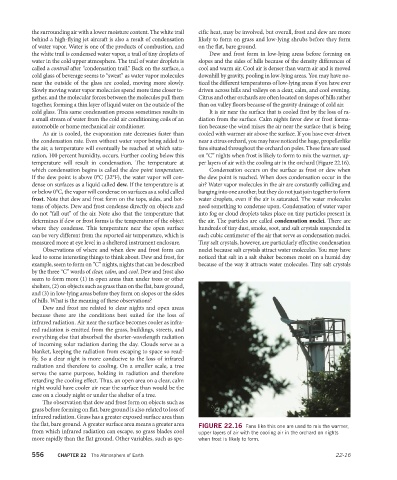
                   ration, 100 percent humidity, occurs. Further cooling below this   on “C” nights when frost is likely to form to mix the warmer, up-
                   temperature will result in condensation. The temperature at   per layers of air with the cooling air in the orchard (Figure 22.16).
                   which condensation begins is called the dew point temperature.   Condensation occurs on the surface as frost or dew when
                   If the dew point is above 0°C (32°F), the water vapor will con-  the dew point is reached. When does condensation occur in the
                   dense on surfaces as a liquid called dew. If the temperature is at   air? Water vapor molecules in the air are constantly colliding and
                   or  below 0°C, the vapor will condense on surfaces as a solid called   banging into one another, but they do not just join together to form
                   frost. Note that dew and frost form on the tops, sides, and bot-  water droplets, even if the air is saturated. The water molecules
                   toms of objects. Dew and frost condense directly on objects and   need something to condense upon. Condensation of water vapor
                   do not “fall out” of the air. Note also that the temperature that   into fog or cloud droplets takes place on tiny  particles present in
                   determines if dew or frost forms is the temperature of the object   the air. The particles are called condensation  nuclei. There are
                   where they condense. This temperature near the open surface   hundreds of tiny dust, smoke, soot, and salt crystals suspended in
                   can be very different from the reported air temperature, which is   each cubic centimeter of the air that serve as condensation nuclei.
                   mea sured more at eye level in a sheltered instrument enclosure.  Tiny salt crystals, however, are particularly effective condensation
                      Observations of where and when dew and frost form can   nuclei because salt crystals attract water molecules. You may have
                   lead to some interesting things to think about. Dew and frost, for   noticed that salt in a salt shaker becomes moist on a humid day
                   example, seem to form on “C” nights, nights that can be described   because of the way it attracts water molecules. Tiny salt crystals
                   by the three “C” words of clear, calm, and cool. Dew and frost also
                   seem to form more (1) in open areas than under trees or other
                   shelters, (2) on objects such as grass than on the flat, bare ground,
                   and (3) in low-lying areas before they form on slopes or the sides
                   of hills. What is the meaning of these observations?
                      Dew and frost are related to clear nights and open areas
                     because these are the conditions best suited for the loss of
                     infrared radiation. Air near the surface becomes cooler as infra-
                   red radiation is emitted from the grass, buildings, streets, and
                   everything else that absorbed the shorter-wavelength radiation
                   of  incoming solar radiation during the day. Clouds serve as a
                   blanket, keeping the radiation from escaping to space so read-
                   ily. So a clear night is more conducive to the loss of infrared
                   radiation and therefore to cooling. On a smaller scale, a tree
                   serves the same purpose, holding in radiation and therefore
                   retarding the cooling effect. Thus, an open area on a clear, calm
                   night would have cooler air near the surface than would be the
                   case on a cloudy night or under the shelter of a tree.
                      The observation that dew and frost form on objects such as
                   grass before forming on flat, bare ground is also related to loss of
                   infrared radiation. Grass has a greater exposed surface area than
                   the flat, bare ground. A greater surface area means a greater area   FIGURE 22.16  Fans like this one are used to mix the warmer,
                   from which infrared radiation can escape, so grass blades cool   upper layers of air with the cooling air in the orchard on nights
                   more rapidly than the flat ground. Other variables, such as spe-  when frost is likely to form.

                   556     CHAPTER 22  The Atmosphere of Earth                                                         22-16

