


Page 575 - 9780077418427.pdf
P. 575
/Volume/201/MHDQ233/tat78194_disk1of1/0073378194/tat78194_pagefile
          tiL12214_ch22_541-564.indd Page 552  9/23/10  11:08 AM user-f465
          tiL12214_ch22_541-564.indd Page 552  9/23/10  11:08 AM user-f465             /Volume/201/MHDQ233/tat78194_disk1of1/0073378194/tat78194_pagefiles


                                                                                                   Less direct
                                                                                                   sunlight
                                                                              Incoming solar radiation  Most direct sunlight


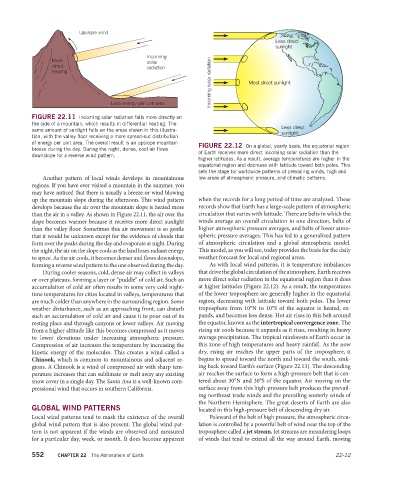
                   FIGURE 22.11  Incoming solar radiation falls more directly on
                   the side of a mountain, which results in differential heating. The                Less direct
                   same amount of sunlight falls on the areas shown in this illustra-                sunlight
                   tion, with the valley floor receiving a more spread-out distribution
                   of energy per unit area. The overall result is an upslope mountain   FIGURE 22.12  On a global, yearly basis, the equatorial region
                   breeze during the day. During the night, dense, cool air flows
                   downslope for a reverse wind pattern.                  of Earth receives more direct incoming solar radiation than the
                                                                          higher latitudes. As a result, average temperatures are higher in the
                                                                          equatorial region and decrease with latitude toward both poles. This
                                                                          sets the stage for worldwide patterns of prevailing winds, high and
                      Another pattern of local winds develops in mountainous   low areas of atmospheric pressure, and climatic patterns.
                     regions. If you have ever visited a mountain in the summer, you
                   may have noticed that there is usually a breeze or wind blowing
                   up the mountain slope during the afternoon. This wind pattern   when the records for a long period of time are analyzed. These
                   develops because the air over the mountain slope is heated more   records show that Earth has a large-scale pattern of atmospheric
                   than the air in a valley. As shown in Figure 22.11, the air over the     circulation that varies with latitude. There are belts in which the
                   slope becomes warmer because it receives more direct sunlight   winds average an overall circulation in one direction, belts of
                   than the valley floor. Sometimes this air movement is so gentle   higher atmospheric pressure averages, and belts of lower atmo-
                   that it would be unknown except for the evidence of clouds that   spheric pressure averages. This has led to a generalized pattern
                   form over the peaks during the day and evaporate at night. During   of atmospheric circulation and a global atmospheric model.
                   the night, the air on the slope cools as the land loses radiant energy   This model, as you will see, today provides the basis for the daily
                   to space. As the air cools, it becomes denser and flows downslope,   weather forecast for local and  regional areas.
                   forming a reverse wind pattern to the one observed during the day.  As with local wind patterns, it is temperature imbalances
                      During cooler seasons, cold, dense air may collect in valleys   that drive the global circulation of the atmosphere. Earth  receives
                   or over plateaus, forming a layer or “puddle” of cold air. Such an   more direct solar radiation in the equatorial region than it does
                   accumulation of cold air often results in some very cold night-  at higher latitudes (Figure 22.12). As a result, the temperatures
                   time temperatures for cities located in valleys, temperatures that   of the lower troposphere are generally higher in the equatorial
                   are much colder than anywhere in the surrounding region. Some   region, decreasing with latitude toward both poles. The lower
                   weather disturbance, such as an approaching front, can disturb   troposphere from 10°N to 10°S of the equator is heated, ex-
                   such an accumulation of cold air and cause it to pour out of its   pands, and becomes less dense. Hot air rises in this belt around
                   resting place and through canyons or lower valleys. Air moving   the equator, known as the intertropical  convergence zone. The
                   from a higher altitude like this becomes compressed as it moves   rising air cools because it expands as it rises,  resulting in heavy
                   to lower elevations under increasing atmospheric  pressure.   average precipitation. The tropical rainforests of Earth occur in
                   Compression of air increases the temperature by in creasing the   this zone of high temperatures and heavy  rainfall. As the now
                   kinetic energy of the molecules. This  creates a wind called a   dry, rising air reaches the upper parts of the troposphere, it
                   Chinook, which is common to mountainous and  adjacent re-    begins to spread toward the north and toward the south, sink-
                   gions. A Chinook is a wind of compressed air with sharp tem-  ing back toward Earth’s surface (Figure 22.13). The descending
                   perature increases that can sublimate or melt away any existing   air reaches the surface to form a high-pressure belt that is cen-
                   snow cover in a single day. The Santa Ana is a well-known com-  tered about 30°N and 30°S of the equator. Air moving on the
                   pressional wind that occurs in southern California.    surface away from this high-pressure belt produces the prevail-
                                                                          ing northeast trade winds and the prevailing westerly winds of
                                                                          the Northern Hemisphere. The great deserts of Earth are also
                   GLOBAL WIND PATTERNS                                     located in this high-pressure belt of descending dry air.
                   Local wind patterns tend to mask the existence of the overall   Poleward of the belt of high pressure, the atmospheric circu-
                   global wind pattern that is also present. The global wind pat-  lation is controlled by a powerful belt of wind near the top of the
                   tern is not apparent if the winds are observed and measured   troposphere called a jet stream. Jet streams are meandering loops
                   for a particular day, week, or month. It does become apparent   of winds that tend to extend all the way around Earth,  moving

                   552     CHAPTER 22  The Atmosphere of Earth                                                         22-12

