


Page 574 - 9780077418427.pdf
P. 574
/Volume/201/MHDQ233/tat78194_disk1of1/0073378194/tat78194_pagefile
          tiL12214_ch22_541-564.indd Page 551  9/23/10  11:08 AM user-f465
          tiL12214_ch22_541-564.indd Page 551  9/23/10  11:08 AM user-f465             /Volume/201/MHDQ233/tat78194_disk1of1/0073378194/tat78194_pagefiles


                                                                                  Science and Society


                                                                                                    Use Wind Energy?
                               illions of windmills were installed   farms,” which are large clusters of intercon-  Oregon, and Wyoming. Other states with
                          Min rural areas of the United States   nected wind turbines connected to a utility   a strong wind power potential include
                          between the late 1800s and the late 1940s.   power grid.             Kansas, Montana, Nebraska, Oklahoma,
                          These windmills used wind energy to pump      Many areas of the United States have   Iowa, Colorado, Michigan, and New York.
                          water, grind grain, or generate electricity.   a high potential for wind power use.   All of these states, in fact, have a greater
                          Some are still in use today, but most were   North Dakota, South Dakota, and Texas   wind energy potential than  California.
                          no longer needed  after inexpensive electric   have enough wind resources to provide
                          power became gen erally available in rural   electricity for the entire nation. Today, only
                                                                                               QUESTIONS TO DISCUSS
                          areas of the country.              California has extensively developed wind
                             In the 1970s, wind energy began mak-  farms, with more than 13,000 wind tur-  Discuss with your group the following
                          ing a comeback as a clean, renewable energy   bines on three wind farms in the Altamont   questions concerning wind power:
                          alternative to fossil fuels. The windmills of   Pass region (east of San  Francisco),
                                                                                                 1.  Why have electric utilities not used
                          the past were replaced by wind turbines of   Techachapi (southeast of  Bakersfield), and
                                                                                                  much wind power as an energy source?
                          today. A wind turbine is usually mounted   San Gorgonio (near Palm Springs). With a
                                                                                                 2.  Should governments provide a tax
                          on a tower, with blades that are rotated   total of 2,361 MW of  installed capacity in
                                                                                                  break to encourage people to use wind
                          by the wind. This rotary motion drives a   California, wind energy generates enough
                                                                                                  power? Why or why not?
                          generator that produces electricity. A loca-  electricity to more than meet the needs of
                          tion should have yearly wind speeds of at   a city the size of San  Francisco. The wind     3.  What are the advantages and disad-
                          least 19 km/h (12 mi/h) to provide enough   farms in  California have a rated capacity   vantages of using wind power in place
                          wind energy for a turbine, and a greater   that is comparable to two large coal-fired   of fossil fuels?
                          yearly average means more energy is avail-  power plants but without the pollution     4.  What are the advantages and
                          able. Farms, homes, and businesses in these   and limits of this non renewable energy   disadvantages of the government
                          locations can use smaller turbines, which   source. Wind energy makes economic as   building huge wind farms in North
                          are generally 50 kW or less. Large tur-  well as environmental sense, and new wind   Dakota, South Dakota, and Texas to
                          bines of 500 kW or more are used in “wind   farms are being developed in Minnesota,   supply electricity for the entire nation?


                                                                                A    Sea Breeze
                              CONCEPTS Applied

                              Why the Beach Is Cooler
                                                                                                                Low pressure
                          Adjacent areas of the surface can have different                 High pressure
                          temperatures  because of different heating or cooling rates.
                          The difference is very pronounced between adjacent areas
                          of land and water.  Under identical conditions of incoming
                          solar radiation, the  temperature changes experienced by
                          the water will be much less than the changes experienced
                          by the adjacent land. There are three principal reasons for   B    Land Breeze
                          this difference: (1) The specific heat of  water is about five
                          times the specific heat of soil. This means that it takes
                          more energy to increase the temperature of water than it
                          does for soil. Equal masses of soil and water  exposed to                              High pressure
                            sunlight will result in the soil heating about 5°C while the
                                                                                          Low pressure
                          water heats 1°C from  absorbing the same amount of solar
                          radiation. (2) Water is a  transparent fluid that is easily
                          mixed, so the incoming solar  radiation warms a body of
                          water throughout, spreading out the heating effect. But
                          incoming solar  radiation on land warms a relatively thin
                          layer on the top, concentrating the heating effect. (3) The
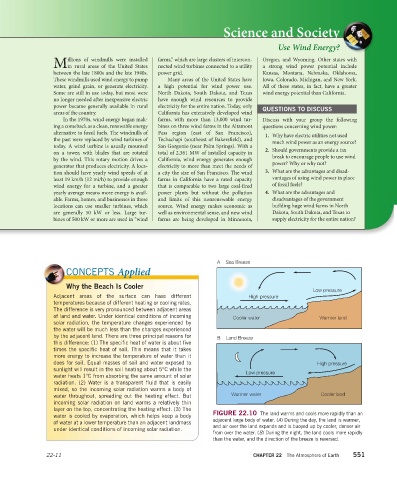
                                                                               FIGURE 22.10  The land warms and cools more rapidly than an
                          water is cooled by evaporation, which helps keep a body
                                                                               adjacent large body of water. (A) During the day, the land is warmer,
                          of water at a lower temperature than an adjacent landmass
                                                                               and air over the land expands and is buoyed up by cooler, denser air
                          under identical conditions of incoming solar radiation.
                                                                               from over the water. (B) During the night, the land cools more rapidly
                                                                               than the water, and the direction of the breeze is reversed.
                       22-11                                                                CHAPTER 22  The Atmosphere of Earth   551

