


Page 577 - 9780077418427.pdf
P. 577
/Volume/201/MHDQ233/tat78194_disk1of1/0073378194/tat78194_pagefile
          tiL12214_ch22_541-564.indd Page 554  9/23/10  11:08 AM user-f465
          tiL12214_ch22_541-564.indd Page 554  9/23/10  11:08 AM user-f465             /Volume/201/MHDQ233/tat78194_disk1of1/0073378194/tat78194_pagefiles


                                                                          “air has a lower capacity to hold water vapor” is an easy way to
                                                                          say that condensation exceeds evaporation, therefore decreasing
                                                                          the amount of water vapor in the atmosphere.


                                                                          Humidity
                                                                          The amount of water vapor is referred to generally as humidity.
                                                                          Damp, moist conditions are more likely to have condensation
                                                                          than evaporation, and this is said to be a high humidity. Dry
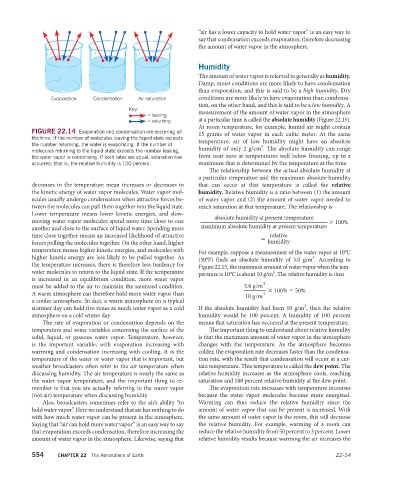
                         Evaporation   Condensation   Air saturation      conditions are more likely to have evaporation than condensa-
                                                                          tion, on the other hand, and this is said to be a low  humidity. A
                                                   Key:
                                                         = leaving        measurement of the amount of water vapor in the atmosphere
                                                         = returning      at a particular time is called the absolute  humidity ( Figure 22.15).
                                                                          At room temperature, for example, humid air might contain
                   FIGURE 22.14  Evaporation and condensation are occurring all
                                                                          15 grams of water vapor in each cubic meter. At the same
                   the time. If the number of molecules leaving the liquid state exceeds   temperature, air of low humidity might have an absolute
                   the number returning, the water is evaporating. If the number of            3
                                                                          humidity of only 2 g/cm . The absolute humidity can range
                   molecules returning to the liquid state exceeds the number leaving,
                   the water vapor is condensing. If both rates are equal, saturation has   from near zero at temperatures well below freezing, up to a
                   occurred; that is, the relative humidity is 100 percent.  maximum that is determined by the temperature at the time.
                                                                             The relationship between the actual absolute humidity at
                                                                          a particular temperature and the maximum absolute humidity
                   decreases in the temperature mean increases or decreases in   that can occur at that temperature is called the  relative
                   the kinetic energy of water vapor molecules. Water vapor mol-  humidity.  Relative humidity is a ratio between (1) the amount
                   ecules usually undergo condensation when attractive forces be-  of water  vapor and (2) the amount of water vapor needed to
                   tween the molecules can pull them together into the liquid state.   reach saturation at that temperature. The relationship is
                   Lower temperature means lower kinetic energies, and slow-   absolute humidity at present temperature
                   moving  water vapor molecules spend more time close to one   _____                                    ×


                                                                                                                    100%
                   another and close to the surface of liquid water. Spending more   maximum absolute humidity at present temperature
                   time close  together means an increased likelihood of attractive
                                                                                                  relative
                                                                                               =


                   forces pulling the molecules  together. On the other hand, higher             humidity
                   temperature means higher kinetic energies, and molecules with
                                                                          For example, suppose a measurement of the water vapor at 10°C
                   higher kinetic energy are less likely to be pulled together. As                              3
                                                                          (50°F) finds an absolute humidity of 5.0 g/m . According to
                   the temperature  increases, there is therefore less tendency for
                                                                          Figure 22.15, the maximum amount of water vapor when the tem-
                   water molecules to return to the liquid state. If the temperature               3
                                                                          perature is 10°C is about 10 g/m . The relative humidity is then
                   is  increased in an equilibrium condition, more water vapor
                                                                                               3
                   must be added to the air to maintain the saturated condition.         5.0 g ∕ m
                                                                                         _
                                                                                                     × 100% = 50%

                   A warm atmosphere can therefore hold more water vapor than                  3
                                                                                         10 g ∕ m
                   a cooler atmosphere. In fact, a warm atmosphere on a typical
                                                                                                             3
                   summer day can hold five times as much water vapor as a cold   If the absolute humidity had been 10 g/m , then the relative
                   atmosphere on a cold winter day.                       humidity would be 100 percent. A humidity of 100 percent
                      The rate of evaporation or condensation depends on the   means that saturation has occurred at the present temperature.
                   temperature and some variables concerning the surface of the   The important thing to understand about relative humidity
                   solid, liquid, or gaseous water vapor. Temperature, however,   is that the maximum amount of water vapor in the atmosphere
                   is the important variable, with evaporation increasing with   changes with the temperature. As the atmosphere becomes
                   warming and condensation increasing with cooling. It is the   colder, the evaporation rate decreases faster than the condensa-
                   temperature of the water or water vapor that is important, but   tion rate, with the result that condensation will occur at a cer-
                   weather broadcasters often refer to the air temperature when   tain temperature. This temperature is called the dew point. The
                   discussing humidity. The air temperature is nearly the same as   relative humidity increases as the atmosphere cools, reaching
                   the water vapor temperature, and the important thing to re-  saturation and 100 percent relative humidity at the dew point.
                   member is that you are actually referring to the waver vapor   The evaporation rate increases with temperature increases
                   (not air) temperature when discussing humidity.        because the water vapor molecules become more energized.
                      Also, broadcasters sometimes refer to the air’s ability “to   Warming can thus reduce the relative humidity since the
                   hold water vapor.” Here we understand that air has nothing to do   amount of water vapor that can be present is increased. With
                   with how much water vapor can be present in the atmosphere.   the same amount of water vapor in the room, this will decrease
                   Saying that “air can hold more water vapor” is an easy way to say   the relative humidity. For example, warming of a room can
                   that evaporation exceeds condensation, therefore  increasing the   reduce the relative humidity from 50 percent to 3 percent. Lower
                   amount of water vapor in the atmosphere. Likewise, saying that   relative humidity results because warming the air increases the
                   554     CHAPTER 22  The Atmosphere of Earth                                                         22-14

