


Page 578 - 9780077418427.pdf
P. 578
/Volume/201/MHDQ233/tat78194_disk1of1/0073378194/tat78194_pagefile
          tiL12214_ch22_541-564.indd Page 555  9/23/10  11:08 AM user-f465
          tiL12214_ch22_541-564.indd Page 555  9/23/10  11:08 AM user-f465             /Volume/201/MHDQ233/tat78194_disk1of1/0073378194/tat78194_pagefiles


                                                                               an equilibrium is reached between water vapor leaving the wick
                             45                                                and water vapor returning to the wick from the air. Since evapora-
                                                                               tion lowers the temperature, the depression of the temperature of
                             40                                                the wet-bulb thermometer is an indirect measure of the water
                                                                               vapor present in the air. The relative humidity can be determined
                                                                               by obtaining the dry- and wet-bulb temperature readings and
                             35
                                                                               referring to a relative humidity table such as the one found in
                                                                               appendix C. If the humidity is 100 percent, no net evaporation will
                          Absolute humidity (g/m 3 )  25                       peratures will be the same. The lower the humidity, the greater the
                             30
                                                                               take place from the wet bulb, and both wet- and dry-bulb tem-
                                                                               difference in the temperature reading of the two thermometers.
                                                                                  You may have noticed that your hair becomes more or
                                                                               less curly in humid weather. The human hair absorbs mois-
                             20
                                                                               dry air. Since the change of length is proportional to changes
                             15                                                ture from the air, becoming longer in humid air and shorter in
                                                                               in humidity, it is possible to use human hair to measure the
                                                                               humidity. A hair hygrom eter is an instrument that measures
                             10                                                the humidity from changes in the length of hair. A bundle of
                                                                               the hair is held under tension by a spring, and changes in the
                              5                                                length move a pointer on a dial that is calibrated to read the
                                                                                relative humidity.
                              0
                              –20   –10   0    10   20    30   40    50
                                                                                     CONCEPTS Applied
                                              Temperature (°C)
                                                                                     Humidity Factors
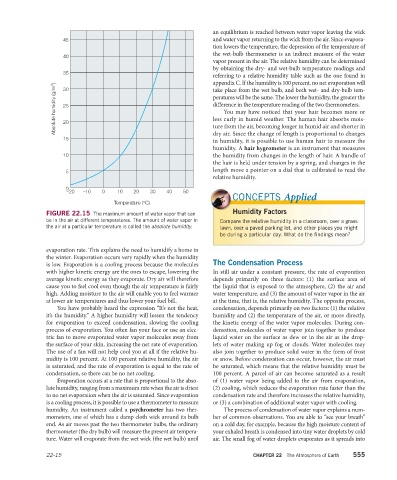
                       FIGURE 22.15  The maximum amount of water vapor that can
                       be in the air at different temperatures. The amount of water vapor in   Compare the relative humidity in a classroom, over a grass
                       the air at a particular temperature is called the absolute humidity.  lawn, over a paved parking lot, and other places you might
                                                                                 be during a particular day. What do the findings mean?

                       evaporation rate. This explains the need to humidify a home in
                       the winter. Evaporation occurs very rapidly when the humidity
                       is low. Evaporation is a cooling process because the molecules   The Condensation Process
                       with higher kinetic energy are the ones to escape, lowering the   In still air under a constant pressure, the rate of evaporation
                       average kinetic energy as they evaporate. Dry air will therefore   depends primarily on three factors: (1) the surface area of
                       cause you to feel cool even though the air temperature is fairly   the liquid that is exposed to the atmosphere, (2) the air and
                       high. Adding moisture to the air will enable you to feel warmer   water temperature, and (3) the amount of water vapor in the air
                       at lower air temperatures and thus lower your fuel bill.  at the time, that is, the relative humidity. The opposite process,
                           You have probably heard the expression “It’s not the heat,   condensation, depends primarily on two factors: (1) the relative
                       it’s the humidity.” A higher humidity will lessen the tendency   humidity and (2) the temperature of the air, or more  directly,
                       for evaporation to exceed condensation, slowing the cooling   the kinetic energy of the water vapor molecules. During con-
                       process of evaporation. You often fan your face or use an elec-  densation,  molecules of water vapor join together to produce
                       tric fan to move evaporated water vapor molecules away from   liquid water on the surface as dew or in the air as the drop-
                       the surface of your skin, increasing the net rate of evaporation.   lets of water making up fog or clouds. Water molecules may
                       The use of a fan will not help cool you at all if the relative hu-  also join  together to produce solid water in the form of frost
                       midity is 100 percent. At 100 percent relative humidity, the air   or snow.  Before condensation can occur, however, the air must
                       is saturated, and the rate of evaporation is equal to the rate of   be saturated, which means that the relative humidity must be
                       condensation, so there can be no net cooling.           100 percent. A parcel of air can become saturated as a result
                           Evaporation occurs at a rate that is proportional to the abso-  of (1) water vapor being added to the air from evaporation,
                       lute humidity, ranging from a maximum rate when the air is driest   (2) cooling, which reduces the evaporation rate faster than the
                       to no net evaporation when the air is saturated. Since  evaporation   condensation rate and therefore increases the relative humidity,
                       is a cooling process, it is possible to use a thermometer to measure   or (3) a combination of additional  water vapor with cooling.
                       humidity. An instrument called a  psychrometer has two ther-  The process of condensation of water vapor explains a num-
                       mometers, one of which has a damp cloth wick around its bulb   ber of common observations. You are able to “see your breath”
                       end. As air moves past the two thermometer bulbs, the ordinary   on a cold day, for example, because the high moisture content of
                       thermometer (the dry bulb) will measure the present air tempera-  your exhaled breath is condensed into tiny water droplets by cold
                       ture. Water will evaporate from the wet wick (the wet bulb) until   air. The small fog of water droplets evaporates as it spreads into

                       22-15                                                                CHAPTER 22  The Atmosphere of Earth   555

