


Page 623 - 9780077418427.pdf
P. 623
/Volume/201/MHDQ233/tat78194_disk1of1/0073378194/tat78194_pagefiles
          tiL12214_ch24_597-622.indd Page 600  9/23/10  11:08 AM user-f465
          tiL12214_ch24_597-622.indd Page 600  9/23/10  11:08 AM user-f465             /Volume/201/MHDQ233/tat78194_disk1of1/0073378194/tat78194_pagefile


                           Science and Society


                           Water Quality
                          hat do you think of when you see a     Indeed, water fit for use in a power plant   as carbon dioxide and nitrogen. Examples
                     Wstream? Do you wonder how deep it   might not be suitable for irrigation. Water   of persistent pollutants include some pesti-
                     is? Do you think of something to do with   quality is determined by the kinds and   cides, petroleum and petroleum products,
                     the water, such as swimming, fishing, or   amounts of substances dissolved and sus-  plastic materials, leached chemicals from
                     having a good time? As you might imagine,   pended in the water and the consequences   landfill sites, oil-based paints, heavy metals
                     not all people look at a stream and think   to users. Whether a source of water can be   and metal compounds such as lead, mercury,
                     about the same thing. A city engineer, for   used for drinking water or not, for example,   and cadmium, and certain radioactive ma-
                     example, might wonder if the stream has   is regulated by stringent rules and guidelines   terials. The damage they cause is either irre-
                     enough water to serve as a source to supple-  about what cannot be in the  water. These   versible or reparable only over long periods.
                     ment the city water supply. A rancher or   rules are designed to protect human health
                     farmer might wonder how the stream could   but do not call for absolutely pure water.
                     be easily diverted to serve as a source of      The water of even the healthiest stream
                                                                                          QUESTIONS TO DISCUSS
                     water for irrigation. An electric utility plan-  is not absolutely pure. All water contains
                     ner, on the other hand, might wonder if the   many naturally occurring substances such   Discuss with your group the following
                     stream could serve as a source of power.  as ions of bicarbonates, calcium, and magne-  questions concerning water quality:
                        Water in a stream is a resource that   sium. A pollutant is not naturally occurring;
                                                                                           1.  Which water use requires the purest wa-
                     can be used many different ways, but using   it is usually a waste material that contami-
                                                                                              ter? Which use requires the least pure?
                     it  requires knowing about the water qual-  nates air, soil, or water. There are basically
                     ity as well as quantity. We need to know if   two types of water pollutants: degradable    2.  Create a hierarchy of possible water
                     the quality of the water is good enough for   and persistent. Examples of degradable pol-  uses; for example, can water used in a
                     the intended use—and different uses have   lutants include sewage, fertilizers, and some   power plant later be recycled for agri-
                     different requirements. Water fit for use in   industrial wastes. As the term implies,   culture? Recycled for domestic use?
                     an electric power plant, for example, might   degradable pollutants can be broken down    3.  What can an individual do to improve
                     not be suitable for use as a city water supply.   into simple, nonpolluting substances such   water quality?


                   SURFACE WATER                                          stream is known as the stream’s drainage basin, or watershed.
                   If you could follow the smallest of streams downhill, you   Each stream has its own watershed, but the watershed of a large
                   would find that it eventually merges with other streams until   river includes all the watersheds of the smaller streams that feed
                   they merge to form a major river. The land area drained by a   into the larger river. Figure 24.5 shows the watersheds of the
                                                                          Columbia River, the  Colorado River, and the Mississippi River.
                                                                          Note that the water from the Columbia River and the Colorado
                                                                          River watersheds empties into the Pacific Ocean. The Missis-
                                                                          sippi River watershed drains into the Gulf of Mexico, which is
                                                                          part of the Atlantic Ocean.


                                                                                                         Steam


                                                                                       Runoff
                                                                                                      Runoff


                                                                                      Groundwater


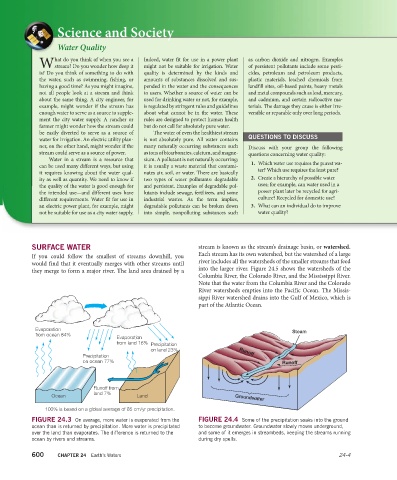
                   FIGURE 24.3  On average, more water is evaporated from the   FIGURE 24.4  Some of the precipitation soaks into the ground
                   ocean than is returned by precipitation. More water is precipitated   to become groundwater. Groundwater slowly moves underground,
                   over the land than evaporates. The difference is returned to the   and some of it emerges in streambeds, keeping the streams running
                   ocean by rivers and streams.                           during dry spells.

                   600     CHAPTER 24 Earth’s Waters                                                                    24-4

