


Page 626 - 9780077418427.pdf
P. 626
/Volume/201/MHDQ233/tat78194_disk1of1/0073378194/tat78194_pagefile
          tiL12214_ch24_597-622.indd Page 603  9/23/10  11:09 AM user-f465
          tiL12214_ch24_597-622.indd Page 603  9/23/10  11:09 AM user-f465             /Volume/201/MHDQ233/tat78194_disk1of1/0073378194/tat78194_pagefiles


                          A


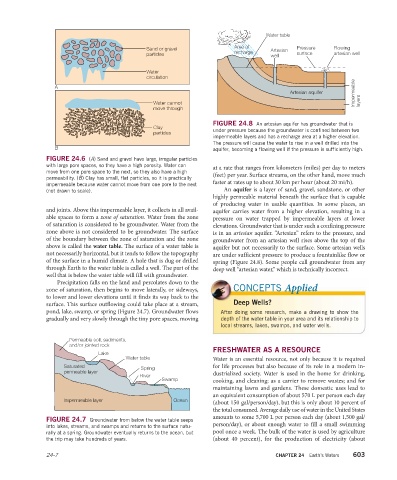
                                                                               FIGURE 24.8  An artesian aquifer has groundwater that is
                                                                               under pressure because the groundwater is confined between two
                                                                               impermeable layers and has a recharge area at a higher elevation.
                                                                               The pressure will cause the water to rise in a well drilled into the
                          B                                                    aquifer, becoming a flowing well if the pressure is sufficiently high.
                       FIGURE 24.6  (A) Sand and gravel have large, irregular particles
                       with large pore spaces, so they have a high porosity. Water can   at a rate that ranges from kilometers (miles) per day to meters
                       move from one pore space to the next, so they also have a high
                                                                               (feet) per year. Surface streams, on the other hand, move much
                       permeability. (B) Clay has small, flat particles, so it is practically
                       impermeable because water cannot move from one pore to the next   faster at rates up to about 30 km per hour (about 20 mi/h).
                       (not drawn to scale).                                      An aquifer is a layer of sand, gravel, sandstone, or other
                                                                               highly permeable material beneath the surface that is capable
                                                                               of producing water in usable quantities. In some places, an
                        and joints. Above this impermeable layer, it collects in all avail-  aquifer carries water from a higher elevation, resulting in a
                        able spaces to form a zone of saturation. Water from the zone   pressure on water trapped by impermeable layers at lower
                        of saturation is considered to be groundwater. Water from the   elevations. Groundwater that is under such a confining pressure
                        zone above is not considered to be groundwater. The surface   is in an artesian aquifer. “Artesian” refers to the pressure, and
                        of the boundary between the zone of saturation and the zone   groundwater from an artesian well rises above the top of the
                        above is called the water table. The surface of a water table is   aquifer but not necessarily to the surface. Some artesian wells
                        not necessarily horizontal, but it tends to follow the  topography   are under sufficient pressure to produce a fountainlike flow or
                        of the surface in a humid climate. A hole that is dug or drilled   spring (Figure 24.8). Some people call groundwater from any
                        through Earth to the water table is called a well. The part of the   deep well “artesian water,” which is technically incorrect.
                        well that is below the water table will fill with groundwater.
                           Precipitation falls on the land and percolates down to the
                        zone of saturation, then begins to move laterally, or sideways,   CONCEPTS Applied
                        to lower and lower elevations until it finds its way back to the
                        surface. This surface outflowing could take place at a stream,   Deep Wells?
                        pond, lake, swamp, or spring (Figure 24.7). Groundwater flows   After doing some research, make a drawing to show the
                        gradually and very slowly through the tiny pore spaces, moving   depth of the water table in your area and its relationship to
                                                                                 local streams, lakes, swamps, and water wells.


                                                                               FRESHWATER AS A RESOURCE
                                                                               Water is an essential resource, not only because it is required
                                                                               for life processes but also because of its role in a modern in-
                                                                               dustrialized society. Water is used in the home for drinking,
                                                                               cooking, and cleaning; as a carrier to remove wastes; and for
                                                                               maintaining lawns and gardens. These domestic uses lead to
                                                                               an equivalent consumption of about 570 L per person each day
                                                                               (about 150 gal/person/day), but this is only about 10 percent of
                                                                               the total consumed. Average daily use of water in the United States
                                                                               amounts to some 5,700 L per person each day (about 1,500 gal/
                        FIGURE 24.7  Groundwater from below the water table seeps
                       into lakes, streams, and swamps and returns to the surface natu-  person/day), or about enough water to fill a small swimming
                       rally at a spring. Groundwater eventually returns to the ocean, but   pool once a week. The bulk of the water is used by agriculture
                       the trip may take hundreds of years.                    (about 40 percent), for the production of electricity (about

                        24-7                                                                       CHAPTER 24  Earth’s Waters   603

