


Page 628 - 9780077418427.pdf
P. 628
/Volume/201/MHDQ233/tat78194_disk1of1/0073378194/tat78194_pagefile
          tiL12214_ch24_597-622.indd Page 605  9/23/10  11:09 AM user-f465
          tiL12214_ch24_597-622.indd Page 605  9/23/10  11:09 AM user-f465             /Volume/201/MHDQ233/tat78194_disk1of1/0073378194/tat78194_pagefiles


                          up the work of the bacteria by bringing                        Secondary Treatment
                          air and sludge heavily laden with bacteria                    Activated sludge process
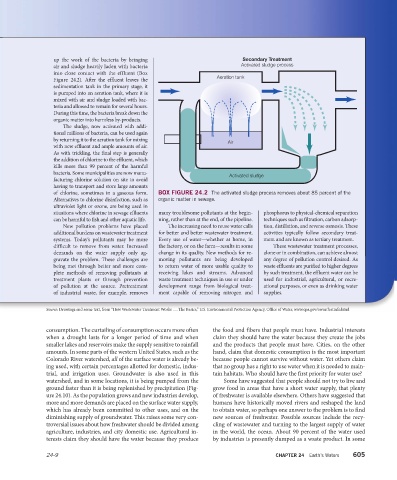
                          into close contact with the effluent (Box
                                                                                Aeration tank
                           Figure  24.2). After the effluent leaves the
                          sedimen tation tank in the primary stage, it
                          is pumped into an aeration tank, where it is
                          mixed with air and sludge loaded with bac-
                          teria and allowed to remain for several hours.
                          During this time, the bacteria break down the
                          organic matter into harmless by-products.
                             The sludge, now activated with addi-
                          tional millions of bacteria, can be used again
                          by returning it to the aeration tank for mixing
                                                                                    Air
                          with new effluent and ample amounts of air.
                          As with trickling, the final step is generally
                          the addition of chlorine to the effluent, which
                          kills more than 99 percent of the harmful
                          bacteria. Some municipalities are now manu-
                                                                                    Activated sludge
                          facturing chlorine solution on site to avoid
                          having to transport and store large amounts
                          of chlorine, sometimes in a gaseous form.     BOX FIGURE 24.2  The activated sludge process removes about 85 percent of the
                          Alternatives to chlorine disinfection, such as   organic matter in sewage.
                          ultraviolet light or ozone, are being used in
                          situations where chlorine in sewage effluents   many troublesome pollutants at the begin-  phosphorus to physical-chemical separation
                          can be harmful to fish and other aquatic life.   ning, rather than at the end, of the pipeline.  techniques such as filtration, carbon adsorp-
                             New pollution problems have placed   The increasing need to reuse water calls   tion, distillation, and reverse osmosis. These
                          additional burdens on wastewater treatment   for better and better wastewater treatment.   activities typically follow secondary treat-
                          systems. Today’s pollutants may be more   Every use of water—whether at home, in   ment and are known as tertiary treatment.
                          difficult to remove from water.  Increased   the factory, or on the farm—results in some   These wastewater treatment processes,
                          demands on the water supply only ag-  change in its quality. New methods for re-  alone or in combination, can achieve almost
                          gravate the problem. These challenges are   moving pollutants are being developed   any degree of pollution control desired. As
                          being met through better and more com-  to return water of more usable quality to   waste effluents are purified to higher  degrees
                          plete methods of removing pollutants at   receiving lakes and streams. Advanced   by such treatment, the effluent  water can be
                          treatment plants or through prevention   waste treatment techniques in use or under   used for industrial, agricultural, or recre-
                          of pollution at the source. Pretreatment     development range from biological treat-  ational purposes, or even as drinking water
                          of industrial waste, for example, removes   ment capable of removing nitrogen and   supplies.

                       Source: Drawings and some text, from “How Wastewater Treatment Works . . . The Basics,” U.S. Environmental Protection Agency, Office of Water, www.epa.gov/owm/featinfo.html


                        consumption. The curtailing of consumption occurs more often   the food and fibers that people must have. Industrial interests
                        when a drought lasts for a longer period of time and when   claim they should have the  water because they create the jobs
                        smaller lakes and reservoirs make the supply sensitive to rainfall   and the products that people must have. Cities, on the other
                        amounts. In some parts of the western United States, such as the   hand, claim that domestic consumption is the most  important
                        Colorado River watershed, all of the surface water is already be-  because people cannot survive without water. Yet others claim
                        ing used, with certain percentages allotted for domestic, indus-  that no group has a right to use water when it is needed to main-
                        trial, and irrigation uses. Groundwater is also used in this   tain habitats. Who should have the first priority for  water use?
                        watershed, and in some locations, it is being pumped from the   Some have suggested that people should not try to live and
                        ground faster than it is being replenished by precipitation (Fig-  grow food in areas that have a short water supply, that plenty
                       ure 24.10). As the population grows and new industries develop,   of freshwater is available elsewhere. Others have suggested that
                       more and more demands are placed on the surface water supply,   humans have historically moved rivers and reshaped the land
                       which has already been committed to other uses, and on the   to obtain water, so perhaps one answer to the problem is to find
                       diminishing supply of groundwater. This raises some very con-  new sources of freshwater. Possible sources include the recy-
                       troversial issues about how freshwater should be divided among   cling of wastewater and turning to the largest supply of water
                       agriculture, industries, and city domestic use. Agricultural in-  in the world, the ocean. About 90 percent of the water used
                       terests claim they should have the water because they produce   by industries is presently dumped as a waste product. In some

                        24-9                                                                       CHAPTER 24  Earth’s Waters   605

