


Page 624 - 9780077418427.pdf
P. 624
/Volume/201/MHDQ233/tat78194_disk1of1/0073378194/tat78194_pagefile
          tiL12214_ch24_597-622.indd Page 601  9/23/10  11:09 AM user-f465
          tiL12214_ch24_597-622.indd Page 601  9/23/10  11:09 AM user-f465             /Volume/201/MHDQ233/tat78194_disk1of1/0073378194/tat78194_pagefiles


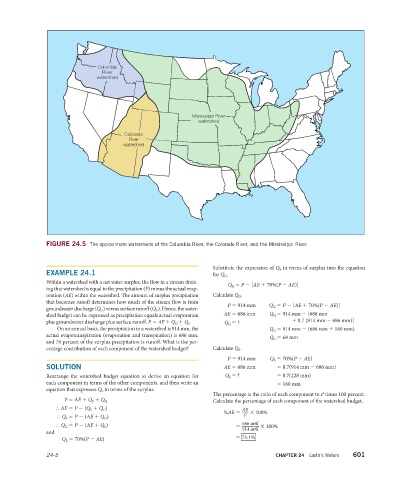
                        FIGURE 24.5  The approximate watersheds of the Columbia River, the Colorado River, and the Mississippi River.


                                                                               Substitute the expression of Q S  in terms of surplus into the equation
                         EXAMPLE 24.1                                          for Q G .
                       Within a watershed with a net water surplus, the flow in a stream drain-  Q G  = P − [AE + 70%(P − AE)]
                       ing that watershed is equal to the precipitation (P) minus the actual evap-
                       oration (AE) within the watershed. The amount of surplus precipitation   Calculate Q G .
                       that becomes runoff determines how much of the stream flow is from   P = 914 mm   Q G  = P − [AE + 70%(P − AE)]
                       groundwater discharge (Q G ) versus surface runoff (Q S  ). Hence, the water-
                          shed budget can be expressed as precipitation equals actual evaporation   AE = 686 mm    Q G  = 914 mm − [686 mm
                                                                                                         + 0.7 (914 mm − 686 mm)]
                        plus groundwater discharge plus surface runoff.  P = AE + Q G  + Q S  Q G  = ?
                           On an annual basis, the precipitation in a watershed is 914 mm, the   Q G  = 914 mm − (686 mm + 160 mm)
                       actual evapotranspiration (evaporation and transpiration) is  686 mm,     Q G  = 68 mm
                       and 70 percent of the surplus precipitation is runoff. What is the per-
                       centage contribution of each component of the watershed budget?  Calculate Q S .
                                                                                    P = 914 mm    Q S  = 70%(P − AE)
                       SOLUTION                                                   AE = 686 mm         = 0.7(914 mm − 686 mm)
                       Rearrange the watershed budget equation to derive an equation for   Q S  = ?  = 0.7(228 mm)
                       each component in terms of the other components, and then write an           = 160 mm
                       equation that expresses Q S  in terms of the surplus.
                                                                               The percentage is the ratio of each component to P times 100 percent.
                              P = AE + Q S  + Q G                              Calculate the percentage of each component of the watershed budget.
                           ∴ AE = P − (Q S  + Q G )                                     _
                                                                                        AE

                                                                                  %AE =       × 100%

                           ∴ Q S  = P − (AE + Q G )                                      P
                                                                                        686 mm
                           ∴ Q G  = P − (AE + Q S )                                   =    _      × 100%

                       and                                                              914 mm
                             Q S  = 70%(P − AE)                                       = 75.1%
                        24-5                                                                       CHAPTER 24  Earth’s Waters   601

