


Page 629 - 9780077418427.pdf
P. 629
/Volume/201/MHDQ233/tat78194_disk1of1/0073378194/tat78194_pagefile
          tiL12214_ch24_597-622.indd Page 606  9/23/10  11:09 AM user-f465
          tiL12214_ch24_597-622.indd Page 606  9/23/10  11:09 AM user-f465             /Volume/201/MHDQ233/tat78194_disk1of1/0073378194/tat78194_pagefiles


                                                                          areas, treated city wastewater is already being recycled for use
                                                                          in power plants and for watering parks. A practically limitless
                                                                          supply of freshwater could be available by desalting ocean wa-
                                                                          ter, something which occurs naturally in the hydrologic cycle.
                                                                          The treatment of seawater to obtain a new supply of fresh -
                                                                          water is presently too expensive because of the cost of energy
                                                                          to accomplish the task. New technologies, perhaps ones that
                                                                          use solar energy, may make this more practical in the future.
                                                                          In the meantime, the best sources of extending the supply of
                                                                          fresh water appear to be the control of pollution, the recycling of

                                                                          wastewater, and conservation of the existing supply.

                                                                                CONCEPTS Applied

                                                                                Who Uses How Much?

                                                                            Find out how much water is used in the industrial processes
                                                                            in your location. Compare this to the amount of water used
                                                                            in the home for drinking, cooking, cleaning, and so on.


                                                                           24.2 SEAWATER
                                                                          More than 70 percent of the surface of Earth is covered by sea-
                                                                          water, with an average depth of 3,800 m (about 12,500 ft). The
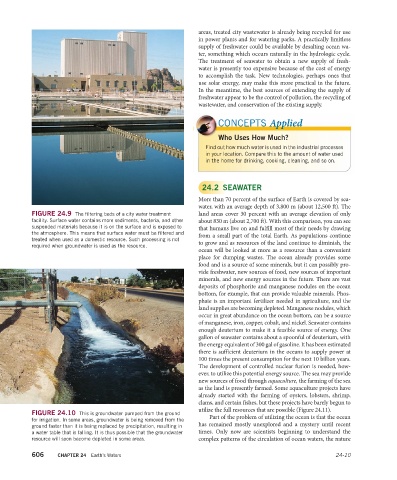
                   FIGURE 24.9  The filtering beds of a city water treatment   land areas cover 30 percent with an average elevation of only
                   facility. Surface water contains more sediments, bacteria, and other   about 830 m (about 2,700 ft). With this comparison, you can see
                   suspended materials because it is on the surface and is exposed to   that humans live on and fulfill most of their needs by drawing
                   the atmosphere. This means that surface water must be filtered and   from a small part of the total Earth. As populations continue
                   treated when used as a domestic resource. Such processing is not
                                                                          to grow and as resources of the land continue to diminish, the
                   required when groundwater is used as the resource.
                                                                          ocean will be looked at more as a resource than a convenient
                                                                          place for dumping wastes. The ocean already provides some
                                                                          food and is a source of some minerals, but it can possibly pro-
                                                                          vide freshwater, new sources of food, new sources of important
                                                                          minerals, and new energy sources in the future. There are vast
                                                                          deposits of phosphorite and manganese nodules on the ocean
                                                                          bottom, for example, that can provide valuable minerals. Phos-
                                                                          phate is an important fertilizer needed in agriculture, and the
                                                                          land supplies are becoming depleted. Manganese nodules, which
                                                                          occur in great abundance on the ocean bottom, can be a source
                                                                          of manganese, iron, copper, cobalt, and nickel. Seawater contains
                                                                          enough deuterium to make it a feasible source of energy. One
                                                                          gallon of seawater contains about a spoonful of deuterium, with
                                                                          the energy equivalent of 300 gal of gasoline. It has been estimated
                                                                          there is sufficient deuterium in the oceans to supply power at
                                                                          100 times the present consumption for the next 10 billion years.
                                                                          The development of controlled nuclear fusion is needed, how-
                                                                          ever, to utilize this  potential energy source. The sea may provide
                                                                          new sources of food through aquaculture, the farming of the sea
                                                                          as the land is presently farmed. Some aquaculture projects have
                                                                            already started with the farming of oysters, lobsters, shrimp,
                                                                          clams, and certain fishes, but these projects have barely begun to
                                                                          utilize the full resources that are possible (Figure 24.11).
                   FIGURE 24.10  This is groundwater pumped from the ground
                   for irrigation. In some areas, groundwater is being removed from the   Part of the problem of utilizing the ocean is that the ocean
                                                                          has remained mostly unexplored and a mystery until recent
                   ground faster than it is being replaced by precipitation, resulting in
                   a water table that is falling. It is thus possible that the groundwater   times. Only now are scientists beginning to understand the
                   resource will soon become depleted in some areas.      complex patterns of the circulation of ocean waters, the nature

                   606     CHAPTER 24 Earth’s Waters                                                                   24-10

