


Page 636 - 9780077418427.pdf
P. 636
/Volume/201/MHDQ233/tat78194_disk1of1/0073378194/tat78194_pagefile
          tiL12214_ch24_597-622.indd Page 613  9/23/10  11:09 AM user-f465
          tiL12214_ch24_597-622.indd Page 613  9/23/10  11:09 AM user-f465             /Volume/201/MHDQ233/tat78194_disk1of1/0073378194/tat78194_pagefiles


                                                                                            A Closer Look


                                                                                                          Rogue Waves
                             rogue wave is an unusually large wave   wind direction, for example. Large rogue   coming together to form a mountain-
                          A  that appears with smaller waves. The   waves have been reported from 21 to 35 m   ous wave that lasts several minutes before
                          rogue wave has also been called a "freak"   (69 to 114 ft) tall and have been observed to   subsiding. Other processes, such as wave
                          wave. Whatever the name, it is generally   almost capsize large ships.  focusing by the shape of the coast or move-
                          one or a group of two or three waves that   It is believed that a rogue wave is an   ment by currents, may play a part in form-
                          are more than twice the size of the normal   extreme storm wave. It probably forms dur-  ing rogue waves. The source of rogue waves
                          surrounding waves. The rogue wave is one   ing a storm from constructive interference   continues to be a mystery and an active
                          or several very large "walls of water" and has   (see p.  126) between smaller waves when   topic of  research. This much is known—
                          unpredictable behavior, not following the   the crests and troughs happen to match,   rogue waves do exist.


                          EXAMPLE 24.3
                        The position offshore where waves with the circular motion of water
                        particles will encounter the bottom can be determined from the slope
                        of the bottom and the wavelength (λ). If a beach gently slopes at
                        2.1 centimeters per meter and the wavelength is 12 meters, how far
                        offshore will wave base encounter the bottom?
                           The depth of wave base is one-half the wavelength.
                                                      1 _
                                 λ = 12 m           =        λ
                                             wave  base
                           wave base = ?              2
                                                      1 _
                                                               =       (12 m)

                                                      2
                                                               = 6 m
                       Slope is the ratio between the change in depth of the bottom and the
                       distance offshore; hence, the distance offshore where wave base will
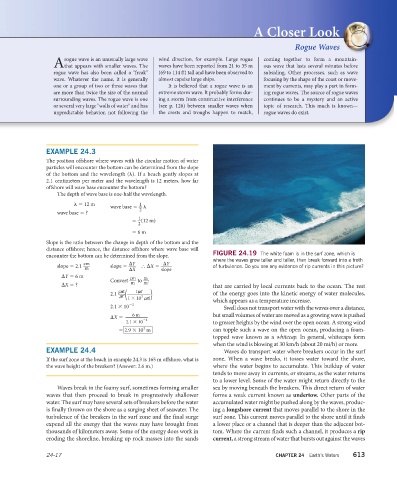
                       encounter the bottom can be determined from the slope.  FIGURE 24.19  The white foam is in the surf zone, which is
                                                                               where the waves grow taller and taller, then break forward into a froth
                                    _              _         _
                                                              ΔY
                                                   ΔY
                                    cm

                           slope = 2.1            slope =           ∴ ΔX =          of turbulence. Do you see any evidence of rip currents in this picture?


                                    m              ΔX         slope
                            ΔY = 6 m               _    m _
                                                   cm

                                             Convert  m        to         :
                                                        m
                            ΔX = ?                                             that are carried by local currents back to the ocean. The rest
                                               cm _
                                               _     1m


                                             2.1  m(   2 )                     of the energy goes into the kinetic energy of water  molecules,

                                                  1 ×  10    cm
                                                                               which appears as a temperature increase.
                                                   −2
                                             2.1 × 1 0                            Swell does not transport water with the waves over a distance,
                                                  _                            but small volumes of water are moved as a growing wave is pushed
                                                    6 m

                                             ΔX =

                                                        −2
                                                  2.1 ×  10                    to greater heights by the wind over the open ocean. A strong wind
                                                     = 2.9 ×  10    m          can topple such a wave on the open ocean, producing a foam-
                                                        2
                                                                               topped wave known as a  whitecap. In general, whitecaps form
                                                                               when the wind is blowing at 30 km/h (about 20 mi/h) or more.
                        EXAMPLE 24.4                                              Waves do transport water where breakers occur in the surf
                        If the surf zone at the beach in example 24.3 is 165 m offshore, what is   zone. When a wave breaks, it tosses water toward the shore,
                        the wave height of the breakers? (Answer: 2.6 m.)      where the water begins to accumulate. This buildup of water
                                                                               tends to move away in currents, or streams, as the water returns
                                                                               to a lower level. Some of the water might return directly to the
                           Waves break in the foamy surf, sometimes forming smaller   sea by moving beneath the breakers. This direct return of water
                        waves that then proceed to break in progressively shallower   forms a weak current known as undertow. Other parts of the
                          water. The surf may have several sets of breakers before the  water   accumulated water might be pushed along by the waves, produc-
                        is finally thrown on the shore as a surging sheet of seawater. The   ing a longshore current that moves parallel to the shore in the
                        turbulence of the breakers in the surf zone and the final surge   surf zone. This current moves parallel to the shore until it finds
                        expend all the energy that the waves may have brought from   a lower place or a channel that is deeper than the adjacent bot-
                        thousands of kilometers away. Some of the energy does work in   tom. Where the current finds such a channel, it produces a rip
                        eroding the shoreline, breaking up rock masses into the sands    current, a strong stream of water that bursts out against the waves
                       24-17                                                                       CHAPTER 24  Earth’s Waters   613

