


Page 634 - 9780077418427.pdf
P. 634
/Volume/201/MHDQ233/tat78194_disk1of1/0073378194/tat78194_pagefile
          tiL12214_ch24_597-622.indd Page 611  9/23/10  11:09 AM user-f465
          tiL12214_ch24_597-622.indd Page 611  9/23/10  11:09 AM user-f465             /Volume/201/MHDQ233/tat78194_disk1of1/0073378194/tat78194_pagefiles


                                                                               ger time over a long fetch. In general, longer-blowing, stronger
                                                                               winds produce waves with greater wave heights, longer wave-
                                                                               lengths, and longer periods, but a given wind produces waves
                                                                               with a wide range of sizes and speeds. In addition, the wind
                                                                               does not blow in just one direction, and shifting winds produce
                                                                               a chaotic pattern of waves of many different heights and wave-
                                                                               lengths. Thus, the surface of the ocean in the area of a storm or
                                                                               strong wind has a complicated mixture of many sizes and speeds
                                                                               of superimposed waves. The smaller waves soon die out from
                                                                               friction within the water, and the larger ones grow as the wind
                                                                               pushes against their crests. Ocean waves range in height from a
                                                                               few centimeters up to more than 30 m (about 100 ft), but giant
                                                                               waves more than 15 m (about 50 ft) are extremely rare.
                                                                                  The larger waves of the chaotic, superimposed mixture of
                                                                               waves in a storm area last longer than the winds that formed
                                                                               them, and they may travel for hundreds or thousands of kilo-
                                                                               meters from their place of origin. The longer-wavelength waves
                                                                               travel faster and last longer than the shorter-wavelength waves,
                                                                               so the longer-wavelength waves tend to outrun the shorter-
                                                                               wavelength waves as they die out from energy losses to water
                                                                               friction. Thus, the irregular, superimposed waves created in the
                                                                               area of a storm become transformed as they travel away from
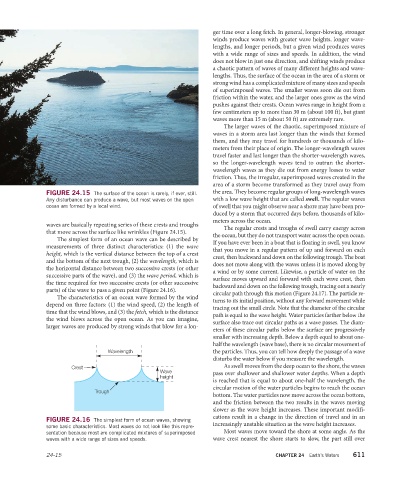
                        FIGURE 24.15  The surface of the ocean is rarely, if ever, still.   the area. They become regular groups of long-wavelength waves
                       Any disturbance can produce a wave, but most waves on the open   with a low wave height that are called swell. The regular waves
                       ocean are formed by a local wind.                       of swell that you might observe near a shore may have been pro-
                                                                               duced by a storm that occurred days before, thousands of kilo-
                                                                               meters across the ocean.
                       waves are basically  repeating series of these crests and troughs
                                                                                  The regular crests and troughs of swell carry energy across
                       that move across the surface like wrinkles (Figure 24.15).
                                                                               the ocean, but they do not transport water across the open ocean.
                           The simplest form of an ocean wave can be described by
                                                                               If you have ever been in a boat that is floating in swell, you know
                       measurements of three distinct characteristics: (1) the  wave
                                                                               that you move in a regular pattern of up and forward on each
                       height, which is the vertical distance between the top of a crest
                                                                               crest, then backward and down on the following trough. The boat
                       and the bottom of the next trough, (2) the wavelength, which is
                                                                               does not move along with the waves unless it is moved along by
                       the horizontal distance between two successive crests (or other
                                                                               a wind or by some current. Likewise, a particle of water on the
                       successive parts of the wave), and (3) the wave period, which is
                                                                               surface moves upward and forward with each wave crest, then
                       the time required for two successive crests (or other successive
                                                                               backward and down on the following trough, tracing out a nearly
                       parts) of the wave to pass a given point (Figure 24.16).
                                                                               circular path through this motion (Figure 24.17). The particle re-
                           The characteristics of an ocean wave formed by the wind
                                                                               turns to its initial position, without any forward movement while
                       depend on three factors: (1) the wind speed, (2) the length of
                                                                               tracing out the small circle. Note that the diameter of the circular
                       time that the wind blows, and (3) the fetch, which is the distance
                                                                               path is equal to the wave height.  Water particles farther below the
                       the wind blows across the open ocean. As you can imagine,
                                                                               surface also trace out circular paths as a wave passes. The diam-
                       larger waves are produced by strong winds that blow for a lon-
                                                                               eters of these circular paths  below the surface are progressively
                                                                               smaller with increasing depth. Below a depth equal to about one-
                                                                               half the wavelength (wave base), there is no  circular movement of
                                            Wavelength                         the particles. Thus, you can tell how deeply the passage of a wave
                                                                                 disturbs the water  below if you measure the wavelength.
                                Crest                                             As swell moves from the deep ocean to the shore, the waves
                                                             Wave              pass over shallower and shallower water depths. When a depth
                                                             height
                                                                               is reached that is equal to about one-half the wavelength, the
                                                                               circular motion of the water particles begins to reach the ocean
                                        Trough
                                                                               bottom. The water particles now move across the ocean bottom,
                                                                               and the friction between the two results in the waves moving
                                                                               slower as the wave height increases. These important modifi-
                                                                               cations result in a change in the direction of travel and in an
                        FIGURE 24.16  The simplest form of ocean waves, showing
                       some basic characteristics. Most waves do not look like this repre-  increasingly unstable situation as the wave height increases.
                       sentation because most are complicated mixtures of superimposed   Most waves move toward the shore at some angle. As the
                       waves with a wide range of sizes and speeds.            wave crest nearest the shore starts to slow, the part still over
                        24-15                                                                      CHAPTER 24  Earth’s Waters   611

