


Page 631 - 9780077418427.pdf
P. 631
/Volume/201/MHDQ233/tat78194_disk1of1/0073378194/tat78194_pagefile
          tiL12214_ch24_597-622.indd Page 608  9/23/10  11:09 AM user-f465
          tiL12214_ch24_597-622.indd Page 608  9/23/10  11:09 AM user-f465             /Volume/201/MHDQ233/tat78194_disk1of1/0073378194/tat78194_pagefiles


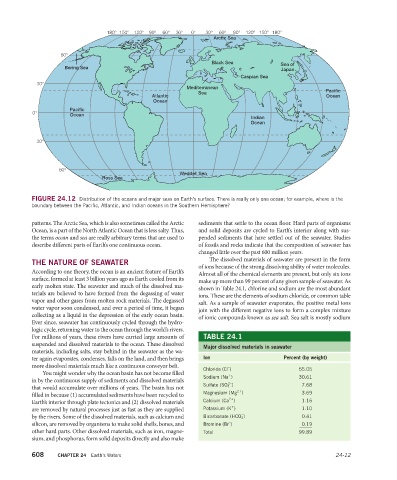
                   FIGURE 24.12  Distribution of the oceans and major seas on Earth’s surface. There is really only one ocean; for example, where is the
                   boundary between the Pacific, Atlantic, and Indian oceans in the Southern Hemisphere?

                   patterns. The Arctic Sea, which is also sometimes called the Arctic   sediments that settle to the ocean floor. Hard parts of organisms
                   Ocean, is a part of the North  Atlantic Ocean that is less salty. Thus,   and solid deposits are cycled to Earth’s interior along with sus-
                   the terms ocean and sea are  really arbitrary terms that are used to   pended sediments that have settled out of the seawater. Studies
                   describe different parts of Earth’s one continuous ocean.  of fossils and rocks  indicate that the composition of seawater has
                                                                          changed little over the past 600 million years.
                                                                             The dissolved materials of seawater are present in the form
                   THE NATURE OF SEAWATER
                                                                          of ions because of the strong dissolving ability of water molecules.
                   According to one theory, the ocean is an ancient feature of Earth’s   Almost all of the chemical elements are present, but only six ions
                   surface, formed at least 3 billion years ago as Earth cooled from its   make up more than 99 percent of any given sample of seawater. As
                   early molten state. The seawater and much of the dissolved ma-  shown in Table 24.1, chlorine and sodium are the most abundant
                   terials are believed to have formed from the  degassing of water   ions. These are the elements of sodium chloride, or common table
                   vapor and other gases from molten rock materials. The degassed   salt. As a sample of seawater evaporates, the positive metal ions
                   water vapor soon condensed, and over a period of time, it began   join with the different negative ions to form a complex mixture
                   collecting as a liquid in the depression of the early ocean basin.   of ionic compounds known as sea salt. Sea salt is mostly sodium
                   Ever since, seawater has continuously cycled through the hydro-
                   logic cycle, returning water to the ocean through the world’s rivers.
                   For millions of years, these rivers have carried large amounts of   TABLE 24.1
                   suspended and  dissolved materials to the ocean. These dissolved   Major dissolved materials in seawater
                   materials,  including salts, stay behind in the seawater as the wa-
                   ter again evaporates, condenses, falls on the land, and then brings   Ion          Percent (by weight)
                   more dissolved materials much like a continuous conveyor belt.  Chloride (Cl )          55.05
                                                                                    –
                      You might wonder why the ocean basin has not become filled    +
                   in by the continuous supply of sediments and dissolved materials   Sodium (Na )         30.61
                                                                                    2–
                   that would accumulate over millions of years. The basin has not   Sulfate (SO 4 )   2+   7.68
                   filled in because (1) accumulated sediments have been recycled to   Magnesium (Mg )      3.69
                                                                                    2+
                   Earth’s interior through plate tectonics and (2) dissolved materials   Calcium (Ca )     1.16
                                                                                     +
                   are removed by natural processes just as fast as they are supplied   Potassium (K )      1.10
                                                                                        –
                   by the rivers. Some of the dissolved materials, such as calcium and   Bicarbonate (HCO 3 )  0.41
                                                                                    –
                   silicon, are removed by organisms to make solid shells, bones, and   Bromine (Br )       0.19
                   other hard parts. Other dissolved materials, such as iron, magne-  Total                99.89
                   sium, and phosphorus, form solid deposits directly and also make
                   608     CHAPTER 24 Earth’s Waters                                                                   24-12

