


Page 635 - 9780077418427.pdf
P. 635
/Volume/201/MHDQ233/tat78194_disk1of1/0073378194/tat78194_pagefile
          tiL12214_ch24_597-622.indd Page 612  9/23/10  11:09 AM user-f465
          tiL12214_ch24_597-622.indd Page 612  9/23/10  11:09 AM user-f465             /Volume/201/MHDQ233/tat78194_disk1of1/0073378194/tat78194_pagefiles


                           A Closer Look


                           Health of Chesapeake Bay
                        ubmerged aquatic vegetation—SAV for   grasses came the decline of the aquatic spe-  manure. The manure is used as fertilizer, and
                     Sshort—is vital to the Chesapeake Bay   cies living in the bay. Shad, haddock, and   significant amounts of nitrogen and phos-
                     ecosystem and a key measuring stick for the   sturgeon once supported large fisheries but   phates wash from these fields. These nutri-
                     Chesapeake’s overall health. Eel and wigeon   are now scarce. The rockfish (striped bass)   ents accelerate algae growth in the bay, which
                     grasses grow in the shallows around the bay   as well as the prized blue crab were once   blocks sunlight. The grass dies and the loss
                     and across the bottom, providing food and   abundant but seem to decline and recover   results in muddying of the water, making it
                     shelter for baby blue crabs and fish, filter-  over the years. The decline of the blue crab   impossible for new grasses to  begin growing.
                     ing pollutants, and providing life-sustaining   population has shocked  watermen because   There is some evidence to support this
                     oxygen for the water. So the health of the   the crab is amazingly fertile. The  crabs   idea since the 600,000 acres of underwater
                     grasses provides an indication of the overall   reach sexual maturity in about a year, and   grasses died back to a low of 40,000 acres in
                     health of the Chesapeake.          one female bears millions of eggs. Part of   1984, then began to rebound when sewage
                        Chesapeake Bay once had an estimated   the problem is the loss of the underwater   treatment plants were modernized and there
                     600,000 acres of grasses and provided an   grasses, which shelter the baby crabs from   were fewer pollutants from industry and farms.
                     abundance of oysters, blue crab, shad, had-  predators. In addition to the loss of habitat,   The grasses recovered to some 63,500 acres
                     dock, sturgeon, rockfish, and other prized   some believe the crab is being overfished.  by 1999 but are evidently very sensitive to
                     sport fish and seafood. At this time, the bay   What happened to the underwater   even slight changes in water quality. Thus,
                     water was clear, and watermen reported   grasses of the Chesapeake? Scientists believe   they may be expected to die back with un-
                     they could clearly see grasses on the bottom   it is a combination of natural erosion and   usual weather conditions that might bring
                     some 6 m (about 20 ft) below their boats.   pollutants that wash from farms in the water-  more pollutants or muddy conditions but
                     Then the water clouded, the grasses began   shed. The pollutants include nutrient-rich   continue to rebound when the conditions are
                     to die, and the ecosystem of the bay began to   fertilizers, chemical residues, and overflow   right. The abundance of blue crabs and other
                     decline. The low point was reached in 1984,   from sewage treatment plants. There are   aquatic species can be expected to fluctuate
                     when fewer than 40,000 acres of grasses   some 6,000 chicken houses around the Ches-  with the health of the grasses. The trends of
                     could be found in the now murky waters   apeake, raising more than 600 million chick-  underwater grass growth do indeed provide a
                     of the Chesapeake. With the decline of the   ens a year and producing 750,000 tons of   key measure for the health of Chesapeake Bay.


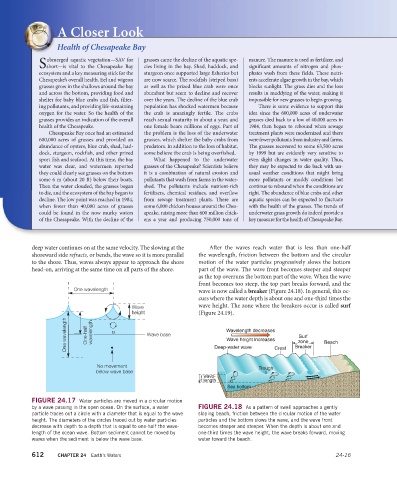
                   deep water continues on at the same velocity. The slowing at the   After the waves reach water that is less than one-half
                   shoreward side refracts, or bends, the wave so it is more parallel   the wavelength, friction between the bottom and the circular
                   to the shore. Thus, waves always appear to approach the shore     motion of the water particles progressively slows the bottom
                   head-on, arriving at the same time on all parts of the shore.  part of the wave. The wave front becomes steeper and steeper
                                                                          as the top overruns the bottom part of the wave. When the wave
                                                                          front becomes too steep, the top part breaks forward, and the
                                 One wavelength                           wave is now called a breaker (Figure 24.18). In general, this oc-
                                                                          curs where the water depth is about one and one-third times the
                                                    Wave                  wave height. The zone where the breakers occur is called surf
                                                    height                (Figure 24.19).
                              One wavelength  One-half  wavelength  Wave base  Deep-water wave     Crest  Breaker   Beach

                                                                                   Wavelength decreases
                                                                                                           Surf
                                                                                   Wave height increases
                                                                                                           zone


                                        No movement
                                        below wave base                                       Trough
                                                                           1 wave-
                                                                           2 length
                                                                                   Sea bottom
                   FIGURE 24.17  Water particles are moved in a circular  motion
                   by a wave passing in the open ocean. On the surface, a water   FIGURE 24.18  As a pattern of swell approaches a gently
                   particle traces out a circle with a diameter that is equal to the wave   sloping beach, friction between the circular motion of the  water
                   height. The diameters of the circles traced out by water particles   particles and the bottom slows the wave, and the wave front
                   decrease with depth to a depth that is equal to one-half the wave-  becomes steeper and steeper. When the depth is about one and
                   length of the ocean wave. Bottom sediment cannot be moved by   one-third times the wave height, the wave breaks forward, moving
                   waves when the sediment is below the wave base.        water toward the beach.

                   612     CHAPTER 24 Earth’s Waters                                                                   24-16

