


Page 638 - 9780077418427.pdf
P. 638
/Volume/201/MHDQ233/tat78194_disk1of1/0073378194/tat78194_pagefile
          tiL12214_ch24_597-622.indd Page 615  9/23/10  11:09 AM user-f465
          tiL12214_ch24_597-622.indd Page 615  9/23/10  11:09 AM user-f465             /Volume/201/MHDQ233/tat78194_disk1of1/0073378194/tat78194_pagefiles


                           A second type of density current results because of differ-  tem of prevailing winds (see chapter 22). This similarity exists
                       ences in salinity. The water in the Mediterranean, for example,   because it is the friction of the prevailing winds on the seawater
                       has a high salinity because it is mostly surrounded by land in a   surface that drives the ocean currents. The currents are modi-
                       warm, dry climate. The Mediterranean seawater, with its higher   fied by other factors, such as the rotation of Earth and the shape
                       salinity, is denser than the seawater in the open Atlantic Ocean.   of the ocean basins, but they are basically maintained by the
                       This density difference results in two separate currents that flow   wind systems.
                       in  opposite directions between the Mediterranean and the At-  Each ocean has a great system of moving water called a
                       lantic. The greater-density seawater flows from the bottom of   gyre that is centered in the mid-latitudes. The gyres rotate to
                       the Mediterranean into the Atlantic, while the less dense At-  the right in the Northern Hemisphere and to the left in the
                       lantic  water flows into the Mediterranean near the surface. The   Southern Hemisphere because of the Coriolis effect (see chap-
                       dense Mediterranean seawater sinks to a depth of about 1,000 m   ter 16). The movement of water around these systems, or gyres,
                       (about 3,300 ft) in the Atlantic, where it spreads over a large part   and some smaller systems form the surface circulation system
                       of the North Atlantic Ocean. This increases the salinity of this   of the world ocean. Each part of the system has a separate name,
                       part of the ocean, making it one of the more saline areas in the     usually based on its direction of flow. All are called currents, ex-
                       world.                                                  cept one that is called a stream (the Gulf Stream) and those that
                           The third type of density current occurs when underwater   are called drifts. Both the Gulf Stream and the drifts are currents
                       sediments on a slope slide toward the ocean bottom, producing   that are part of the connected system.
                       a current of muddy or turbid water called a turbidity  current.   The major surface currents are like giant rivers of seawater
                       Turbidity currents are believed to be a major mechanism that   that move through the ocean near the surface. You know that
                       moves sediments from the continents to the ocean basin. They   all the currents are connected, for a giant river of water cannot
                       may also be responsible for some undersea  features, such as   just start moving in one place, then stop in another. The Gulf
                         submarine canyons. Turbidity currents are believed to occur   Stream, for example, is a current about 100 km (about 60 mi)
                       only occasionally, however, and none has ever been directly   wide that may extend to a depth of 1 km (about 0.6 mi) below
                         observed or studied. There is thus no data or direct evidence   the surface, moving more than 75 million cubic meters of water
                       of how they form or what effects they have on the ocean floor.  per second (about 2.6 billion cubic ft/s). The Gulf Stream carries
                                                                               more than 370 times more water than the Mississippi River. The
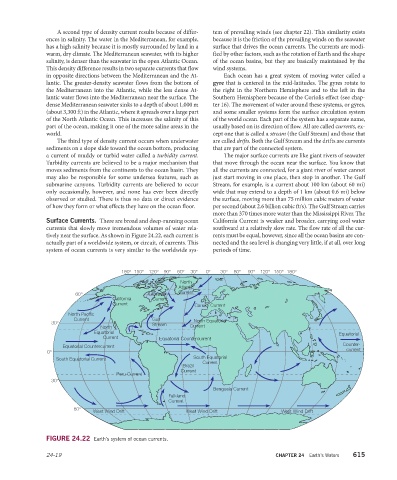
                         Surface Currents.  There are broad and deep-running ocean   California Current is weaker and broader, carrying cool  water
                       currents that slowly move tremendous volumes of water rela-  southward at a relatively slow rate. The flow rate of all the cur-
                       tively near the surface. As shown in Figure 24.22, each current is   rents must be equal, however, since all the ocean basins are con-
                       actually part of a worldwide system, or circuit, of  currents. This   nected and the sea level is changing very little, if at all, over long
                       system of ocean currents is very similar to the worldwide sys-  periods of time.


                       FIGURE 24.22  Earth’s system of ocean currents.

                       24-19                                                                       CHAPTER 24  Earth’s Waters   615

