


Page 68 - 9780077418427.pdf
P. 68
/Users/user-f465/Desktop
          tiL12214_ch02_025-060.indd Page 45  9/1/10  9:55 PM user-f465
          tiL12214_ch02_025-060.indd Page 45  9/1/10  9:55 PM user-f465                                                 /Users/user-f465/Desktop


                        Force of                                 Force of
                        spacecraft                               astronaut on
                        on astronaut                             spacecraft
                            F                                       F


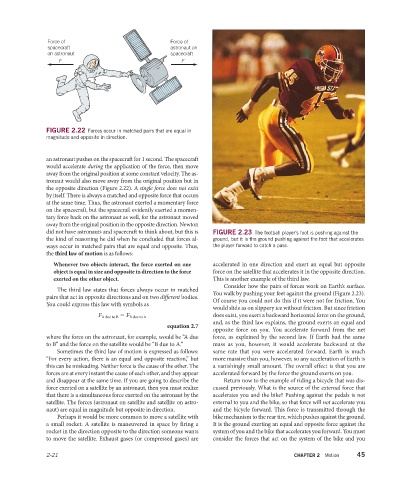
                       FIGURE 2.22  Forces occur in matched pairs that are equal in
                       magnitude and opposite in direction.


                       an astronaut pushes on the spacecraft for 1 second. The spacecraft
                       would accelerate during the application of the force, then move
                       away from the original position at some constant velocity. The as-
                       tronaut would also move away from the orig inal position but in
                       the opposite direction (Figure 2.22). A single force does not exist
                       by itself. There is always a matched and opposite force that occurs
                       at the same time. Thus, the  astronaut exerted a momentary force
                       on the spacecraft, but the spacecraft evidently exerted a momen-
                       tary force back on the  astronaut as well, for the astronaut moved
                       away from the original position in the opposite direction.  Newton
                       did not have astronauts and spacecraft to think about, but this is   FIGURE 2.23  The football player’s foot is pushing against the
                       the kind of reasoning he did when he concluded that forces al-  ground, but it is the ground pushing against the foot that accelerates
                       ways occur in matched pairs that are equal and opposite. Thus,   the player forward to catch a pass.
                       the third law of motion is as follows:

                          Whenever two objects interact, the force exerted on one   accelerated in one direction and exert an equal but opposite
                          object is equal in size and opposite in direction to the force   force on the satellite that accelerates it in the opposite direction.
                          exerted on the other object.                         This is another example of the third law.
                                                                                  Consider how the pairs of forces work on Earth’s  surface.
                           The third law states that forces always occur in matched
                                                                               You walk by pushing your feet against the ground  (Figure 2.23).
                       pairs that act in opposite directions and on two different bodies.
                                                                               Of course you could not do this if it were not for friction. You
                       You could express this law with symbols as
                                                                               would slide as on slippery ice without friction. But since friction
                                                                               does exist, you exert a backward horizontal force on the ground,
                                         F A due to B  = F B due to A
                                                                               and, as the third law explains, the ground exerts an equal and
                                                                equation 2.7
                                                                               opposite force on you. You accelerate forward from the net
                       where the force on the astronaut, for example, would be “A due   force, as explained by the second law. If Earth had the same
                       to B” and the force on the satellite would be “B due to A.”  mass as  you, however, it would accelerate backward at the
                           Sometimes the third law of motion is expressed as follows:   same  rate that you were accelerated forward. Earth is much
                       “For every action, there is an equal and opposite reaction,” but   more massive than you, however, so any acceleration of Earth is
                       this can be misleading. Neither force is the cause of the other. The   a vanishingly small amount. The overall  effect is that you are
                       forces are at every instant the cause of each other, and they appear   accelerated forward by the force the ground exerts on you.
                       and disappear at the same time. If you are going to describe the   Return now to the example of riding a bicycle that was dis-
                       force exerted on a satellite by an astronaut, then you must realize   cussed previously. What is the source of the external force that
                       that there is a simultaneous force exerted on the astronaut by the   accelerates you and the bike? Pushing against the pedals is not
                       satellite. The forces (astronaut on satellite and satellite on astro-  external to you and the bike, so that force will not accelerate you
                       naut) are equal in magnitude but opposite in direction.  and the bicycle forward. This force is transmitted through the
                           Perhaps it would be more common to move a satellite with   bike mechanism to the rear tire, which pushes against the ground.
                       a small rocket. A satellite is maneuvered in space by firing a   It is the ground exerting an equal and opposite force against the
                       rocket in the direction opposite to the direction someone wants   system of you and the bike that accelerates you forward. You must
                       to move the satellite. Exhaust gases (or compressed gases) are   consider the forces that act on the system of the bike and you

                       2-21                                                                               CHAPTER 2  Motion   45

