


Page 39 - ACE YR IGCSE A TOP APPROACH TO CHEM
P. 39
OH   will  lose  electrons  instead  of  Cl   since  the      Energy needed to break the bonds:
                               –
                                                         –
                                          –
                            concentration of Cl  is low.                  C–H   435 × 4  = +1740 kJ/mol
                               –
                            4OH  ➞ O  + 2H O + 4e                         O=O   498 × 2  = +996 kJ/mol
                                        2
                                    2
                            The  cathode  has  no  change.  H   gains  electrons,         Total  = +2736 kJ/mol
                                                    +
                            leaving Na  in the solution.                  Energy needed to form the bonds:
                                    +
                            H  and OH  are attracted to the electrodes and turn      C=O   803 × 2  = –1606 kJ/mol
                             +
                                    –
                            into  molecules.  So,  water  molecules  (H O)  in  the      O–H   464 × 4  = –1856 kJ/mol
                                                          2
                            solution are being removed.                          Total  = –3462 kJ/mol
                                                                          Enthalpy change = 2736 – 3462
                       5    Chemical Energetics                                       = –726 kJ/mol
                                                                        10  D
                     Part 1: Multiple-choice Questions                    This statement is not related to enthalpy change.
                        Penerbitan Pelangi Sdn Bhd. All Rights Reserved.
                       1  D                                             11  D
                         The  reaction  between  calcium  carbonate  and  sulfuric      Uranium-235  is  a  radioisotope.  It  is  used  to  generate
                         acid is neutralisation.                          energy.  But  energy  is  released  through  the  decay  of
                         Neutralisation   is   mostly   exothermic.   Thermal   atoms. It does not need to react with oxygen.
                         decomposition  and  cracking  are  both  endothermic  as
                         the reactions take in heat to break down the molecules.  Part 2: Structured Questions
                         Rusting is an exothermic reaction as it releases heat.    1  (a)  Ag (aq) + Cl (aq) ➞ AgCl(s)
                                                                                       –
                                                                               +
                       2  B                                                  Correct formula                    [1]
                         During photosynthesis, energy from sunlight is absorbed.         Correct state symbols   [1]
                       3  B                                                  The  ionic  equation  shows  the  reacting  ions  in  a
                         The bottom of the flask freezes and this shows that part   chemical reaction. The precipitate formed is a solid.
                         of the flask is cold.
                         Therefore,  this  reaction  is  endothermic.  Heat  is  taken       (b)  Exothermic    [1]
                         in  from  the  surroundings  to  break  the  bonds.  In  an   The  temperature  increases  at  the  end  of  the
                         endothermic reaction, the energy released is lower than   reaction. Heat was given out.
                         the energy absorbed.                                Exothermic reactions give out heat.
                       4  C                                               (c)
                         An exothermic reaction releases heat to the surroundings.  AgNO 3  + KCI
                         N   +  3H   ➞  2NH   is  a  reaction  in  the  Haber  process.
                          2
                                      3
                               2
                         Making ammonia is an exothermic reaction.
                         The rest are all endothermic reactions.
                       5  C                                                             AgCI + KNO 3
                         The energy level diagram shows an exothermic reaction
                         as the energy level in the molecule reduces. The energy
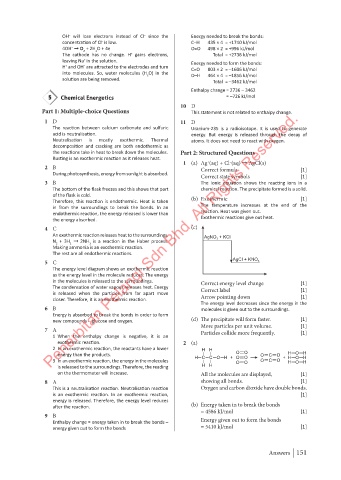
                         in the molecules is released to the surroundings.         Correct energy level change   [1]
                         The condensation of water vapour releases heat. Energy          Correct label          [1]
                         is  released  when  the  particles  from  far  apart  move
                         closer. Therefore, it is an exothermic reaction.         Arrow pointing down           [1]
                                                                             The energy level decreases since the energy in the
                       6  B                                                  molecules is given out to the surroundings.
                         Energy is absorbed to break the bonds in order to form
                         new compounds – glucose and oxygen.              (d)  The precipitate will form faster.   [1]
                                                                             More particles per unit volume.    [1]
                       7  A                                                  Particles collide more frequently.   [1]
                         1   When  the  enthalpy  change  is  negative,  it  is  an
                           exothermic reaction.                         2  (a)
                         2   In an exothermic reaction, the reactants have a lower   H H
                           energy than the products.                                      O  O    O  C  O   H O H
                         3   In an exothermic reaction, the energy in the molecules   H  C C O H +  O  O  O  C  O  +  H O H
                                                                                            O
                                                                                                            H O H
                                                                                          O
                           is released to the surroundings. Therefore, the reading   H H
                           on the thermometer will increase.                 All the molecules are displayed,   [1]
                       8  A                                                  showing all bonds.                 [1]
                         This is a neutralisation reaction. Neutralisation reaction          Oxygen and carbon dioxide have double bonds.
                         is  an  exothermic  reaction.  In  an  exothermic  reaction,                           [1]
                         energy is released. Therefore, the energy level reduces
                         after the reaction.                              (b)  Energy taken in to break the bonds
                       9  B                                                  = 4586 kJ/mol                      [1]
                         Enthalpy change = energy taken in to break the bonds –          Energy given out to form the bonds
                         energy given out to form the bonds                  = 5410 kJ/mol                      [1]


                                                                                                     Answers    151


         Answers.indd   151                                                                                         3/4/22   3:54 PM

