


Page 40 - ACE YR IGCSE A TOP APPROACH TO CHEM
P. 40
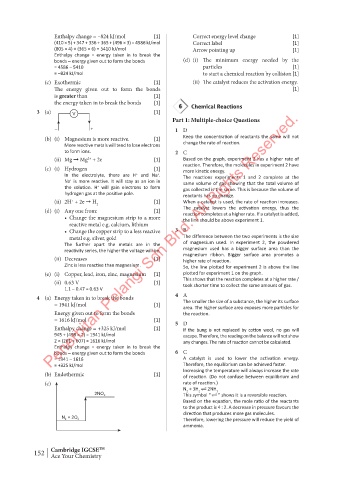
Enthalpy change = –824 kJ/mol       [1]          Correct energy level change        [1]
                         (410 × 5) + 347 + 336 + 365 + (496 × 3) = 4586 kJ/mol         Correct label         [1]
                         (805 × 4) + (365 × 6) = 5410 kJ/mol              Arrow pointing up                  [1]
                         Enthalpy  change  =  energy  taken  in  to  break  the
                         bonds – energy given out to form the bonds      (d)  (i)  The minimum energy needed by the
                         = 4586 – 5410                                        particles                      [1]
                         = –824 kJ/mol                                        to start a chemical reaction by collision [1]
                      (c)  Exothermic                        [1]          (ii)  The catalyst reduces the activation energy.
                         The energy given out to form the bonds                                              [1]
                         is greater than                     [1]
                         the energy taken in to break the bonds   [1]
                                                                     6    Chemical Reactions
                        Penerbitan Pelangi Sdn Bhd. All Rights Reserved.
                    3  (a)      V                            [1]
                                                                   Part 1: Multiple-choice Questions
                          –           +                              1  D
                      (b)  (i)  Magnesium is more reactive.   [1]      Keep the concentration of reactants the same will not
                             More reactive metals will tend to lose electrons   change the rate of reaction.
                             to form ions.                           2  C
                         (ii)  Mg ➞ Mg  + 2e                 [1]       Based on the graph, experiment 2 has a higher rate of
                                     2+
                                                                       reaction. Therefore, the molecules in experiment 2 have
                      (c)  (i)  Hydrogen                     [1]       more kinetic energy.
                             In  the  electrolyte,  there  are  H   and  Na .      The  reactions  experiments  1  and  2  complete  at  the
                                                              +
                                                      +
                             Na  is more reactive. It will stay as an ion in   same volume of gas showing that the total volume of
                               +
                             the  solution.  H   will  gain  electrons  to  form   gas collected is the same. This is because the volume of
                                         +
                             hydrogen gas at the positive pole.        reactants has no change.
                               +
                         (ii)  2H  + 2e ➞ H                  [1]       When a catalyst is used, the rate of reaction increases.
                                        2                              The  catalyst  lowers  the  activation  energy,  thus  the
                      (d)  (i)  Any one from:                [1]       reaction completes at a higher rate. If a catalyst is added,
                             •   Change the magnesium strip to a more   the line should be above experiment 1.
                               reactive metal e.g. calcium, lithium
                             •   Change the copper strip to a less reactive     3  B
                               metal e.g. silver, gold                 The difference between the two experiments is the size
                             The  further  apart  the  metals  are  in  the   of  magnesium  used.  In  experiment  2,  the  powdered
                             reactivity series, the higher the voltage will be.  magnesium  used  has  a  bigger  surface  area  than  the
                         (ii)  Decreases                     [1]       magnesium  ribbon.  Bigger  surface  area  promotes  a
                                                                       higher rate of reaction.
                             Zinc is less reactive than magnesium.     So, the line plotted for experiment 2 is above the line
                      (e)  (i)  Copper, lead, iron, zinc, magnesium   [1]  plotted for experiment 1 on the graph.
                         (ii)  0.63 V                        [1]       This shows that the reaction completes at a higher rate /
                                                                       took shorter time to collect the same amount of gas.
                             1.1 – 0.47 = 0.63 V
                    4  (a)  Energy taken in to break the bonds       4  A
                                                                       The smaller the size of a substance, the higher its surface

                         = 1941 kJ/mol                       [1]       area. The higher surface area exposes more particles for
                         Energy given out to form the bonds            the reaction.
                         = 1616 kJ/mol                       [1]     5  D
                         Enthalpy change = +325 kJ/mol       [1]       If  the  bung  is  not  replaced  by  cotton  wool,  no  gas  will
                         945 + (498 × 2) = 1941 kJ/mol                 escape. Therefore, the reading on the balance will not show
                         2 × (201 + 607) = 1616 kJ/mol                 any changes. The rate of reaction cannot be calculated.
                         Enthalpy  change  =  energy  taken  in  to  break  the
                         bonds – energy given out to form the bonds    6  C
                         = 1941 – 1616                                 A  catalyst  is  used  to  lower  the  activation  energy.
                         = +325 kJ/mol                                 Therefore, the equilibrium can be achieved faster.
                                                                       Increasing the temperature will always increase the rate
                      (b)  Endothermic                       [1]       of reaction. (Do not confuse between equilibrium and
                      (c)                                              rate of reaction.)
                                                                       N  + 3H  L 2NH 3
                                                                            2
                                                                        2
                                                                       This symbol “ L ” shows it is a reversible reaction.
                                        2NO 2
                                                                       Based on the equation, the mole ratio of the reactants
                                                                       to the product is 4 : 2. A decrease in pressure favours the
                                                                       direction that produces more gas molecules.
                            N 2  + 2O 2                                Therefore, lowering the pressure will reduce the yield of
                                                                       ammonia.


                        Cambridge IGCSE  TM
                  152     Ace Your Chemistry


         Answers.indd   152                                                                                         3/4/22   3:54 PM

