


Page 42 - ACE YR IGCSE A TOP APPROACH TO CHEM
P. 42
(e)  (i)  A  substance  that  will  oxidise  another   The  ratio  of  the  number  of  molecules  of  the
                             substance                       [1]          reactants to the products = 2 : 2
                             itself being reduced            [1]          Increasing the pressure will not affect the yield.
                         (ii)  Potassium manganate(VII)      [1]       (f)  Achieve the equilibrium faster   [1]
                             MnO  ➞ Mn 2+
                                 –
                                 4
                             Mn   is  reduced  to  Mn .  It  changes  from     5  (a)  The reaction can go forward   [1]
                               7+
                                                2+
                             purple to colourless.                        and backward                       [1]
                                                                          The reaction is reversible.
                    3  (a)  A chemical reaction that obtains energy   [1]
                         from light                          [1]       (b)  Endothermic                      [1]
                                                                          Energy is taken in                 [1]
                      (b)  The uncovered part is exposed to light.   [1]         to break the bonds          [1]
                         Silver bromide on the film decomposes,   [1]
                        Penerbitan Pelangi Sdn Bhd. All Rights Reserved.
                         turns into silver which is black.   [1]       (c)  Turns blue                       [1]
                         2AgBr ➞ 2Ag + Br 2                          6  (a)  A chemical reaction in which a more reactive
                      (c)  (i)  Photosynthesis               [1]          metal displaces                    [1]
                         (ii)  Chlorophyll                   [1]          a less reactive metal from its compounds   [1]
                                                                                   2+
                                                                                             2+
                             Without  chloroplasts,  photosynthesis  cannot       (b)  Zn(s) + Cu (aq) ➞ Zn (aq) + Cu(s)
                             be carried out.                              Correct formula                    [1]
                                                                          Correct state symbols              [1]
                    4  (a)  Reaction 2                       [1]
                         The energy needed to break the bonds is lower       (c)  Blue to colourless         [1]
                                                             [1]          Copper(II) sulfate is blue. Zinc sulfate is colourless.
                         than the energy given out to form the bonds. [1]         Zinc is dissolved.         [1]
                         The  “–”  sign  shows  that  the  forward  reaction  is   Zinc  is  a  solid  before  the  reaction  starts.  It  will
                         exothermic.                                      dissolve when reacting with copper(II) sulfate.
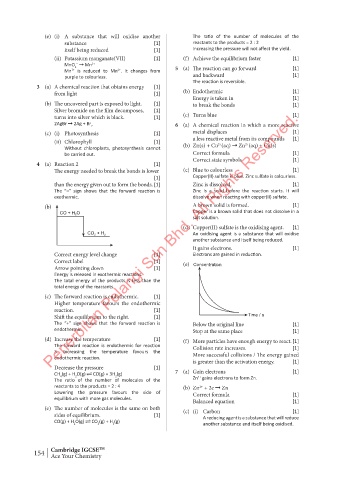
                      (b)                                                 A brown solid is formed.           [1]
                           CO + H 2 O                                     Copper is a brown solid that does not dissolve in a
                                                                          salt solution.
                                                                       (d)  Copper(II) sulfate is the oxidising agent.   [1]
                                                                          An oxidising agent is a substance that will oxidise
                                     CO 2  + H 2
                                                                          another substance and itself being reduced.
                                                                          It gains electrons.                [1]
                         Correct energy level change         [1]          Electrons are gained in reduction.
                         Correct label                       [1]       (e)  Concentration
                         Arrow pointing down                 [1]
                         Energy is released in exothermic reactions.
                         The  total  energy  of  the  products  is  less  than  the
                         total energy of the reactants.
                      (c)  The forward reaction is endothermic.   [1]
                         Higher  temperature  favours  the  endothermic
                         reaction.                           [1]
                         Shift the equilibrium to the right.   [1]                            Time / s
                         The  “+”  sign  shows  that  the  forward  reaction  is          Below the original line   [1]
                         endothermic.                                     Stop at the same place             [1]
                      (d)  Increase the temperature          [1]       (f)  More particles have enough energy to react. [1]
                         The  forward  reaction  is  endothermic  for  reaction          Collision rate increases.   [1]
                         3.  Increasing  the  temperature  favours  the          More successful collisions / The energy gained
                         endothermic reaction.
                                                                          is greater than the activation energy.   [1]
                         Decrease the pressure               [1]
                         CH (g) + H O(g) L CO(g) + 3H (g)            7  (a)  Gain electrons                  [1]
                                 2
                           4
                                               2
                                                                            2+
                         The  ratio  of  the  number  of  molecules  of  the   Zn  gains electrons to form Zn.
                         reactants to the products = 2 : 4             (b)  Zn  + 2e ➞ Zn
                                                                             2+
                         Lowering  the  pressure  favours  the  side  of          Correct formula            [1]
                         equilibrium with more gas molecules.
                                                                          Balanced equation                  [1]
                      (e)  The number of molecules is the same on both       (c)  (i)  Carbon                [1]
                         sides of equilibrium.               [1]              A reducing agent is a substance that will reduce
                         CO(g) + H O(g) L CO (g) + H (g)
                                2        2    2                               another substance and itself being oxidised.
                        Cambridge IGCSE  TM
                  154     Ace Your Chemistry


         Answers.indd   154                                                                                         3/4/22   3:54 PM

