


Page 41 - ACE YR IGCSE A TOP APPROACH TO CHEM
P. 41
7  A                                               (c)  (i)
                         Increasing the concentration of reactants increases the
                         particles  per  unit  volume.  The  particles  collide  more
                         frequently.                                                           or
                       8  B
                         The  forward  reaction  is  endothermic.  Increasing
                         the  temperature  favours  the  endothermic  reaction.                                 [1]
                         Therefore,  increasing  the  temperature  increases  the
                         yield of products.                                  (ii)
                       9  D
                         Oxidation = gaining oxygen, losing electrons, increase in   Volume of gas / cm 3
                       Penerbitan Pelangi Sdn Bhd. All Rights Reserved.
                         oxidation number
                         Reduction = losing oxygen, gaining electrons, decrease in
                         oxidation number                                                            Time / s
                                                                                                                [1]
                                       2Mg(s) + O (g) ➞ 2Mg O (s)
                                                          2–
                                                       2+
                                               2                             (iii)  The flask is heated:
                         Oxidation number:     0         –2                      More particles have enough energy to
                         The oxidation number decreases from 0 to –2.
                                                                                 react.                         [1]
                       10  A                                                     Collision rate increases.      [1]
                         Reduction is a process that shows a decrease in oxidation             More  successful  collisions  /  The  energy
                         number.                                                 gained is greater than the activation
                                       H   + O  ➞ H O                            energy.                        [1]
                                        2   2   2  2
                         Oxidation number:   0   –1
                       11  D
                         The sum of the oxidation numbers in an ion is the same
                         as the charge on the ion.

                     Part 2: Structured Questions

                       1  (a)  Carbon dioxide escapes from the flask.   [1]
                            Carbon dioxide is a gas. It will escape through the        Powdered calcium carbonate is used:
                            cotton wool.                                         More particles are exposed for the reaction.
                                                                                                                [1]
                         (b)  (i)  Mass of flask                                 Collision rate increases.      [1]
                                and contents / g
                                                                                 More  successful  collisions  /  The  energy
                                                                                 gained is greater than the activation
                                                                                 energy.                        [1]
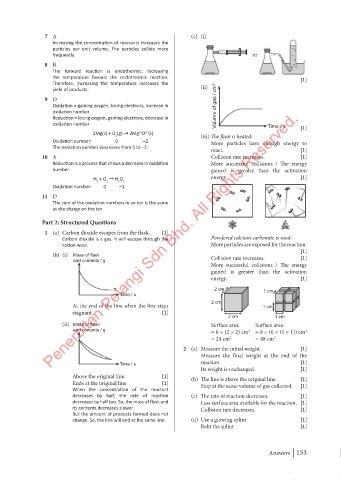
                                              T                                   2 cm             1 cm
                                                 Time / s
                                                                                 2 cm
                                At the end of the line when the line stays                         1 cm
                                stagnant.                      [1]
                                                                                       2 cm            1 cm
                            (ii)  Mass of flask                                  Surface area   Surface area
                                and contents / g                                 = 6 × (2 × 2) cm 2  = 8 × (6 × (1 × 1)) cm 2
                                                                                 = 24 cm 2      = 48 cm 2
                                                                        2  (a)  Measure the initial weight.     [1]
                                                                             Measure  the  final  weight  at  the  end  of  the
                                                 Time / s                    reaction.                          [1]
                                                                             Its weight is unchanged.           [1]
                                Above the original line        [1]        (b)  The line is above the original line.   [1]
                                Ends at the original line      [1]           Stop at the same volume of gas collected.   [1]
                                When  the  concentration  of  the  reactant
                                decreases  by  half,  the  rate  of  reaction       (c)  The rate of reaction decreases.   [1]
                                decreases by half too. So, the mass of flask and          Less surface area available for the reaction.  [1]
                                its contents decreases slower.               Collision rate decreases.          [1]
                                But the amount of products formed does not
                                change. So, the line will end at the same line.      (d)  Use a glowing splint   [1]
                                                                             Relit the splint                   [1]


                                                                                                     Answers    153


         Answers.indd   153                                                                                         3/4/22   3:54 PM

